










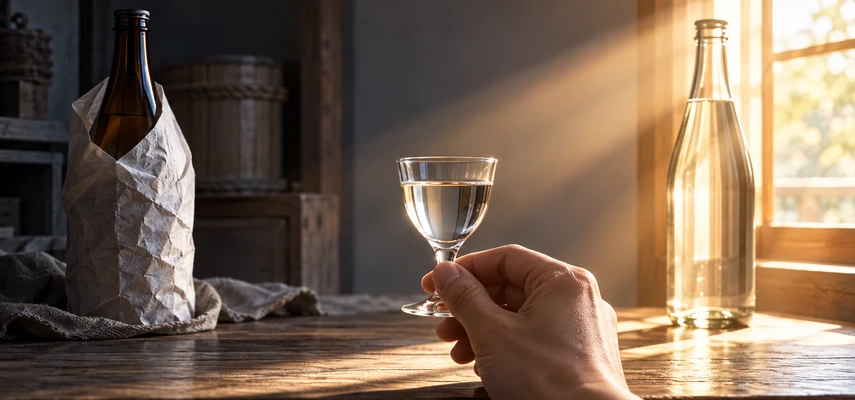

A sake smells nutty. Is it mature, faulty or simply a style you weren’t expecting? Sake faults cannot be diagnosed by treating every unfamiliar aroma as a problem. Start with the intended style, then examine appearance, aroma, palate and the available production and storage history together.
The four categories prescribed at Level 2 are oxidation, out of condition in unpasteurised sake, light damage and microbial spoilage. Their causes and sensory clues can overlap, but they are not interchangeable labels. A useful assessment describes what is wrong and why that explanation fits, while acknowledging when the precise cause remains uncertain.
Sake faults need context before a verdict
An amber koshu and a white nigori deliberately depart from the appearance of a young clear sake. A savory junmai can differ from a delicate aromatic ginjō without either being defective. The first task is to understand what the sample is meant to be, rather than judge every style against one favorite bottle.
The official Level 2 specification names the four fault categories. This lesson explains their practical distinctions in original terms. It does not offer a laboratory diagnosis from a single smell or require readers to taste damaged products to prepare for the theory examination.
Consider a hypothetical bottle with a mature aroma and deeper colour. If it is a deliberately aged sake with balanced character, those observations may fit the producer’s aim. If it was intended as a fresh, delicate expression and now seems stale and unbalanced, the same broad observations need a different interpretation.
Oxidation can erode freshness and balance
Oxidative deterioration is associated with time, oxygen exposure and conditions that allow unwanted change. A sake can lose fresh aromatic definition, deepen in colour and become less balanced. In more developed cases, pungent or stale impressions can dominate what was once an attractive profile.
Opening a bottle introduces an additional handling history. Repeated pouring and a long period before finishing can leave the drink unlike its original condition. Higher storage temperature can accelerate change. The practical prevention is appropriate cool storage, a tight closure and timely enjoyment rather than assuming alcohol makes the contents permanently stable.
WSET’s storage-and-service explanation gives sensory examples of oxidative deterioration alongside the other prescribed faults. The important idea is loss of the intended fresh balance, not a universal rule that any deeper colour proves oxygen damage.
Many reactions can occur during storage, so colour alone cannot identify the mechanism with certainty. Use the complete evidence. A bottle can be old, warm-stored and oxidatively affected at the same time, and a casual tasting may not separate every chemical contribution. A careful description is better than an overconfident molecular story.
Out of condition is especially relevant to unpasteurised sake
Nama retains active enzymes and may be particularly sensitive to storage. If it spends too long in unsuitable conditions, it can lose the fresh character the producer intended and develop unattractive heavy, malty or meaty impressions. The general category is out of condition in unpasteurised sake.
This should not be reduced to all nama is unstable and therefore bad. Its treatment history creates handling needs, not a built-in quality failure. Well-managed cold storage helps preserve its intended expression. The fault arises when the result has moved into unwanted condition, not merely because the word nama appears on the label.
NRIB research discusses mureka, a stuffy off-odor associated with isovaleraldehyde in sake. The institute’s research summary supports that specific connection. It does not justify assigning every unpleasant aroma in every nama to one molecule or claiming that all such changes require microbial spoilage.
That distinction matters because enzymes can change a liquid even when the taster has no evidence of a new microbial population growing. Out-of-condition character and microbial spoilage are separate syllabus categories. They can share practical concerns about handling while requiring different explanations.
Light damage has its own exposure history
Strong light can cause unwanted changes to aroma, taste and colour. Some descriptions evoke burnt, rubber-like or otherwise disagreeable notes. Sunlight is an obvious source, but artificial lighting can also be relevant. A cold display does not automatically prevent this kind of damage if the liquid remains strongly illuminated.
The NRIB storage guide describes light-struck character and the protective role of packaging. Darker bottles can reduce some damaging light transmission, while paper wrapping and appropriate storage further limit exposure. Dark glass is a useful barrier, not a license for indefinite bright display.
Separate heat from light in your explanation. A sunny window can provide both, but the fact that they arrive together doesn’t make them the same cause. A refrigerator can help with temperature; it does not turn damaging light into harmless decoration. Prevention has to address both conditions.
Nor should a learner diagnose light damage just because the bottle is clear. Clear glass creates a need for protection, not proof that damage occurred. The exposure history and sensory result matter. The same package can arrive in good or poor condition depending on how it has been handled.
Microbial spoilage reflects unwanted biological activity
Microbial spoilage concerns the effects of unwanted organisms rather than simply the presence of the desired yeast in an earlier production stage. It can produce unpleasant aromas, including sour, rotten, rancid or otherwise discordant impressions. Appropriate sanitation and production stability measures help control the risk.
For the Level 2 account, brewery contamination and process control are the central context. Pasteurisation can help manage relevant organisms, but clean handling around later stages remains important. A successful heating step should not be treated as a substitute for a controlled bottling environment.
Don’t turn this into a claim that a taster can name the species from a generic sour smell. Different mechanisms can produce related impressions, and a sample’s complete history may be unavailable. Report the sensory problem and the plausible category while leaving unsupported microbiological detail out of the conclusion.
The NRIB finishing overview explains why controlling organisms and enzymes matters after fermentation. Remember that alcoholic fermentation uses desired yeast productively, whereas spoilage describes an unwanted outcome. Calling every microbial process spoilage would make sake production itself impossible to explain.
Compare the categories by cause, not one magic aroma
| Category | Main question to ask | Prevention link |
|---|---|---|
| Oxidation | Has exposure and storage undermined the intended freshness and balance? | Cool handling, secure closure and timely consumption |
| Out-of-condition unpasteurised sake | Has active nama changed undesirably through time or unsuitable temperature? | Appropriate refrigeration and product guidance |
| Light damage | Has strong light contributed to off-character? | Dark storage and protective packaging |
| Microbial spoilage | Has unwanted biological activity compromised the drink? | Brewery hygiene, stability measures and clean handling |
The table organizes reasoning rather than guaranteeing four mutually exclusive smells. More than one poor condition can affect a bottle. The sensible conclusion may be that the sample is out of its intended condition without enough evidence to isolate one cause beyond doubt.
Intended maturation is not automatically a fault
Koshu can develop attractive nutty, caramel-like and other evolved character. Those changes can be deliberately cultivated through selection and storage. A young sake’s loss of freshness and a mature sake’s intended development should not be collapsed into the same negative judgment merely because both involve time.
Equally, mature should not become an excuse for anything unpleasant. Assess balance, clarity of character and the finish. If a stale note dominates and the drink seems disjointed, its age does not automatically make the result admirable. Intended style gives context; it does not cancel sensory judgment.
This is a practical skill in service. Before telling a guest that an unusual sake is faulty, check whether the character belongs to the declared style. Before serving an obviously compromised sample, don’t hide behind the possibility that someone somewhere enjoys a more evolved taste. Evidence and the producer’s intended product both matter.
A careful assessment can remain appropriately limited
Use a clean vessel and assess appearance and aroma without needing to consume a suspicious sample. Compare the observations with the product description and handling history if available. In a commercial setting, check with the responsible supplier or producer rather than inventing a certainty you cannot support.
For study, practice linking scenarios to the four categories. Warm-stored nama with unwanted heavy character points toward out of condition. Strong light exposure with light-struck off-aroma points toward light damage. The scenario supplies the cause evidence; the smell alone often supplies less certainty.
When evidence is incomplete, distinguish an observation from a diagnosis in your notes. An unpleasant aroma can be established directly; the exact cause may remain a reasoned possibility until the production and storage history is checked.
One-page revision summary
Learn all four categories and their prevention links. Oxidation concerns unwanted loss of fresh balance; nama can become out of condition through unsuitable handling; light can cause its own damage; unwanted microbes can spoil sake. Similar sensations do not prove identical causes. Interpret colour and aroma against intended style, and keep desirable koshu maturation separate from an automatic fault verdict.
Knowledge check: 10 original practice questions
Independent TFE questions, not official WSET examination items. Choose one answer per question; explanations follow separately.
1. Which list includes all four prescribed fault categories?
- Cloudiness, bubbles, amber and warmth
- Oxidation, out of condition, light damage and microbial spoilage
- Junmai, ginjō, nama and koshu
- Rice, water, kōji and yeast
2. What can oxidative deterioration do?
- Guarantee better balance
- Create a new rice variety
- Reduce fresh aroma and deepen color
- Prove nama status
3. Which scenario best illustrates out-of-condition unpasteurised sake?
- Warm-stored nama develops unattractive heavy character
- A correctly made cloudy nigori
- A fresh clear sake
- An intentionally sparkling sake
4. Why is cold storage alone insufficient in a brightly lit display?
- Cold creates light
- All glass is opaque
- Every bottle is spoiled
- Light exposure is a separate influence
5. What chiefly characterizes microbial spoilage?
- Any desired yeast fermentation
- Unwanted biological activity causing off-character
- All intentional ageing
- All visible sediment
6. Does an amber koshu automatically have a fault?
- Yes
- Only if transparent
- No, evolved color may fit the intended style
- Only if served warm
7. Can a generic sour smell identify a microbial species reliably?
- No, more evidence is needed
- Yes, always
- Only if the bottle is clear
- Only if the sake is premium
8. What is a sound first step when assessing an unfamiliar aroma?
- Declare every unusual sake faulty
- Ignore the label
- Assume all old sake is excellent
- Check the intended style and full sensory context
9. Does clear glass prove light damage?
- Yes
- No, exposure history and condition matter
- Only if unopened
- Only if junmai
10. Why distinguish out-of-condition nama from microbial spoilage?
- They are always identical
- Nama contains no enzymes
- Enzyme-related change need not prove unwanted microbial growth
- Neither affects aroma
Answers and explanations
1. B — Oxidation, out of condition, light damage and microbial spoilage. The other lists contain style observations, classifications or ingredients rather than the four faults. Mapping: LO3.
2. C — Reduce fresh aroma and deepen color. Unwanted development can erode freshness and balance, though color alone is not conclusive. Mapping: LO3.
3. A — Warm-stored nama develops unattractive heavy character. Unsuitable handling can move active nama away from the intended condition. Mapping: LO3.
4. D — Light exposure is a separate influence. Temperature and light need separate control even when they act on the same bottle. Mapping: LO3.
5. B — Unwanted biological activity causing off-character. Spoilage describes an unwanted outcome, not every productive microbial process. Mapping: LO3.
6. C — No, evolved color may fit the intended style. Intentional maturation can produce attractive evolved character and needs contextual assessment. Mapping: LO3.
7. A — No, more evidence is needed. Similar impressions can have different causes, so unsupported organism identification should be avoided. Mapping: LO3.
8. D — Check the intended style and full sensory context. Context separates deliberate specialty character from a compromised result. Mapping: LO3.
9. B — No, exposure history and condition matter. Packaging can indicate vulnerability without proving that damaging exposure occurred. Mapping: LO3.
10. C — Enzyme-related change need not prove unwanted microbial growth. The syllabus categories have distinct mechanisms even when practical handling concerns overlap. Mapping: LO3.
Continue studying sake
Article #1: How to Understand and Evaluate Sake: The WSET Level 2 Framework · Article #10: Sake Pasteurisation and Finishing Explained: Charcoal Fining, Storage, and Dilution · Article #17: Nama Sake Explained: Unpasteurised, Nama-chozō, and Nama-zume Styles · Article #19: Koshu Sake Explained: Ageing, Maturation, and Flavor Development












