










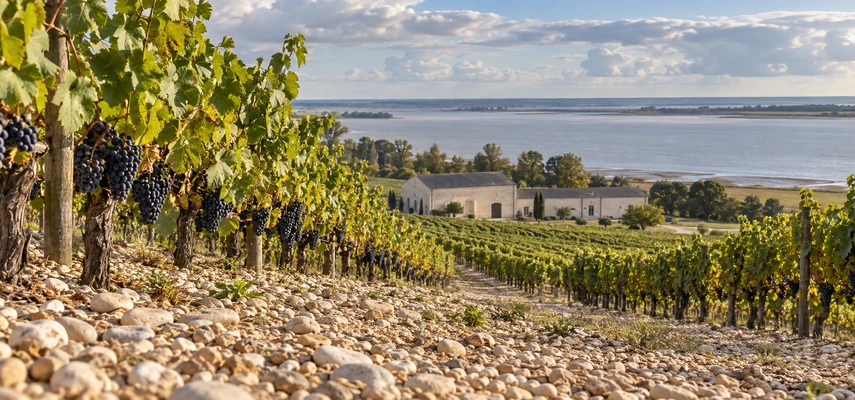

Pick up a handful of Médoc gravel and you have a useful clue, not a complete explanation. Those stones tell part of a story about drainage, warmth and where vines were planted. They don’t dictate a tasting note, guarantee quality or explain why two neighbouring estates charge very different prices.
Bordeaux Left Bank wines make more sense when the pieces are connected: a maritime growing environment, varied soils, Cabernet Sauvignon’s ripening needs, blending, cellar choices and a highly developed trading system. Classification adds reputation and historical context, but it is another piece of the puzzle rather than a substitute for examining the wine.
For Diploma study, follow that chain from environment to style, quality and price. The official WSET specification requires explanation and evaluation, not merely recognition of famous château names. This article concentrates on dry reds; Graves and Pessac-Léognan also produce important dry whites, treated separately within the Bordeaux sequence.
Put the Left Bank on the right map
The Left Bank lies west of the Gironde estuary and along the Garonne’s left bank. The Médoc peninsula extends north of Bordeaux between Atlantic influence and the estuary. Graves lies south of the city, with Pessac-Léognan covering its prestigious northern sector. Neither “Left Bank” nor “Graves” means one uniform soil profile or one identical red-wine style.
Distinguish the geographical Médoc from the Médoc appellation. The regional body’s Médoc explanation notes that the broader designation can apply across its delimited peninsula, while most wines using it come from the northern part. Haut-Médoc lies farther upstream to the south; “Haut” doesn’t mean the northern end of the map.
Within the Haut-Médoc area, learn the important communal appellations: Margaux, Moulis-en-Médoc, Listrac-Médoc, Saint-Julien, Pauillac and Saint-Estèphe. They are origins, not the five ranks of the 1855 classification. A wine can carry an appellation without belonging to that historic list.
Maritime conditions offer help and uncertainty
The Atlantic and Gironde moderate temperature, helping create a long growing season. The oceanic setting also brings variable weather and rainfall. Sunshine and warmth during ripening influence the chance of achieving suitable fruit maturity; wet flowering, cloudy periods or rain near harvest can create very different problems in different years.
The INAO account of Pauillac connects its temperate oceanic conditions with gravelly rises near the estuary. That local account isn’t a licence to assume identical conditions throughout Bordeaux. Proximity to water can moderate extremes while frost risk still varies with topography, air movement and the particular event.
Water availability depends on rainfall, drainage, soil depth and the roots’ access to reserves. Free drainage can help in wet conditions but become a disadvantage when reserves are limited during drought. Clay beneath gravel can alter that balance. “Gravel is best” is less useful than asking how this complete soil profile performs in this season.
Nutrient availability affects vigour alongside water. A vigorous canopy may need careful management to maintain exposure and airflow; severely limiting growth isn’t automatically beneficial. Soil and vine assessment should guide decisions. The point isn’t to feed every parcel identically or equate low fertility with guaranteed concentration.
Cabernet leads many blends, but not every vineyard
Cabernet Sauvignon is especially important on suitably warm, well-drained gravel sites because it needs sufficient time and conditions to ripen. Its contribution can include black-fruit character, acidity and tannic structure. Inadequate ripening or excessive extraction can produce a different balance from the poised ageworthy stereotype.
Merlot remains important, adding fruit and a different ripening pattern; on some sites and in some wines it is the leading component. Cabernet Franc and Petit Verdot can contribute further character. Don’t turn a Left Bank tendency into a legal requirement that Cabernet Sauvignon must dominate every bottle.
Permitted varieties need checking appellation by appellation. Pauillac’s specification approved in April 2026 includes six black varieties, including less commonly encountered Carmenère and Cot/Malbec. A short promotional description naming four principal grapes isn’t the full legal list. Nor does permission prove substantial planting or inclusion in every blend.
Vineyard establishment therefore combines parcel suitability, drainage, variety, rootstock and training design with applicable rules. Grafted material must suit soil, water and pest conditions; the name of the scion alone doesn’t describe the planting decision. High planting density also brings resource and management implications rather than an automatic quality guarantee.
Manage the season rather than a fixed recipe
Canopy management balances light, airflow, crop exposure and protection. Opening a dense fruit zone can help in a humid season, while exposing bunches indiscriminately can increase damage under intense heat. Nutrient and water management should reflect actual vine status and the legal framework, not an assumption that irrigation or fertilisation is an unrestricted remedy.
Frost, hail, heat, drought and harvest rain are hazards with different responses and limits. Site selection and cold-air drainage address a different problem from protecting a crop during an acute event. No investment removes every weather risk, and an expensive protective measure needs a realistic benefit and suitable permissions.
Humidity can support downy mildew, powdery mildew and bunch-rot pressures. Monitoring, canopy work, hygiene and appropriately timed permitted protection belong together; pests such as grape moths also require observation rather than automatic treatment. Disease-control costs and potential crop loss help connect growing conditions with economic pressure.
Harvest decisions balance flavour, sugar, acid and tannin development against deteriorating weather or fruit health. Separate parcels and varieties may be picked at different times. Hand selection can suit a demanding programme, while mechanical harvesting can offer speed where appropriate; don’t assume every classified wine follows one harvesting method.
Make extraction fit the fruit
Grape transportation and reception affect what reaches fermentation. Prompt handling, suitable containers and sorting help manage damage and unwanted material. Processing decisions can include destemming and the extent of crushing; premium selection costs labour and can reduce the volume entering the principal wine.
Alcoholic fermentation with skins develops colour and tannin alongside alcohol and aroma. Temperature, cap management and maceration time influence extraction, but more extraction isn’t synonymous with better quality. The appropriate approach depends on ripe fruit, intended structure and whether the resulting tannin supports the wine.
Press wine can be assessed separately and used selectively in blending. It may contribute useful structure, while unsuitable inclusion can upset the balance. Malolactic conversion is important in the red-wine sequence, changing the acid profile; it isn’t a synonym for ageing or a guarantee of a buttery red wine.
Maturation frequently includes oak, with cost and sensory effects depending on vessel, age, proportion and time. Château Margaux’s account of its cellar work illustrates separate fermentation, press-wine, blending and barrel operations at one estate. Its programme isn’t a universal prescription for every Médoc or Graves producer.
Blending can combine varieties, parcels and batches to build a coherent wine and respond to vintage differences. Selection for a principal wine and another cuvée can change both style and saleable quantities. A second wine isn’t a second-growth classification; those expressions describe different things.
Compare origins without turning them into caricatures
Pauillac is a useful reference for Cabernet-led structure and black-fruit character, with development bringing further interest in suitable examples. Saint-Estèphe’s varied profiles, including clay influences, invite attention to water and tannin rather than a rule that every wine is austere. Saint-Julien offers another important concentration of classified estates, while Margaux encompasses diverse sites rather than one guaranteed floral perfume.
Moulis and Listrac deserve attention beyond the famous river-facing communes. Their site and soil variation can support substantial reds, and lack of an 1855 rank doesn’t establish poor quality. Haut-Médoc and Médoc designations also span a broad range of styles and prices; Merlot’s role and the intended drinking horizon can vary considerably.
In Graves and Pessac-Léognan, Cabernet and Merlot blends can combine fruit, structure and savoury development. The Pessac-Léognan appellation body describes gravel mixed with other materials rather than a single pure layer of stones. Smoke or earth in a note isn’t proof that the taster has identified the soil chemically.
Use these regional tendencies as hypotheses and comparisons, then account for estate, vintage, blend, winemaking and age. Price ranges extend well beyond the collectible names. A practical study file should include accessible wines as well as prestige examples, with each quality conclusion justified from the sample.
Separate appellation rules from estate classifications
The European protected-origin framework, French recognition and each appellation’s detailed specification work together. AOP/PDO identifies a protected origin and its conditions; AOC is the familiar French appellation terminology. International destination rules can add import and label obligations when the wine travels abroad. None of those layers is identical to an estate’s classification rank.
The 1855 classification divides the relevant red estates into five ranks and also has a separate sweet-wine component. For the reds, its Médoc focus includes the Graves exception Haut-Brion. The five first growths are Lafite Rothschild, Latour, Margaux, Haut-Brion and Mouton Rothschild; Mouton’s own history records its promotion in 1973. Describe the system as historically stable, not literally unchanged.
The Graves classification, established in 1953 and completed in 1959, recognises red and/or white wines rather than reproducing the five 1855 ranks. Its classified properties are in the area now covered by Pessac-Léognan. Don’t transfer a property’s recognition for one colour automatically to the other.
Crus Bourgeois is another Médoc system, distinct from 1855. The official 2025 classification dossier retains three levels: Cru Bourgeois, Supérieur and Exceptionnel, within a five-year classification framework. Verify the relevant edition rather than applying an old annual-recognition explanation. Classification supports reputation and positioning; it doesn’t replace evaluation of an individual bottle.
Follow the wine through the market
An estate can grow, make and bottle its wine, while its winery’s resources and working capital influence cost. Bordeaux’s trading system also includes merchants, or négociants, and brokers, or courtiers. The CIVB account of brokerage distinguishes the intermediary connecting producers and merchants; a broker isn’t automatically the stock-buying merchant or overseas importer.
For wines offered en primeur, customers buy before the finished wine is physically delivered. That timing can help move funding and inventory commitments through the chain, but price, counterparty, delivery and future demand still matter. It isn’t a guaranteed investment gain or the selling method for every Left Bank wine.
Supply responds to harvest, permitted production and selection, while demand differs sharply between prestige estates and broader categories. Land, labour, fruit selection, barrels, holding stock and packaging contribute to cost; reputation, scarcity, distribution and buyer willingness help explain why costs alone don’t set price. Currency movements can alter an export buyer’s cost without changing the estate’s euro quote.
An importer can connect the wine with specialist or wider retail and restaurant accounts, subject to market rules. Direct consumer sales can support visits or relationships where permitted, but a regulated monopoly or three-tier destination may require a different arrangement. Compare reach, margin, service and retained work rather than assuming one route suits all volumes and positions.
The château name can function as a powerful brand, alongside origin, classification and vintage. Relevant industry associations, including the CIVB, appellation bodies and classification organisations, have different promotional or representative roles; they aren’t interchangeable regulators. Packaging and closures must protect and identify the wine, and transport/storage must preserve condition after the cellar work is finished. A fine reputation doesn’t repair heat-damaged stock.
Compare the evidence here with Bordeaux’s Right Bank as a regional case, then apply the regional comparison framework to the comparison. Compare growing conditions, production decisions, style, quality and the commercial reasons for price. Establish the differences rather than assuming that one familiar name must be better.
Original Diploma practice
These are original teaching exercises, not official WSET questions or marking keys. No personal tasting or producer interview is claimed.
Question 1: evaluate a gravel-site advantage
Compare how a free-draining gravel site and a site with greater accessible water reserves might perform in a wet season and a dry season. Apply the reasoning to Cabernet Sauvignon without guaranteeing a quality winner.
Indicative answer points: drainage; root access; seasonal water; ripening; canopy; selection; conditional quality.
Outline answer: Drainage can help avoid excessive wetness, while accessible reserves can protect vine function during drought. The complete profile, roots, weather and management determine the response. Cabernet needs suitable ripening conditions, but warmth or low water alone doesn’t guarantee balanced fruit. Evaluate the crop and final wine rather than ranking sites from their surface stones.
Question 2: distinguish three label claims
Explain why Pauillac, second wine and second growth don’t mean the same thing, and evaluate how each may influence a buyer’s expectations.
Indicative answer points: protected origin; producer selection; classification; reputation; price; sensory evidence.
Outline answer: Pauillac is an appellation with defined rules. A second wine is another producer cuvée or selection, not an 1855 rank. A second growth belongs to the second level of the relevant classification. The terms can affect expectations, supply and price, but none determines every bottle’s quality or ageing suitability. Verify the exact wine, vintage and applicable claim.
Question 3: evaluate an export-price change
A classified estate holds its euro price steady while an overseas retailer raises its local-currency price. Explain plausible causes and why the classification alone cannot identify the cause.
Indicative answer points: currency; freight and duty; intermediary costs; stock and demand; stage boundaries; evidence.
Outline answer: Exchange movements, import charges, transport, distribution costs or retail pricing decisions can change the final price. Establish the transaction date, currency, cost base and relevant terms, alongside local demand and inventory. Classification contributes reputation but doesn’t explain an exchange move or every downstream charge. Avoid attributing the whole retail difference to the producer.
Analytical tasting preparation: compare level and development
Build a proposed flight using the specification’s Bordeaux recommendations: an acceptable-quality Bordeaux AOC red; a good-quality Bordeaux AOC or communal red; and a very good or outstanding Haut-Médoc communal or Pessac-Léognan red. These sit within the essential recommended categories. An additional contrasting vintage or example with at least five years’ further age from the relevant higher-quality group is an optional comparison, not another compulsory category. This selection covers part of the Bordeaux recommendations, not the entire regional list.
Taste blind and record a full systematic note before revealing identities. Compare fruit intensity, acid, tannin amount and texture, alcohol, body, development and desirable flavour persistence. Do not assign the requested study quality from the label: have a tutor or suitable prior evaluation help select the intended comparison, then evaluate the actual bottles.
Indicative review: Explain quality through integration, concentration, complexity and finish, with evidence for weaknesses as well as strengths. Justify bottle-ageing suitability separately; substantial tannin needs adequate fruit and balance, while mature character doesn’t establish remaining improvement. The exercise supplies no fabricated sample notes, guaranteed sensory outcomes or official grades. A successful identity guess doesn’t compensate for an unsupported quality conclusion.












