










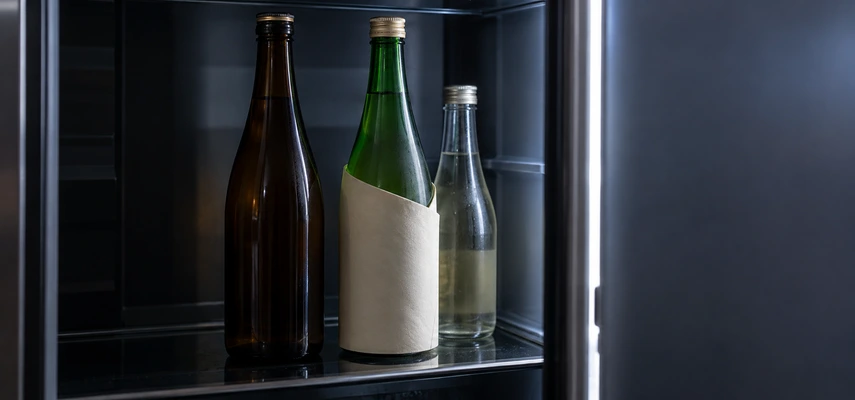

The brewer has finished making the sake. Your cupboard can still keep working on it. To store sake properly, the aim is to slow unwanted change and protect the character intended at release. That requires attention to temperature, light, bottle position and the time between opening and drinking.
The Level 2 essentials are simple enough to remember: keep it cool, store upright, avoid bright light and generally drink it young. The useful part is understanding why those instructions belong together, and why a deliberately aged koshu or an unpasteurised nama may need more specific interpretation.
Store sake properly by protecting the intended style
Storage is not always neutral. Chemical reactions can alter colour and aroma, while remaining biological activity can change certain products. The drink may become less like the one the producer wanted you to experience. Good handling aims to preserve that intended condition rather than merely keep the bottle physically intact.
The official specification gives the four general storage principles. It also includes faults and service as connected topics. Think of this lesson as prevention; the next one examines how problems can present themselves after prevention fails.
Imagine two identical bottles. One spends its time in cool darkness; the other sits by a bright warm window. Their shared grade and bottling date do not make their later condition identical. The storage history has become part of the explanation for what reaches the glass.
Cool conditions slow unwanted development
Higher temperature accelerates many changes in sake. Delicate fruit-led aromas can fade, and stale or otherwise unwanted character can develop more readily. Keeping the drink cool helps limit that movement away from the intended profile. It doesn’t mean every reaction stops completely.
The NRIB storage guide prioritizes the manufacturer’s recommendations and distinguishes especially sensitive styles. Nama, sparkling sake and delicate ginjō are directed toward refrigeration, while other styles may use an appropriately cool place. Product-specific instructions should guide the actual bottle.
For a practical home decision, a warm kitchen shelf beside an oven is a poor interpretation of cool. A stable, suitably chilled location protects the drink more effectively. The fact that a bottle was sold at room temperature does not mean any temperature reached during transport or home storage is equally acceptable.
Avoid solving warmth by leaving glass bottles in a household freezer. Freezing and expanding liquid can damage packaging, and the actual freezing behavior depends on composition. Refrigeration is not the same instruction as freezing. A colder environment isn’t automatically a better storage plan without regard to the package and product.
Nama deserves particular attention
Nama-zake has not received pasteurisation, so relevant enzymes and potential microbial activity have not been managed by that heat step. Its quality can be especially sensitive to storage conditions. Refrigeration helps protect the intended fresh character, with producer guidance supplying the specific handling instructions.
The NRIB sake questions connect nama’s relative instability with continuing enzyme-related changes. This is the reason behind the storage advice. Unpasteurised does not mean faulty, but it is a production fact that should affect how the bottle is handled.
Think about the journey as well as the destination. Leaving a bottle in a hot car for an extended time is not undone by cooling it afterward. Later cold storage slows future change; it cannot reliably reverse what has already happened. That principle applies to other delicate sake too.
Bright light is a chemical influence, not just a display choice
Light can damage sake’s aroma, taste and colour. Sunlight is an obvious exposure, but some artificial lighting can also matter. A beautifully illuminated shelf is therefore not necessarily a sensible place for long-term storage. The liquid responds to its environment even when the display looks tasteful.
Dark glass reduces some light transmission, but it does not make all exposure irrelevant. Clear bottles especially benefit from protection, while paper wrapping or an appropriate carton can help limit light reaching the liquid. The packaging should support storage rather than encourage indefinite display beside a window.
The NRIB preservation resource explains light protection alongside temperature. Keep the mechanism separate: refrigeration controls temperature, while darkness controls light exposure. A cold bottle in strong light and a warm bottle in darkness each leaves a different problem unresolved.
For a hypothetical shop display, ask two questions. Is the product held at a suitable temperature, and is it protected from damaging light? One yes does not supply the other. This is a practical example of independent controls working toward the same preservation goal.
Upright storage fits sake handling
Store bottles upright as the syllabus advises. Do not automatically copy the horizontal storage associated with certain cork-closed wines. Sake packaging and closure arrangements can differ, and an instruction borrowed from another drink may not suit the bottle in front of you.
Upright positioning also makes settled material easier to manage in products such as nigori. A sediment layer can be expected without proving deterioration. If redistribution is needed, follow producer directions and consider whether the sake is sparkling before moving it. Position and opening technique belong to the same handling story.
The main exam point is straightforward: upright is the general sake recommendation. The practical follow-through is to keep the closure secure, the package stable and the product’s other features in mind. A bottle falling around a refrigerator door is not improved by technically being vertical most of the time.
Drink young is a general rule with a deliberate exception
Most sake is released for enjoyment in its intended current condition rather than for years of speculative home cellaring. Drinking it reasonably young helps preserve that style. A prestigious grade or high price does not automatically make a bottle suitable for long ageing.
Koshu demonstrates the deliberate exception. The producer selects sake and conditions for an aged expression, managing time, temperature and vessel. That is different from keeping an arbitrary bottle warm and hoping its value or complexity increases. The existence of attractive aged sake does not invalidate general freshness advice.
Likewise, no universal rule says all sake is ruined the moment it reaches one particular birthday. Product, process and storage vary. Read dates and instructions in context, and avoid inventing a precise shelf life where the producer has not supplied one. A calendar helps document history but doesn’t replace condition assessment.
Opening introduces another set of changes
After opening, oxygen exposure and repeated handling can influence development. Close the bottle tightly, return it to appropriate storage and aim to enjoy it promptly. Sake may be more resistant to some oxygen effects than wine, but resistance is not immunity.
Each pour can change the bottle’s headspace and introduce fresh air. A nearly empty bottle stored for a long period is therefore not the same situation as an unopened full one. This does not mean the last glass will instantly fail; it means opened and unopened storage should not share an unqualified guarantee.
If you choose to track development, note the opening date and observe the actual aroma and palate over time. Do not deliberately use heat or bright light as an ageing shortcut. The storage lesson’s aim is protecting the product, not accelerating unknown changes for their own sake.
Build a practical routine rather than a list of exceptions
At purchase, check the style and handling directions. During transport, limit unsuitable warmth and direct light. At home, store upright in an appropriately cool, dark place, using refrigeration for sensitive products as directed. After opening, close securely and enjoy the sake within a sensible product-specific period.
This routine is useful because it follows the bottle through its whole history. It doesn’t rely on a single dramatic action at the end. Protecting a delicate drink is usually a sequence of modest decisions, none especially glamorous and all more useful than a decorative bottle gathering sunlight on a shelf.
Match the advice to the bottle in front of you
For a hypothetical unpasteurised ginjō, refrigeration and light protection are the obvious priorities; the two sensitive features reinforce the need for careful handling. A deliberately matured sake released ready to drink still benefits from protection of the condition the producer selected. Its earlier ageing does not mean more uncontrolled warmth is desirable afterward.
For a nigori, upright storage can create a sediment layer that needs interpretation alongside the product directions. For a sparkling sake, avoiding agitation and keeping it suitably chilled also support controlled opening. These are extensions of the same storage principles, not reasons to discard them. Identify the product features, apply the shared controls and then follow the specific instructions that account for its remaining differences.
One-page revision summary
Keep sake cool, upright and away from bright light, and generally enjoy it young. Nama and other sensitive styles need particular temperature attention. Refrigeration does not reverse past damage, and dark glass does not erase light risk. Deliberately matured koshu is a different plan from random home ageing. Once opened, seal the bottle, store it appropriately and use product guidance rather than one universal expiry claim.
Knowledge check: 10 original practice questions
Independent TFE questions, not official WSET examination items. Choose one answer per question; explanations follow separately.
1. Which set matches the general syllabus storage advice?
- Warm, horizontal and brightly lit
- Cool, upright, away from bright light, generally young
- Frozen indefinitely
- Always open to air
2. Why are higher temperatures often undesirable?
- They change the rice variety
- They remove all ethanol
- They can accelerate unwanted development
- They guarantee desirable koshu
3. Which product especially calls for cold attention?
- Nama-zake
- An empty bottle
- A wooden serving tray
- A paper label alone
4. Can later refrigeration reliably reverse earlier heat damage?
- Always
- Only if junmai
- Only in dark glass
- No, it mainly limits further change
5. Does a refrigerator automatically solve light exposure?
- Yes, in every display
- No, light and temperature are separate controls
- Only if the bottle is clear
- Only if sparkling
6. Which bottle position is generally advised?
- Upside down
- Horizontal by copying all wine practice
- Upright
- Open on its side
7. Does drink young prohibit deliberate koshu production?
- No, selected controlled maturation is a distinct plan
- Yes, all aged sake is faulty
- Only if amber
- Only if no yeast was used
8. What should follow opening?
- Leave the closure off
- Display in sunlight
- Warm the whole bottle daily
- Close tightly and return to suitable storage
9. Why is a universal lifespan unreliable?
- Dates have no meaning
- Products and storage histories differ
- All sake changes identically
- Only price determines stability
10. Is a household freezer simply a better refrigerator for sake?
- Always
- Only for expensive sake
- No, freezing can damage liquid and packaging
- Only for nama
Answers and explanations
1. B — Cool, upright, away from bright light, generally young. These principles work together to preserve the intended sake condition. Mapping: LO3.
2. C — They can accelerate unwanted development. Temperature influences change rates, which can undermine freshness and aroma. Mapping: LO3.
3. A — Nama-zake. Without pasteurisation, relevant continuing activity makes nama particularly storage-sensitive. Mapping: LO3.
4. D — No, it mainly limits further change. Cooling afterward does not reconstruct the drink’s earlier condition or erase its history. Mapping: LO3.
5. B — No, light and temperature are separate controls. A chilled display can still expose sake to damaging light if not appropriately protected. Mapping: LO3.
6. C — Upright. Upright storage is the general sake recommendation in the syllabus. Mapping: LO3.
7. A — No, selected controlled maturation is a distinct plan. General freshness advice and intentional producer-managed ageing can both be valid. Mapping: LO3.
8. D — Close tightly and return to suitable storage. Managing air exposure and temperature helps preserve the opened drink. Mapping: LO3.
9. B — Products and storage histories differ. Process, packaging and actual handling influence condition, so producer guidance matters. Mapping: LO3.
10. C — No, freezing can damage liquid and packaging. More extreme cold is not a substitute for appropriate product-specific storage. Mapping: LO3.
Continue studying sake
Article #10: Sake Pasteurisation and Finishing Explained: Charcoal Fining, Storage, and Dilution · Article #17: Nama Sake Explained: Unpasteurised, Nama-chozō, and Nama-zume Styles · Article #18: Sparkling Sake Explained: Carbonation vs. Bottle Fermentation · Article #19: Koshu Sake Explained: Ageing, Maturation, and Flavor Development











