










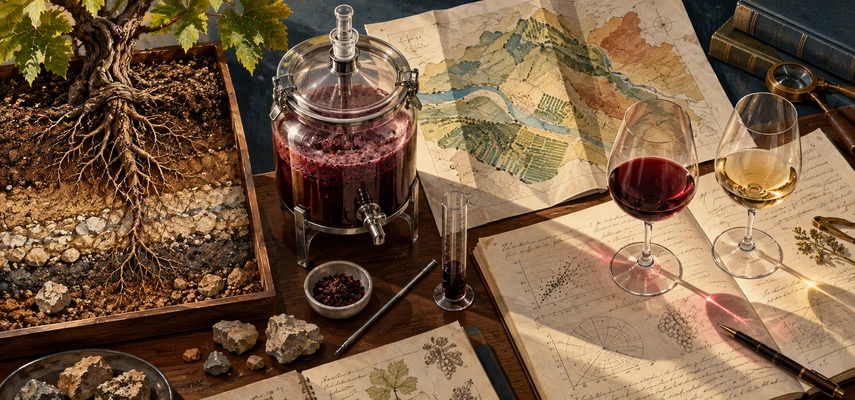

Why can two wines made from the same grape taste so different, and sit several shelves apart in price? The WSET Level 4 Diploma in Wines turns that everyday puzzle into a demanding programme of investigation. The variety is one clue. The vineyard, producer’s decisions, local rules and route to market supply many more.
Imagine two hypothetical Chardonnays. One is made efficiently for early drinking; the other involves expensive fruit, barrel maturation and a long wait before sale. Their prices may differ because their costs differ. Yet reputation, scarcity and demand can widen the gap again. A higher price alone cannot establish which wine has better balance or a longer finish.
The useful chain is growing environment → viticulture → winemaking → wine law and business → style, quality and price. Diploma study asks for the links between those stages. A memorable fact is helpful; an explanation that survives a follow-up question is better.
What changes at WSET Level 4 Diploma level?
Level 3 provides the foundation for explaining wines. Diploma develops that reasoning across a broader, more detailed syllabus, adds a dedicated wine-business unit and requires independent research. The progression is therefore more than a larger stack of regional flashcards. A student must select relevant knowledge, apply it to a particular situation and evaluate competing choices.
Consider the claim that barrel maturation raises a wine’s price. An advanced answer separates the purchase and maintenance of barrels from cellar space, evaporation and money tied up in unsold stock. It then considers whether buyers will pay enough to recover those costs. A costly decision can produce a commercially unsuccessful wine. Economics does not award sympathy points.
The official qualification overview describes the Diploma as building on Level 3 through production, business and analytical tasting. Entry requires the Level 3 Award in Wines or the earlier Level 3 Award in Wines and Spirits. Enrolment is through an Approved Programme Provider, whose timetable and student guidance should anchor the study plan.
TFE’s series is independent supplementary education. It is not WSET-endorsed training, an authorised course or a substitute for assessment. This introduction uses the official 2025 specification, Issue 1.4; check the provider’s current materials before making examination arrangements.
Six units, six different jobs
The units work together, but they do different intellectual jobs. Production explains available choices. Business explains their commercial setting. The regional units apply both. Research teaches how to test an argument when the answer is not waiting in a textbook paragraph.
On a narrow screen, scroll the table sideways to read all columns.
| Unit | Main purpose | Recommended study weighting |
|---|---|---|
| D1: Wine Production | Explain growing conditions, vineyard choices and winemaking | 20% |
| D2: Wine Business | Evaluate costs, markets, distribution and marketing | 10% |
| D3: Wines of the World | Explain and compare principal still wines; taste analytically | 50% |
| D4: Sparkling Wines | Connect sparkling production and business with the finished wine | 5% |
| D5: Fortified Wines | Explain fortified styles, maturation and commercial choices | 5% |
| D6: Independent Research Assignment | Research a prescribed subject and build an evidenced argument | 10% |
These are study weightings, not the proportions of articles in this library. They are also a useful warning: D3 deserves a substantial share of the calendar. Ten sparkling-wine articles do not make D4 equal in study demand to sixty regional articles.
D1 and D2 are the foundation units studied at the beginning of the programme. The D1 examination must be sat first. After that foundation, D3, D4, D5 and D6 can be studied and assessed in different orders, subject to provider arrangements. “D3” is a unit label, not an instruction to ignore sparkling wine until a particular month.
Assessment: learn the task before practising it
The official specification sets different assessments for the six units. The distinctions matter: a good revision routine should rehearse the action required on the day.
D1 has a 90-minute closed-book open-response examination. It tests production knowledge through written answers. D2 has a 60-minute closed-book open-response examination focused on wine business. For both, practise explaining decisions and consequences rather than relying on recognition questions.
D3 combines theory and tasting across two consecutive examination days. The theory day comprises a two-hour open-response paper and an 80-minute open-response paper: three hours and 20 minutes altogether. The tasting day comprises two 90-minute papers, each with six wines, for twelve wines across three hours. Theory fluency and sensory judgment need separate practice, then coordinated preparation.
D4 has one 90-minute combined assessment involving open-response questions and three sparkling wines tasted blind. D5 follows the same combined duration and three-wine structure for fortified wines. Ninety minutes covers the assessment as a whole; it is not an allowance for each component.
D6 is an independently researched 3,000-word assignment on a WSET-prescribed topic. It is neither a multiple-choice paper nor a tasting examination. Its subject may require research beyond the other units. Use the actual assignment brief for scope, presentation, referencing and submission instructions; a plausible topic invented by a study website is not an official title.
There is no fixed written-question count asserted here for D1, D2, D4 or D5. Original TFE exercises are practice material, and their indicative points are not official WSET marking schemes. Provider resources supply the additional candidate guidance needed for a particular examination sitting.
Explain causes, then evaluate choices
A useful written-answer sequence is factor → mechanism → consequence → evaluation. Start with the relevant condition, explain what it changes, connect that change to the wine or its cost, and qualify the conclusion.
For example, new oak barrels require investment. Dividing that cost across the wine matured in them adds a production expense. Holding wine before release also delays revenue. However, a higher retail price depends partly on demand, distribution and positioning. That final qualification answers the commercial question instead of quietly changing it into a cellar question.
Environment and production also interact. A growing condition changes the raw material; a winemaking decision acts on that material. It is therefore risky to treat one cellar technique as having the same result in every wine. Ask what the producer is trying to achieve and what limitations the fruit presents.
Separate the three outcomes. Style concerns the wine’s character, such as sweetness, body, acidity and maturation expression. Quality requires a supported evaluation of how well the wine performs. Price is a market outcome influenced by costs, supply and demand. The categories interact, but substituting one for another leaves a hole in the reasoning.
This approach also keeps comparison focused. Instead of writing everything remembered about two regions, select a common question: how does each achieve a particular style, what risks or costs follow, and why might the resulting wines occupy different markets?
Tasting: observations before conclusions
The Level 4 Systematic Approach to Tasting Wine provides a shared framework for appearance, nose, palate and conclusions. Use the current official terminology with tutor feedback. Copying the sheet repeatedly is not the same as learning to judge a wine.
An aroma can suggest a hypothesis. Structural observations and the overall pattern of the wine must test it. If a guessed identity makes the recorded acidity suddenly change, the guess has started editing the evidence. Record what is perceived first, then consider explanations.
For a clearly hypothetical example, suppose a wine shows concentrated flavour, a persistent finish and acidity that supports its fruit. Those observations may support a favourable quality assessment. The answer still needs to discuss balance and other relevant evidence. Neither a prestigious guessed origin nor a familiar producer name supplies that explanation.
Bottle-ageing suitability is a further judgment. Identify what could help the wine develop and what might limit it. High acidity alone does not guarantee an interesting future if the rest of the wine lacks the substance to accompany it. Equally, being enjoyable now does not automatically rule out further development.
Practise real comparative tastings with suitable samples, a spittoon and informed feedback. The specification’s recommended samples guide preparation; they are not an exhaustive list of possible examination wines. Written descriptions, including the example above, cannot replace sensory work.
Build a study programme that can withstand ordinary life
The specification gives a total qualification time of 500 hours, including guided learning, assessment and private study. Treat that as a minimum planning reference, not a personal guarantee. Prior knowledge, language, writing speed and tasting experience change the work required. WSET’s discussion of common Diploma misconceptions also stresses the substantial private-study commitment.
Begin with the provider’s dates, then reserve time for each task: reading, closed-book recall, written answers, tasting, feedback and revision. D6 also needs source discovery, evaluation, drafting and editing. A research assignment becomes much less manageable when all those stages are labelled “write essay” in the final week.
Create a syllabus checklist with evidence of learning beside each item. “Read canopy management” records an activity. “Explained two different canopy choices under contrasting conditions without notes” records a more useful result. Keep an error log that identifies the missing mechanism or unsupported conclusion, then revisit it later.
For regional study, use comparable headings in working notes: environment, varieties, vineyard decisions, winemaking, law, style, quality and price. Change the emphasis to fit the region. Repeated structure makes comparison easier without pretending every wine area has the same problems.
As the programme develops, bring earlier units back into later work. A regional pricing question can expose a weak D2 explanation. A tasting comparison can reveal that a production technique has been memorised without understanding its sensory consequences. Those are productive discoveries while there is still time to practise.
Begin with grapevine anatomy to connect vine structure with growing decisions, then use D6 research requirements to distinguish independent research from the taught units’ assessment tasks.
Original Diploma practice and outline answers
These exercises are TFE-designed. The suggested points guide self-review; they do not reproduce an official paper or examiner’s allocation.
Study-planning exercise: make eight hours useful
For a hypothetical week outside scheduled classes, allocate eight hours across an upcoming theory unit, tasting preparation and longer-term D6 work. Explain how the allocation would change if a theory examination were approaching. Check the proposal against the provider’s actual schedule rather than treating this scenario as a prescribed timetable.
Outline answer: One possible allocation is three hours of reading and closed-book recall, two hours of written practice and review, two hours of comparative tasting with feedback, and one hour evaluating research sources. The total is eight hours. Near a theory examination, transfer some time toward timed answers and identified weaknesses while protecting essential course commitments. A D6 deadline could justify a different allocation. Credit the reasoned priorities, feedback and contingency, not this particular split.
Question 1: evaluate a barrel decision
A hypothetical producer adds a barrel-matured Chardonnay above its existing early-release wine. Explain two routes through which costs could rise, then evaluate why a higher selling price is not assured.
Indicative points: Barrel investment must be recovered across production; maturation requires storage and ties up money; demand and positioning affect achievable price; distribution influences the producer’s return.
Outline answer: Barrels add an equipment cost, while holding stock delays sales and requires cellar resources. These costs can raise the price needed for a viable margin. However, customers may not value the changed style enough to pay that price. The producer must assess demand and route to market before assuming that extra expenditure creates a profitable premium product.
Question 2: compare two tasting arguments
One student calls a wine outstanding because it seems expensive. Another cites concentration, balance and persistence but gives no explanation of ageing suitability. Identify the strength and limitation of each argument.
Indicative points: Price is not sensory proof of quality; observed characteristics provide relevant evidence; those observations still need accurate assessment; quality and ageing suitability require their own supported conclusions.
Outline answer: The first student substitutes a market assumption for wine evidence. The second has a stronger basis because the judgment refers to characteristics of the sample. However, naming positive attributes does not by itself establish the highest quality category. Ageing suitability also needs a reasoned account of the wine’s capacity for development, rather than being inferred automatically from a favourable quality judgment.
Question 3: explain the value of a common framework
Why is the environment-to-price chain more useful than learning disconnected production and regional facts? Give one limitation of using the chain mechanically.
Indicative points: It connects a factor to a mechanism and an outcome; supports comparison; links technical decisions with commercial consequences; requires local evidence and contextual qualifications.
Outline answer: The chain makes knowledge usable in a question about an unfamiliar combination of conditions. A student can trace how a change affects production, then distinguish sensory and commercial outcomes. However, treating the arrows as automatic rules can hide tradeoffs. Several factors may act together, and buyers may respond differently from the producer’s expectations.
The next useful step
Keep the six-unit assessment map beside the provider’s schedule, and test one short causal explanation before adding more notes. The Diploma rewards a growing capacity to describe, explain, compare and evaluate. Every study session can practise one of those actions. The collection ahead follows that progression from the vine to the research argument, with claims checked and conclusions earned.











