










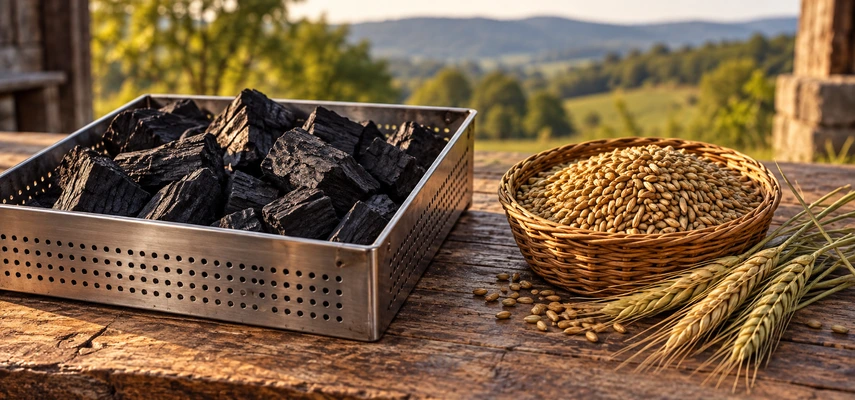

A Tennessee whiskey and an American rye can share a barrel type while telling very different grain stories. The first belongs to a corn-led tradition with a defined place and characteristic charcoal treatment. The second is identified by putting rye at the centre of its American mash bill. Tennessee and rye whiskey are easier to compare once those different organising ideas are clear.
Neither name is a complete tasting note. Fermentation, still operation, warehouse conditions and selection continue to matter after the category is identified. A rye can show oak-derived vanilla, while a Tennessee whiskey can carry spice-like impressions. Production rules help explain possibilities without assigning every bottle the same personality.
This lesson builds on Bourbon’s grain-to-new-oak framework rather than repeating it in full. We will focus on the Tennessee origin and mellowing route, the American rye grain requirement and the care needed when comparing labels, processes and sensory descriptions.
Tennessee and rye whiskey organise different production facts
Tennessee whiskey is tied to manufacture in Tennessee and the relevant state production framework. American rye whiskey identifies a grain-led type that can be made across the USA, rather than only in Tennessee or Kentucky. A location and a dominant grain can both appear on a label, but they are not interchangeable classification tools.
The course associates Tennessee whiskey with a minimum 51% corn mash bill, selected yeast, relatively low distillation strength, new charred oak and the Lincoln County Process. American rye uses at least 51% rye, with other grains providing the remainder. Attach the grain percentage to its category rather than memorising one American 51% rule with no grain named.
Think of two hypothetical grain recipes. One contains 70% corn and some rye; another contains 60% rye and some corn. The first does not become American rye because rye is present. The second does not become Bourbon because it includes corn. The minimum and the grain it applies to need to be read together.
Tennessee’s grain and strength framework is familiar
The Tennessee statutory text describes manufacture in the state, the corn minimum, distillation at no more than 80% ABV and entry into new charred oak at no more than 62.5% ABV. It also requires the relevant ageing in Tennessee and bottling at not less than 40% ABV.
Those strength limits concern different stages. Eighty percent is the distillation ceiling; 62.5% is the maximum on entering the required wood. Neither is a claim that every Tennessee bottle must be sold at that strength. Water adjustment and the actual bottling choice can produce a different labelled ABV later.
The other grains in a corn-led recipe and the chosen yeast help establish the fermented base. The distiller then selects the spirit that will proceed to further treatment and oak. The category does not supply one compulsory yeast strain, and it doesn’t make differences in fermentation irrelevant simply because the grain minimum has been met.
The Lincoln County Process happens before maturation
The defining production association is the Lincoln County Process, in which new spirit passes through maple charcoal before oak ageing. The timing is central. It is a treatment of the new distillate on its way towards maturation, not merely a final filter applied to a whiskey already fully developed in the barrel.
Brown-Forman’s account of Jack Daniel’s describes its sugar-maple charcoal mellowing. The producer’s process discussion likewise locates that step before the barrel. These are concrete examples of the tradition, not evidence that every producer uses identical equipment, depths or treatment times.
Charcoal can adsorb selected components and change the spirit’s balance. The intended effect is often described as mellowing, but avoid translating that into “all flavour is removed” or “every undesirable compound is eliminated.” Treatment conditions matter, and a complete mature profile still reflects the grain, fermentation, distillation and later cask.
The state framework contains a narrow exception to its charcoal provision. For that reason, “every Tennessee whiskey without exception is charcoal mellowed” is too absolute. The accurate introductory association remains strong: Tennessee whiskey is linked to the Lincoln County Process, with applicable legal qualifications acknowledged rather than hidden.
Charcoal treatment is not the same as charring a barrel
New charred oak concerns the maturation vessel’s inner wood surface. Passing spirit through a separate charcoal bed is a different operation at a different point. Both involve heat-treated wood in the broader production story, but they cannot be substituted for one another in an examination answer.
Nor should the treatment be confused with sour mash. Sour mash concerns preparing fermentation conditions using suitable material from an earlier production cycle; charcoal mellowing acts on distilled spirit. Maturation comes afterwards. If you put those three operations in order, the vocabulary becomes easier to keep straight without relying on a label’s typography.
A useful revision sketch is a timeline with three separate boxes: fermentation preparation, distillation and charcoal treatment, then oak. Add a short purpose beside each operation. Don’t draw the charcoal vat as a fermenter or label the inside of a Bourbon barrel “Lincoln County Process.” The distinction is functional as well as visual.
American rye changes the dominant grain
Under the federal whisky standards, American rye whiskey uses a fermented mash containing at least 51% rye. Corn, barley or wheat can appear in the rest of an appropriate recipe. The category does not require every rye whiskey to use exactly the minimum rye proportion.
Rye brings different processing behaviour and flavour possibilities from a corn-led mash. Bread-like or spice-associated descriptions can be useful in particular examples, but a percentage does not create one guaranteed tasting note. A high-rye mash and a minimum-rye mash can also differ, while fermentation and wood introduce further variables.
The recipe is prepared to supply suitable sugars, then fermented with selected yeast before distillation. Remember the distinction between a grain percentage and alcoholic strength. A mash containing 60% rye is not a claim of 60% ABV in the bottle, just as a 100-proof rye doesn’t mean its recipe contains 100% rye.
Rye shares some limits with Bourbon, but not every rule
American rye is distilled at no more than 80% ABV and stored in new charred oak at no more than 62.5% ABV on entry. Those familiar figures make comparison with Bourbon useful. The main grain minimum changes from corn to rye, while important distillation and wood conditions overlap.
Straight rye adds a minimum of two years of qualifying maturation and the relevant restrictions attached to that designation. Do not assume every bottle labelled rye is automatically straight. Conversely, straight does not promise one barrel, one fixed bottling strength or the oldest whiskey in a blend. The label terms continue to do separate jobs.
Take care with permitted additions as well. The federal table distinguishes ordinary rye from straight rye and treats Bourbon differently in the relevant colouring and flavouring column. It would be inaccurate to copy Bourbon’s no-colouring rule onto every American rye presentation without checking the complete designation. This is exactly why reading the actual category matters.
Compare styles without declaring the grain a dictator
A hypothetical corn-led Tennessee whiskey may combine grain-derived character, charcoal treatment and pronounced new-oak influence. A hypothetical rye may combine a different grain emphasis with its own fermentation, still and warehouse choices. Even if their ages and bottled strengths match, those production histories are not identical.
One comparison might find a more rounded impression in the Tennessee example and more grain spice in the rye. Another pair may be less neatly divided. Broad tendencies help organise learning, but they should not silence the actual observations. Describe the examples you have, then explain plausible production links rather than forcing them into a slogan.
If the samples differ in age, cask management or ABV as well, state those differences. A comparison with many variables can still be educational; it simply cannot isolate one cause perfectly. That caution improves both tasting notes and examination reasoning because it prevents a familiar association from being promoted into a universal law.
Read a Tennessee rye label carefully
A distillery located in Tennessee can make more than one type of whiskey. A rye made there does not become the corn-led Tennessee whiskey category merely because of its address. It may also undergo a producer’s charcoal treatment without its grain recipe changing into at least 51% corn. Place, grain and processing need separate attention.
Similarly, a producer’s brand identity doesn’t replace the designation on an individual bottle. Read the actual type, strength, age information and production description. The same principle applies across the series: a famous distillery can offer different products, so the name above the label isn’t a shortcut around the category below it.
For revision without drinking, sort three production descriptions: corn-led whiskey made and aged in Tennessee with the typical mellowing route; rye-led American whiskey from another state; and rye produced in Tennessee. Identify the grain category and the relevant geographical claim separately. This small exercise reveals why an address alone cannot solve every classification question.
What to remember
Tennessee whiskey links place, a corn-led recipe and a characteristic pre-ageing maple-charcoal process, with legal qualifications. American rye links the name to at least 51% rye and its federal distillation and new-oak framework. Compare the shared requirements, then name the genuine differences. Keep sour mash, charcoal mellowing, barrel charring and maturation in separate boxes, and the two traditions become much easier to explain.
Continue your study
To compare the Bourbon rules, read Bourbon Explained: Mash Bills, Yeast, New Oak, and American Whiskey Labels. To keep American and Canadian rye usage separate, read Irish, Canadian, and Japanese Whisky Explained: Different Production Traditions. To distinguish charcoal treatment from maturation, read How Spirits Develop Flavor: Oak Maturation, Blending, Filtration, and Finishing.
Knowledge check: 10 original practice questions
Independent TFE questions, not official WSET examination items. Choose one answer per question; explanations follow separately.
1. Which statement about flavour tendencies is most accurate?
- Every rye must taste identical
- Grain, treatment, fermentation and cask choices all influence the result
- Every Tennessee whiskey has no spice
- Bottled ABV alone proves the entire production route
2. Which wood requirement is central to American rye?
- Only uncharred used oak
- Only inert steel
- New charred oak
- No oak under any circumstances
3. Where can American rye be made in the course framework?
- Only in Kentucky
- Across the USA
- Only in Canada
- Only in Tennessee
4. What minimum does straight rye add?
- Two years of qualifying maturation
- Exactly ten years
- Mandatory 100-proof bottling
- A prohibition on every blend
5. What is the American rye grain minimum?
- Exactly 51% corn
- At least 51% rye
- Exactly 100% wheat
- At least 80% corn
6. Which distinction is correct?
- Sour mash is another name for barrel charring
- Charcoal mellowing and charring a barrel are separate operations
- Both terms mean the same required filter
- Maturation creates the original fermentation ethanol
7. Does a Tennessee distillery address make every rye it produces corn-led Tennessee whiskey?
- No, the actual type and grain recipe must still be read
- Yes, if the bottle is amber
- Yes, if any charcoal is present
- Yes, the address overrides the grain
8. Which grain minimum belongs to the Tennessee whiskey framework discussed?
- Exactly 100% barley
- At least 51% rye
- At least 51% corn
- At least 30% wheat
9. What is the Lincoln County Process associated with?
- Maple-charcoal treatment before oak ageing
- Mandatory redistillation after bottling
- Adding caramel after maturation
- Malting every grain in the mash
10. Which maximum entry strength is shared in the comparison?
- 96% ABV
- 62.5% ABV
- 80% ABV
- 100% ABV
Answers and explanations
1. B — Grain, treatment, fermentation and cask choices all influence the result. A category helps explain possibilities, but several production choices contribute to a specific sensory result. Mapping: LO2.
2. C — New charred oak. The named American rye type uses new charred oak under the federal standards discussed. Mapping: LO2.
3. B — Across the USA. The American rye type is not confined to Kentucky or Tennessee, although individual geographical claims still matter. Mapping: LO2.
4. A — Two years of qualifying maturation. Straight rye adds a two-year minimum and the relevant straight-category controls, not those unrelated guarantees. Mapping: LO2.
5. B — At least 51% rye. American rye requires at least 51% rye in the grain mash, with the remainder potentially including other appropriate grains. Mapping: LO2.
6. B — Charcoal mellowing and charring a barrel are separate operations. A separate charcoal bed and a charred wood vessel act at different points and perform different jobs. Mapping: LO2.
7. A — No, the actual type and grain recipe must still be read. A producer’s location does not replace the grain and type designation of the individual product. Mapping: LO2.
8. C — At least 51% corn. The Tennessee framework is corn-led; the 51% rye condition belongs to American rye whiskey. Mapping: LO2.
9. A — Maple-charcoal treatment before oak ageing. The characteristic treatment acts on new spirit before barrel ageing, not simply as a final matured-whiskey filter. Mapping: LO2.
10. B — 62.5% ABV. The relevant new-oak entry maximum is 62.5% ABV, distinct from the 80% distillation ceiling. Mapping: LO2.












