










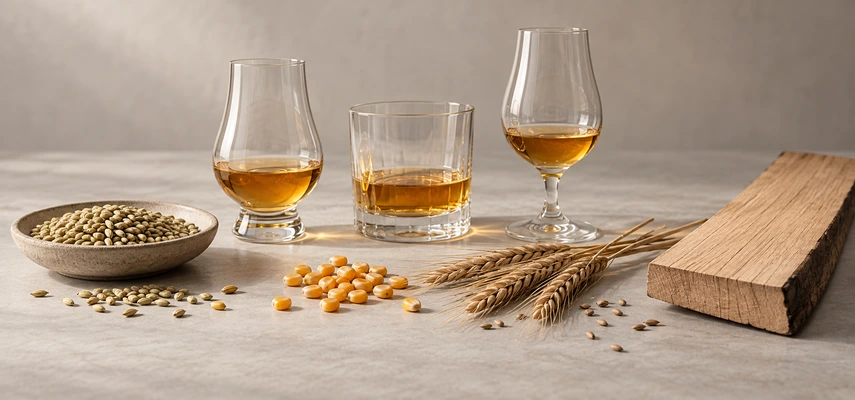

Irish Canadian and Japanese whisky make an excellent test of whether a production rule really travels. A term familiar from an American label may mean something different in Canada. A production habit strongly associated with Ireland may be common without being compulsory. A Japanese-looking bottle may require a closer look at provenance.
The useful starting point is the same in all three places: cereal starch becomes fermentable sugar, yeast makes alcohol and aroma compounds, distillation selects and concentrates them, and wood changes the resulting spirit. What differs is the way producers arrange those decisions and the promises attached to the finished name.
This is a comparison of production traditions, not three national tasting stereotypes. Expect considerable variety within each country. A light blend and a powerful single malt can share a national identity while answering different questions about grain, distillation and maturation.
Irish Canadian and Japanese whisky begin with grain choices
Malted barley has been allowed to germinate before drying. That develops enzymes useful for converting starch during mashing. Unmalted barley has not undergone that malting stage. It still contains starch, so a producer needs an effective route to converting it into sugars before yeast can do its job.
This distinction matters particularly in Ireland. Malted and unmalted barley can appear together in the recipe for pot still whiskey. The unmalted portion is not simply an accidental shortage of malt, nor does it turn the product into a flavoured spirit. It belongs to a deliberately chosen cereal recipe.
Corn and rye matter strongly in Canadian blending traditions. Corn can supply a relatively light foundation when distilled with substantial rectification; rye components can contribute more assertive cereal, herbal and spicy impressions. These are tendencies shaped by processing, not flavours guaranteed by dropping a particular seed into a fermenter.
Japan also uses malted barley and other cereals. Malt whisky and grain whisky can supply different components for a blend. There is no need to invent a uniquely Japanese cereal to explain the category: familiar raw materials can produce distinctive results through the rest of the process.
Ireland: malt, pot still, grain and blends
The Irish technical file distinguishes Malt Irish Whiskey, Pot Still Irish Whiskey, Grain Irish Whiskey and Blended Irish Whiskey. Malt uses malted barley; pot still characteristically combines malted and unmalted barley. Grain provides a further production category, commonly associated with column distillation. Blended combines at least two of those different types.
Single means one distillery for the relevant qualifying type; it does not mean one cask. A single pot still whiskey can therefore combine numerous casks while preserving its production identity. Equally, mixing several casks of the same single-malt type is not automatically the same thing as making a formal blended Irish whiskey.
The geographical identity covers the island of Ireland, including Northern Ireland. Maturation requires at least three years in wooden casks, and bottling strength is at least 40% ABV. Wooden matters: do not automatically import Scotch’s oak-only condition into every other whisky category.
For study purposes, attach each term to its own question. Malt and pot still direct attention to cereal recipe and production type. Single asks about distillery origin. An age statement asks about maturation. A bottle may provide several of these pieces of information without any one replacing the others.
Triple distillation is a tradition with exceptions
Many Irish producers use triple distillation. A further distillation can increase separation and help make a lighter style, depending on the equipment, reflux and the fractions retained. It does not erase every aroma compound or make the resulting whiskey equivalent to vodka.
Drinks Ireland explicitly describes both double and triple distillation within the industry. Irish therefore does not translate into always distilled three times. Nor does it mean that peat smoke is categorically forbidden; unpeated production is common, but exceptions exist.
Think of a third run as another opportunity to shape the spirit. Two producers can use three distillations and still choose different cut points, charge strengths or still designs. Counting runs tells you something useful, but leaves enough unanswered to make the producer’s actual methods worth investigating.
Canada: building flavour from components
Canadian whisky often makes particular sense when approached from the blending room backwards. A producer can make a comparatively light base whisky and a more assertive flavouring whisky, mature them, then combine them in proportions suited to a finished style.
Here flavouring whisky means a characterful whisky component. It does not necessarily mean a bottle of added fruit essence, sugar syrup or artificial flavour. Keeping the production term separate from everyday flavoured drinks prevents a surprisingly persistent misunderstanding.
A corn-based component distilled at high strength can give a blend a restrained foundation. A rye-based component distilled to retain more character can add a distinct accent. Separate processing gives the blender control over how much of each contribution appears in the final liquid, rather than fixing every relationship in a single combined mash.
In a producer interview, J.P. Wiser’s master blender describes fermenting, distilling and ageing grains separately. That is a concrete example of the approach, not a requirement that every Canadian distillery must organise its operations identically.
Canadian rye is not the American rye recipe
Under the current Canadian compositional standard, Canadian Whisky, Canadian Rye Whisky and Rye Whisky share a definition. The name does not impose the American rye whiskey requirement of at least 51% rye in the mash.
The standard requires Canadian mashing, distillation and ageing, at least three years in small wood and at least 40% ABV. It also allows flavouring subject to the applicable framework. Those are Canadian rules, not a reason to assume the same permissions apply to Scotch or Bourbon.
A Canadian bottle labelled rye may consequently contain a substantial corn-based contribution. Conversely, a producer can choose a high-rye recipe. The lesson is to distinguish what a category permits from what a particular producer actually does. Neither the word rye nor a national name supplies a complete recipe by itself.
Japan: familiar equipment, detailed blending decisions
Japanese whisky production includes pot-distilled malt and column-distilled grain styles, as well as blends. Differences in fermentation, still shape, heating, condensers and cuts can produce several distillate characters before the choice of cask is even considered.
That range is useful to a blender. A delicate grain component might support fragrant malt without competing with it, while a more robust malt supplies weight or smoke. Another blend might deliberately be lighter. The existence of careful blending does not imply that every Japanese whisky must taste delicate, floral or unpeated.
Wood then adds another set of choices. A previous Bourbon cask and a wine-seasoned cask will not necessarily make the same contribution. Japanese oak, often discussed as mizunara, can be relevant to particular releases, but is not an ingredient required in every Japanese whisky. Avoid letting a memorable wood name swallow the whole production story.
Read the Japanese provenance standard carefully
The Japan Spirits & Liqueurs Makers Association introduced a member labelling standard for Japanese whisky. Suntory’s explanation describes its application to member products labelled and bottled after April 1, 2024. Its scope matters: an industry membership standard should not be described as a universal statutory definition for every business.
It requires malted grain, Japanese production water, saccharification, fermentation and distillation in Japan, distillation below 95% ABV, at least three years in wooden casks in Japan and Japanese bottling at 40% ABV or above. Plain caramel colouring is permitted. Imported finished whisky is not made Japanese merely by repackaging it there.
Provenance information answers a different question from taste. Compliance does not guarantee one particular aroma, and a transparent blend containing whisky from different countries is not inherently poor quality. The important distinction is whether the description accurately tells the reader what is in the bottle.
Use a comparison that explains rather than stereotypes
Suppose you are comparing an Irish pot still whiskey, a Canadian blend with a light corn base and a Japanese blended whisky. Begin with the disclosed production facts. Identify the cereal choices and the component types, then ask how distillation and wood could help explain the observed differences.
An oily texture or spicy impression in the Irish sample may be consistent with its production style, but cannot reveal a legal grain percentage by itself. A relatively gentle Canadian sample may reflect extensive rectification and blending choices rather than a lack of maturation. A Japanese blend’s balance can emerge from contrasting components, not from a magical national water flavour.
Keep sweet aromas separate from measured sweetness. Vanilla or toffee impressions can come from wood without proving added sugar. Likewise, a peppery note does not establish that spice was added. This distinction is useful whenever sensory language starts sounding like an ingredient list.
For a written comparison, make one supported connection at a time: production choice, likely sensory effect, then qualification. That structure gives a clear explanation while leaving room for real bottles to depart from a broad tendency.
What to remember
Ireland’s malt, pot still, grain and blended categories are more informative than the slogan always triple distilled. Pot still’s malted and unmalted barley combination deserves particular attention. Canada makes a useful case study in lighter base whisky, characterful flavouring whisky and blending; Canadian rye does not copy the American 51% rule.
Japan uses both malt and grain traditions, with a member standard that establishes important provenance requirements. Across all three, distinguish a legal or industry category from a producer’s actual recipe and from the aromas you might reasonably expect. That habit will serve you better than memorising one national adjective.
Continue your study
To revisit the shared grain-production sequence, read How Whisky Is Made: Grains, Mashing, Fermentation, and Maturation. To compare national uses of the word rye, read Tennessee and Rye Whiskey Explained: Production Rules and Style Differences. To contrast Scotch component and blending categories, read Blended and Grain Scotch Whisky Explained: Production, Labels, and Scotland’s Regions.
Knowledge check: 10 original practice questions
Independent TFE questions, not official WSET examination items. Choose one answer per question; explanations follow separately.
1. What does single principally identify on a qualifying Irish whiskey category?
- One year of ageing
- One distillation run
- One distillery
- One barrel
2. Which cereal combination is particularly associated with Irish pot still whiskey?
- Only malted rye
- Malted and unmalted barley
- Molasses and barley
- Only potatoes
3. Why might grains be processed separately for a Canadian blend?
- To preserve independent control over component character
- To guarantee identical flavour from every grain
- To make maturation unnecessary
- To avoid fermentation altogether
4. How should the JSLMA Japanese whisky standard be described?
- A requirement for every whisky sold worldwide
- A member industry labelling standard
- A guarantee of one floral flavour
- A requirement for all-Japanese-grown barley
5. What is the best explanation of a vanilla aroma in a whisky?
- It establishes the exact mash recipe
- It may reflect wood influence without proving added sugar
- It proves the whisky is Canadian
- It proves vanilla beans were added
6. Which statement about Irish distillation is accurate?
- Every Irish whiskey is triple distilled
- Triple distillation is common but not universal
- Column stills are prohibited
- All Irish whiskey is neutral spirit
7. What is a flavouring whisky in the Canadian blending context?
- A mandatory sugar syrup
- Unfermented rye juice
- A characterful whisky component
- Necessarily an artificial flavour extract
8. Which is required in the Japanese member standard described here?
- Malted grain must be used
- Every cask must be mizunara
- Every whisky must be peated
- All distillation must use pot stills
9. A Canadian rye label necessarily guarantees which of these?
- No corn in any component
- Exactly 100% rye
- An American rye mash recipe
- Compliance with the Canadian category rather than a 51% rye mash
10. Which production types can contribute to Japanese blended whisky?
- Only grape brandy
- Pot-distilled malt and column-distilled grain whisky
- Only unaged vodka
- Only charcoal-filtered Bourbon
Answers and explanations
1. C — One distillery. Single identifies distillery origin, while a qualifying whiskey may combine many casks from that distillery. Mapping: LO2.
2. B — Malted and unmalted barley. Irish pot still whiskey characteristically uses malted and unmalted barley; it is distinct from malt whiskey. Mapping: LO2.
3. A — To preserve independent control over component character. Separate processing and maturation give a blender components with different strengths and sensory contributions. Mapping: LO2.
4. B — A member industry labelling standard. Its membership scope must be stated accurately; its provenance conditions do not guarantee one tasting profile. Mapping: LO2.
5. B — It may reflect wood influence without proving added sugar. Aroma descriptors resemble familiar foods but do not necessarily identify added ingredients or measured sweetness. Mapping: LO2.
6. B — Triple distillation is common but not universal. Double and triple distillation exist; nationality alone does not fix the exact number of distillations. Mapping: LO2.
7. C — A characterful whisky component. The term can describe an assertive whisky component blended with a lighter base, rather than an added essence. Mapping: LO2.
8. A — Malted grain must be used. Malted grain is required, while other cereal grains can also be used; no universal mizunara or peat condition applies. Mapping: LO2.
9. D — Compliance with the Canadian category rather than a 51% rye mash. Canadian Rye Whisky shares the Canadian definition and does not impose the American minimum rye proportion. Mapping: LO2.
10. B — Pot-distilled malt and column-distilled grain whisky. Malt and grain whisky can provide contrasting components whose balance is shaped through blending. Mapping: LO2.












