










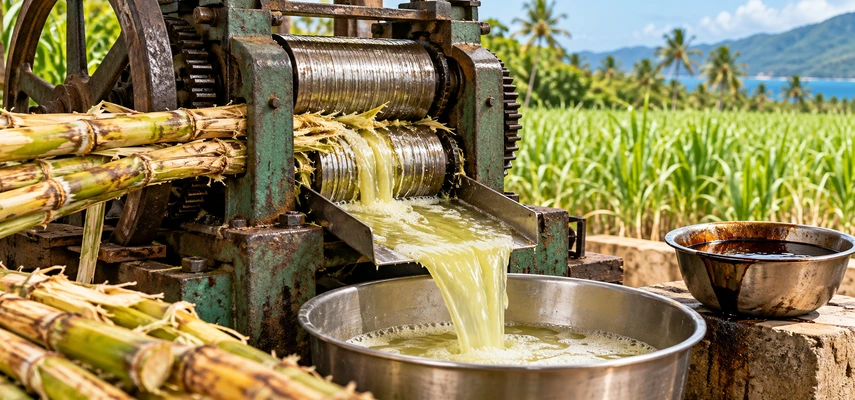

The word rum can lead to a grassy cane-juice spirit, a light mixer or a deeply aromatic oak-aged drink. Those differences aren’t evidence that the category has lost its way. They reveal how many decisions fit between sugar cane and a finished bottle.
Here is rum explained through those decisions: which cane material is fermented, how fermentation develops, how the still is operated, and what happens afterwards. Caribbean producers share a cane-based starting point without sharing one universal recipe, one flavour profile or one set of national production rules.
One plant, two important starting materials
Rum comes from sugar cane materials, notably sugar cane juice and molasses. Cane is crushed to release its juice. That juice can supply fermentable sugars directly. Alternatively, sugar manufacture removes sugar crystals and leaves molasses, a dark, concentrated material that still contains fermentable sugars alongside other components.
Juice and molasses therefore share a plant origin but differ as fermentation materials. Calling molasses simply “sugar cane juice” hides the intervening processing. Calling all rum molasses-based excludes an important part of the category. The useful comparison begins with two routes from the same crop, rather than two unrelated ingredients.
The West Indies Rum and Spirits Producers’ Association follows that cane-to-spirit journey. For a beginner, the important mechanism is sugar availability. Unlike grain starch, cane’s sugars do not require the same malting-and-mashing conversion sequence before yeast can use them. Preparation still matters, including suitable dilution and handling.
Dark molasses also doesn’t guarantee dark rum. Distillation separates volatile material from the fermented base; it doesn’t pour the colour of every ingredient straight through into the collected spirit. Later colour has to be explained through the complete process, including maturation and permitted colouring choices.
Fermentation creates alcohol and character
Yeast consumes fermentable sugars and produces ethanol and carbon dioxide. It also generates compounds relevant to aroma. The resulting alcoholic wash carries the effects of its starting material and fermentation conditions into the distillery. Alcohol exists before distillation begins; the still’s job is concentration and selection.
Different fermentation choices can help produce different aromatic starting points. The yeast used, fermentation duration and conditions all matter. A producer seeking a pronounced spirit may make different choices from one seeking a lighter profile. The distinction is a production aim, not a universal ranking of traditional over modern methods.
That is why a simple “juice equals this flavour, molasses equals that flavour” rule is too rigid. Raw material has influence, but fermentation changes it. Later distillation changes the balance again. A category explanation becomes more accurate when it follows the chain rather than asking the first ingredient to predict everything.
Cane-juice rums can show fresh, grassy or herbal associations, while some molasses-based rums show rich fruit or other pronounced impressions. These are useful tendencies, not a compulsory test that every bottle must pass. Similarity in a tasting note does not establish which material a producer used.
Both still families belong here
Rum uses pot stills and column stills. Pot stills operate in batches. Column equipment can operate continuously, with ongoing feed and output. Those operating patterns matter, but they do not divide the entire rum world into authentic flavour on one side and anonymous alcohol on the other.
Lower-strength distillation generally retains a more substantial contribution from fermentation-derived aroma compounds. Both still families can produce characterful lower-strength spirits. Higher-strength distillation can produce a lighter result. Distillation strength therefore helps connect equipment decisions with the sensory outcome without turning equipment shape into a complete tasting prediction.
A producer can combine distillates made through different approaches where the applicable framework permits. One component may supply an assertive aromatic contribution while another changes balance. The blend’s purpose matters more than forcing every rum into a single-still stereotype. Production can be designed around the finished profile.
The distillate emerging from the process is not dark merely because the wash used molasses. A colourless new spirit may already have pronounced aroma. This is a useful example of why appearance and aroma intensity should be described separately: a clear liquid can be far from neutral.
Unaged and oak-aged are different routes
Unaged rum can preserve a direct impression of the fermented material and distillation decisions. It does not need oak to become a complete beverage style. The absence of wood-derived colour or vanilla-like aromas is not a defect when the producer intends a fresh, characterful unaged spirit.
Oak-aged rum develops through contact with wood and time in its storage environment. The cask can contribute colour and aromas while the spirit changes. New versus previously used oak, barrel history and conditions influence the result. “Aged” is a useful fact, but it leaves much of the sensory explanation still to be supplied.
Vanilla, toast, spice and dried-fruit associations may be relevant in an aged rum. Their intensity and combination vary. The wood’s contribution interacts with the spirit filled into it, so maturation doesn’t automatically replace every earlier difference with one standard oak flavour. The fermented base remains part of the story.
Caribbean climate affects maturation conditions, but there is no reliable universal conversion saying one year there always equals a fixed number of years elsewhere. Different casks and environments do not develop along identical timelines. Comparisons need evidence rather than an appealing multiplication rule.
Blending manages a varied set of components
Blending can combine suitable rums to achieve consistency, complexity or both. Variation in fermentation, distillation and cask development gives the blender different materials. A component may be useful because of a particular aroma or structural effect, rather than because it already tastes like the finished product on its own.
Imagine balancing colours in a painting: a small amount of one strong element can change the whole arrangement. The analogy captures proportion and interaction without pretending flavour is literally paint. More components do not guarantee more complexity, and one component is not automatically purer in an evaluative sense.
Blending also needs a category and jurisdictional context. A general statement that producers blend rum is not permission to add any material while keeping any desired label. The industry’s discussion of rum definitions is a reminder that the shared family includes different national frameworks.
Colour and sweetness answer different questions
Oak can contribute colour. Caramel colouring may also adjust appearance where permitted. Neither route lets you identify an exact age from a glass. A darker rum is not necessarily older than a paler one, and a colour word is not a complete production specification.
Likewise, the cane origin doesn’t prove a sweetened final drink. Fermentation consumes sugars, and normal distillation does not carry sugar across in the same way that it carries volatile compounds. Actual finished sweetness needs its own explanation. Some producers sweeten where allowed; others do not, and some rules restrict it.
A caramel-like or vanilla-like aroma can suggest sweet food without demonstrating sugar addition. This distinction matters especially in rum, where the starting crop encourages an easy but faulty assumption. Sugar cane provides fermentable material. Added sugar after distillation is a separate production choice.
For an examination, keep the qualifications in the sentence. Caramel is optional where permitted; sweetening is not always permitted. Replacing either statement with “all rum contains” would erase the variation the syllabus asks you to understand. A short accurate qualification is better than a confident universal rule.
Rhum agricole identifies a juice connection
Rhum agricole is the key labelling term to recognise here. It is associated with rum made from fresh sugar cane juice, especially in French Caribbean traditions. It distinguishes that juice route from the familiar molasses route. The word does not, by itself, establish a single age, colour or sweetness level.
Specific geographical indications can add further rules. A general explanation of the term should not imply that every cane-juice rum anywhere automatically qualifies for every protected agricultural-rum name. Ingredient route and protected origin are related but separate questions. Read the full designation when evaluating a particular bottle.
For revision, connect the term with juice rather than trying to infer it from a grassy tasting note alone. Sensory clues may support discussion, but an ingredient or production claim needs evidence. A drink can remind someone of fresh cane without that impression functioning as an authenticated production record.
Compare three hypothetical rums
One producer ferments juice and uses a characterful distillation approach before bottling an unaged style. Another ferments molasses, produces a lighter distillate and prepares it for a different use. A third selects oak-aged components for a blended profile. Each follows a cane-to-spirit route while seeking a different result.
Now ask which features can be inferred from colour. Almost none of the full story follows with certainty. You would still need information about raw material, still operation, maturation and permitted additions. The exercise shows why rum rewards a production framework more than a shelf arranged only by shades of brown.
Separate rum’s base production from later flavouring by comparing still operation and spiced and other flavoured spirits.
What to remember
Start with sugar cane, then separate juice from molasses. Add fermentation choices, pot or column equipment and distillation strength. Follow with unaged or oak-aged development, blending and the applicable rules for caramel and sweetening. Link rhum agricole with the cane-juice route while respecting specific origin requirements.
The result is a category with a common agricultural foundation and considerable stylistic range. That range becomes manageable when each difference has a production question behind it. Instead of asking what all rum must taste like, ask which decisions explain the particular style in front of you.
Knowledge check: 10 original practice questions
Independent TFE questions, not official WSET examination items. Choose one answer per question; explanations follow separately.
1. Which statement about sweetening is accurate?
- Sweetening never occurs
- All rum is sweetened
- Rules vary and it is not always permitted
- Cane origin proves added sugar
2. What can oak maturation contribute?
- The initial fermentation ethanol
- The cane crop
- A guaranteed exact quality score
- Colour and aroma development
3. What does rhum agricole chiefly connect with at this level?
- A rye minimum
- Fresh cane juice
- A potato base
- Mandatory cream
4. What does yeast do before rum distillation?
- Concentrates spirit without fermentation
- Makes a barrel
- Produces ethanol and aroma-related compounds
- Adds oak colour
5. Why might rum be blended?
- Consistency and complexity
- Avoiding fermentation
- Replacing cane with grapes
- Making every rum neutral
6. Which still statement is accurate for rum?
- Both pot and column stills can make characterful spirit
- Columns always remove all aroma
- Pot stills operate continuously
- Only pot stills are allowed
7. How should Caribbean maturation be compared with cooler climates?
- Assume all islands share one law
- Always ignore cask history
- Always multiply by three
- Through actual conditions rather than one universal age conversion
8. Which statement about clear unaged rum is reliable?
- It can have pronounced aroma
- It is always sweetened
- It must be flavourless
- It must contain molasses colour
9. Which pair supplies the two main raw-material routes discussed for rum?
- Agave and wheat
- Potato and rye
- Grapes and barley
- Cane juice and molasses
10. What does a dark molasses starting material establish about final colour?
- All rum must be black
- No necessary dark final colour
- Compulsory caramel addition
- A ten-year age
Answers and explanations
1. C — Rules vary and it is not always permitted. Finished additions need their own explanation and must follow the relevant production framework. Mapping: LO2.
2. D — Colour and aroma development. Wood and storage shape the spirit after distillation, with effects depending on cask and conditions. Mapping: LO2.
3. B — Fresh cane juice. The label term is associated with the juice route, with specific protected names carrying further requirements. Mapping: LO2.
4. C — Produces ethanol and aroma-related compounds. Fermentation supplies the alcoholic wash and contributes compounds that later processing reshapes. Mapping: LO2.
5. A — Consistency and complexity. Suitable components can be selected and combined to reach an intended profile. Mapping: LO2.
6. A — Both pot and column stills can make characterful spirit. Lower-strength characterful distillation is possible with both still families. Mapping: LO2.
7. D — Through actual conditions rather than one universal age conversion. Maturation rates and outcomes depend on cask and environment, so one fixed equivalence is misleading. Mapping: LO2.
8. A — It can have pronounced aroma. Absence of oak colour does not mean absence of raw-material or fermentation-derived character. Mapping: LO2.
9. D — Cane juice and molasses. Both derive from sugar cane, though they differ as fermentation materials. Mapping: LO2.
10. B — No necessary dark final colour. Distillation and later operations mean ingredient colour cannot simply be read as finished colour. Mapping: LO2.












