










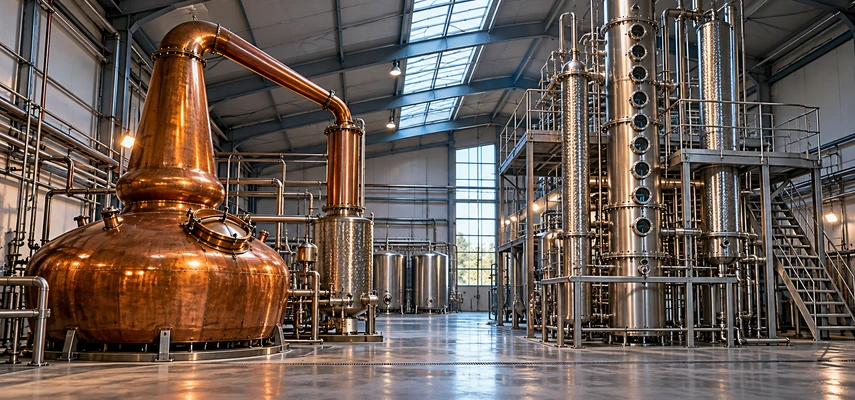

A copper pot still looks rather like a large kettle with architectural ambitions. A column still can look like part of a refinery. It’s tempting to decide that one makes flavour and the other makes something anonymous. Unfortunately for that tidy story, a column can produce plenty of character too.
For pot stills vs column stills, the better comparison starts with how the equipment operates, then asks how strongly it concentrates alcohol. Shape is a clue to the process. It isn’t a complete tasting note, a quality score, or a promise that every spirit from that type of still will behave alike.
What arrives at the still
Distillation begins with an alcoholic liquid. Yeast fermentation has already made ethanol from fermentable sugars. A distiller working with grapes may start with wine; a grain distiller may use an alcoholic wash. Different categories and facilities handle that feed differently, but the ethanol has to exist before it can be concentrated.
That order is the first examination anchor: fermentation produces alcohol; distillation concentrates it. The raw material also matters because the fermented liquid contains more than water and ethanol. It carries other substances, including compounds that contribute aroma. Distillation changes which volatile components travel into the collected spirit and in what proportions.
A still therefore performs separation rather than alchemy. It doesn’t make alcohol appear in a vessel of plain water. Nor does it transfer every feature of the starting liquid unchanged. The material entering the still and the way the still is operated together establish the result.
Vapour first, liquid again
When an alcoholic liquid is heated, a vapour forms whose composition differs from that of the liquid. Under the conditions used for beverage distillation, the vapour is enriched in ethanol relative to the original fermented liquid. Cooling that vapour condenses it back into liquid, giving a distillate with a higher alcoholic strength.
The familiar shorthand “alcohol boils before water” needs care. A fermented liquid is a mixture, and its vapour contains water as well as ethanol and other volatile compounds. The still does not wait while pure alcohol leaves and then switch to water. Understanding enrichment is more useful than imagining perfectly separate queues.
A condenser supplies the cooling needed to turn vapour back into a collectable liquid. Heating and condensation belong to one process. Without the second part, there would be no liquid distillate to collect. For Level 1, recognising this sequence matters more than memorising detailed equipment diagrams or operating temperatures.
Distillers can also repeat or intensify separation. More repeated contact and separation can support a higher-strength output, with a different balance of aroma compounds. This is where still design and operation become especially useful for understanding the contrast between a relatively light spirit and a more pronounced one.
Pot stills: one charge at a time
A pot still operates in batches. A charge goes into the vessel, it is heated, vapour passes to a condenser, and the distillation run proceeds. The still is then prepared for another charge. “Batch” describes that stop-and-start cycle, rather than a particular size or a guarantee that the producer is small.
A spirit may pass through more than one pot distillation. The Cognac authority’s production guide describes its two successive distillations, starting with wine and then redistilling the first distillate. That is a category-specific application of batch distillation, not a rule requiring every pot-distilled spirit to follow exactly the same sequence.
Distillers select which portions of a run contribute to the desired spirit. The composition changes as a batch progresses, so collection decisions help determine character. The Level 1 priority is the broader relationship between pot distillation, batch operation and a characterful spirit; detailed cut management belongs to a more advanced technical discussion.
In the syllabus framework, pot stills produce lower-strength spirits associated with medium to pronounced aroma intensity. More fermentation-derived character can remain noticeable than in a highly concentrated neutral spirit. That doesn’t mean every pot-distilled spirit smells identical, or that all of its eventual aromas come from the still.
Column stills: separation that keeps moving
A column still can work continuously. Fermented liquid is supplied while distillate and other outputs are removed during operation. Instead of treating each complete charge as a separate pot-still run, the equipment supports an ongoing process. Continuous production can be large, but the operating principle is the essential distinction.
Inside a column, rising vapour and descending liquid interact through a series of separation stages. This repeated contact can concentrate ethanol efficiently. A useful analogy is a staircase with repeated opportunities to change the mixture, rather than one giant leap. It helps explain the principle without pretending that each plate acts like an independent little kettle.
The crucial word is can. Column equipment can be configured and operated to make high-strength, light or relatively neutral spirit. It can also make lower-strength, characterful spirit. A column isn’t a machine whose only setting is “remove personality”. The intended product governs how the producer uses its capabilities.
The official Scotch Whisky technical file provides a category example involving different distillation approaches for malt and grain whisky. Other categories also use continuous distillation. Recognising the equipment doesn’t, by itself, identify the finished beverage’s raw material or legal category.
Distillation strength links machinery to aroma
Distillation strength means the alcoholic strength of the spirit as produced by distillation. It is different from the strength shown on a retail bottle. Water may be added later, and maturation can also change alcoholic strength. A bottle at 40% ABV needn’t have left the still anywhere close to that figure.
Lower-strength distillation generally retains more of the mixture of aroma compounds associated with the fermented base. In the introductory framework, the resulting spirit may show medium to pronounced aroma intensity. Both pot stills and column stills can occupy this part of the picture.
Higher-strength distillation concentrates ethanol more strongly and tends to leave a lighter or relatively neutral aroma profile. This is useful where the producer wants a restrained base, including for some later flavouring operations. Neutrality is an intended style characteristic, not evidence that the production has failed to make an interesting drink.
These are tendencies rather than a complete sensory equation. Fermentation, the compounds present in the feed, equipment details and collection choices all matter. Later oak ageing, blending and botanical flavouring can add further influences. The syllabus simplifies a complex process so that the main causal relationship remains visible.
Compare two production decisions
Imagine one producer seeking a pronounced unaged rum character. Fermentation supplies an aromatic base, and lower-strength distillation carries a substantial part of that character into the spirit. Either an appropriate pot process or a suitable column process could support the goal. The still family alone doesn’t settle the choice.
Now imagine a producer seeking a relatively neutral base for a flavoured spirit. A high-strength column-distillation approach can reduce many of the starting liquid’s aroma contributions. The later flavouring then has a different canvas to work on. That is a production decision leading through a mechanism to a sensory consequence.
Neither example is a universal recipe for a category. They show why the question “pot or column?” needs the follow-up “used how, and for what result?” Learning that habit prevents equipment vocabulary from turning into a set of unsupported assumptions about authenticity, quality or flavour.
Keep three kinds of strength apart
A student sees a strongly aromatic spirit bottled at the same ABV as a relatively neutral one. There is no contradiction. Bottling strength concerns ethanol in the retail liquid. Distillation strength concerns the output of an earlier operation. Aroma intensity concerns the strength of sensory impressions. The words overlap in everyday conversation, but the measurements and observations differ.
Likewise, a strong aroma of vanilla may reflect later oak influence rather than the still’s operating strength. A smoky impression may connect with earlier raw-material processing. To reason clearly, place the characteristic in the full production chain before assigning its cause. The still matters enormously without being responsible for everything.
Read a question for its actual claim
Suppose an examination option says a column still can produce neutral spirit. That is compatible with the equipment?s capabilities. An option saying it must always produce neutral spirit makes a much stronger claim and ignores lower-strength operation. Small words such as ?can?, ?typically? and ?always? can change whether a statement is defensible.
Apply the same care to pot stills. Batch operation defines the process, while a particular number of distillations may belong to a named category. Don?t take a correct Cognac example and turn it into an unsupported rule for every spirit made in a pot still.
To compare the still’s result with the finished style, examine vodka and post-distillation operations.
What to remember
Use four short links for revision. Pot still means batch operation. Column still means continuous operation in the Level 1 framework. Lower-strength distillation can produce medium to pronounced aromas in either system. Higher-strength column distillation can produce a light or relatively neutral spirit.
Then explain the underlying process in one sentence: heating an alcoholic liquid forms ethanol-enriched vapour, which is condensed to collect a stronger alcoholic liquid. That explanation is both more accurate and more flexible than “a still makes alcohol”. It also leaves room for the producer’s next decisions, including maturation, blending, dilution and flavouring.
Knowledge check: 12 original practice questions
Independent TFE questions, not official WSET examination items. Choose one answer per question; explanations follow separately.
1. Which statement about column distillation is correct?
- It always produces flavourless spirit
- It replaces fermentation
- It cannot produce lower-strength spirit
- It can produce different aroma intensities depending on operation
2. Which style is associated with higher-strength distillation in the introductory framework?
- Necessarily smoky
- Necessarily sweet
- Light or relatively neutral aroma
- Necessarily oak-aged
3. What must occur before ordinary spirits distillation can concentrate ethanol?
- Caramel colouring
- Alcoholic fermentation
- Oak maturation
- Final dilution
4. What is the role of the condenser?
- To convert starch into sugar
- To ferment the raw material
- To cool vapour back into liquid
- To add barrel colour
5. What happens when ethanol-enriched vapour is condensed?
- It becomes sugar
- It forms a liquid distillate
- It becomes oak
- It automatically becomes gin
6. Which statement avoids a common distillation misconception?
- Pure alcohol always leaves first on its own
- Water cannot enter the vapour
- The vapour contains a mixture of volatile components
- Every aroma passes over unchanged
7. Which operating pattern defines pot stills in the syllabus?
- Batch operation
- Continuous sugar conversion
- Uninterrupted bottling
- Maceration
8. Which statement about bottled ABV and distillation strength is accurate?
- Later dilution can make them different
- They must always be identical
- Bottled ABV proves still type
- Only pot spirits can be diluted
9. What does continuous column operation involve?
- Ongoing feed and output during operation
- One sealed batch followed by emptying
- Mandatory barrel ageing
- One fixed bottling strength
10. What does distillation primarily do to the alcoholic liquid?
- Creates ethanol from water
- Concentrates ethanol and changes the volatile mixture
- Adds fermentable starch
- Makes oak compulsory
11. Which is possible from both pot and column stills?
- Fermentation without yeast
- Mandatory ten-year maturation
- Conversion of starch into sugar
- Lower-strength spirit with pronounced aroma
12. Which inference is justified by seeing a pot still?
- Every resulting spirit is sweet
- Every resulting spirit is old
- Its spirits are automatically higher quality
- The equipment uses batch distillation
Answers and explanations
1. D — It can produce different aroma intensities depending on operation. Columns can produce characterful lower-strength spirit as well as high-strength light or neutral spirit. Mapping: LO1.
2. C — Light or relatively neutral aroma. High-strength distillation tends to reduce many fermentation-derived aroma contributions, giving a lighter profile. Mapping: LO1.
3. B — Alcoholic fermentation. Fermentation produces the ethanol in the alcoholic liquid; distillation then concentrates it. Mapping: LO1.
4. C — To cool vapour back into liquid. Condensation turns the vapour formed during heating into liquid distillate that can be collected. Mapping: LO1.
5. B — It forms a liquid distillate. Cooling the enriched vapour produces the collectable stronger alcoholic liquid called a distillate. Mapping: LO1.
6. C — The vapour contains a mixture of volatile components. Alcoholic mixtures produce mixed vapour; the process enriches ethanol rather than separating perfectly pure queues. Mapping: LO1.
7. A — Batch operation. A pot still handles a charge through a distillation run and is prepared for the next batch. Mapping: LO1.
8. A — Later dilution can make them different. Water may be added after distillation, so retail alcoholic strength does not establish the earlier distillation strength. Mapping: LO1.
9. A — Ongoing feed and output during operation. Continuous operation maintains flows through the equipment instead of treating each charge as a separate pot run. Mapping: LO1.
10. B — Concentrates ethanol and changes the volatile mixture. Distillation separates and concentrates components of an already alcoholic feed rather than creating ethanol. Mapping: LO1.
11. D — Lower-strength spirit with pronounced aroma. The syllabus allows characterful lower-strength spirit from pot or column distillation. Mapping: LO1.
12. D — The equipment uses batch distillation. Batch operation is the relevant defining fact; sweetness, age and quality require other evidence. Mapping: LO1.












