










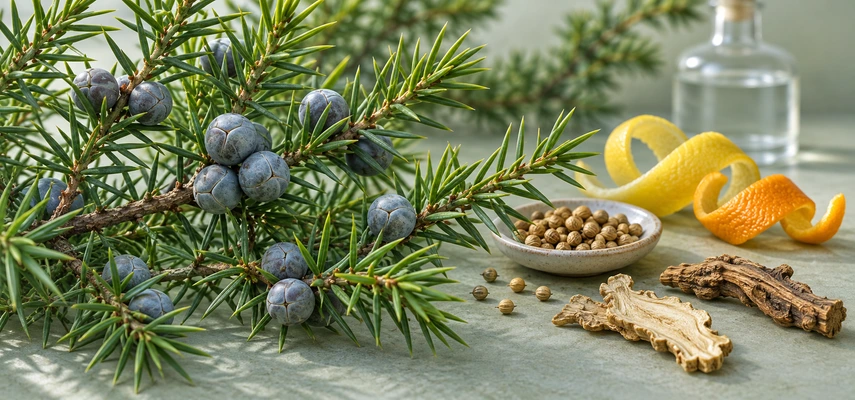

A gin can be made far from London and still qualify as London Dry. Another can smell strongly of citrus yet remain firmly juniper-led. These details become easier to understand once gin styles are separated into three questions: what defines the category, how was flavour introduced, and what does the producer want the drink to taste like?
The anchor is juniper. Gin is not simply any botanical-flavoured spirit in a clear bottle. Other ingredients can bring floral, citrus, spicy or earthy character, but the relevant category framework keeps juniper at the centre of the identity.
This lesson connects the botanical recipe to extraction and distillation, then compares London Dry, distilled gin, Old Tom and contemporary descriptions. The point is to read each term for the information it supplies, rather than asking one word to reveal the entire recipe.
Gin styles share a juniper foundation
Juniper berries contribute the familiar resinous, pine-like and sometimes citrus-associated character. Individual batches and botanical sources vary, so the word juniper is not a promise of one exact aroma intensity. It is nevertheless the reference against which the rest of the recipe is balanced.
In the EU, gin is made by flavouring ethyl alcohol of agricultural origin, a comparatively neutral base. The gin flavour must be predominantly juniper. The EU category framework distinguishes gin, distilled gin and London gin with additional production conditions.
The USA permits a broader production foundation, including original distillation from mash or redistillation of spirits, as well as the specified mixing routes. Its gin standard requires the main characteristic flavour to come from juniper. Do not assume every US gin began as an identical purchased neutral base.
These differences matter when a question names a jurisdiction. A broad sensory resemblance does not make legal definitions interchangeable. Identify the framework first, then decide what a label term requires within it.
The supporting botanicals are doing different jobs
Coriander seeds often bring citrus-like and spicy aromatics. A citrus impression in gin therefore does not necessarily prove that lemon juice was added. Seeds can supply volatile compounds that resemble familiar citrus notes without adding the juice’s acidity.
Citrus peel supplies aromatic oils. The peel, pith and juice are different materials; they should not be treated as equivalent just because they come from the same fruit. A producer’s preparation of peel can influence the balance of fresh aroma, bitterness and other extracted material.
Angelica root can contribute earthy, herbal and structural notes. Orris root, associated with iris, is another traditional botanical with its own aromatic contribution. They are often discussed as supporting the recipe, but avoid describing them as a magic device that guarantees all other flavours remain unchanged forever.
Hayman’s botanical account supplies a practical example of a multi-ingredient recipe. The exact list and proportions belong to the producer, not to the universal definition of gin. Juniper is essential to the category; every supporting botanical in this paragraph is not.
More botanicals do not automatically mean more complexity
A restrained recipe can contain a well-organised balance of aromas, while a long ingredient list can become muddled. The useful question is whether the supporting ingredients complement the juniper and the producer’s intended style.
Ingredient condition matters as well. Freshness, drying, oil content and preparation can influence extraction. Two distillers using the same named plants need not obtain the same result if the materials, proportions and handling differ.
For revision, learn the common roles, then keep the qualifications attached. Coriander can contribute citrus-like aroma; it does not always dominate. A root can provide an earthy accent; it does not make every gin taste of soil. Mechanism and balance are more useful than a rigid adjective per plant.
Redistillation can integrate the botanical recipe
In a common route, the producer combines alcoholic base and botanicals, then redistils. Volatile aroma compounds can pass into the distillate while much non-volatile colour and bitter material remains behind. The resulting gin can be intensely aromatic and still colourless.
Some producers macerate botanicals before heating. Sipsmith describes overnight contact followed by selection of a heart fraction. The soaking and distillation stages work together: extraction prepares the charge, then the still selects from that mixture.
Vapour infusion offers another arrangement. Botanicals are held in the vapour path rather than necessarily submerged in the liquid. Bombay describes that method for its gin. Both routes can produce aromatic distillates; the actual recipe and operation determine the result.
Do not confuse redistilling a neutral base with fermenting juniper into alcohol. The alcohol already exists before botanical treatment. Distillation shapes the aroma carried into the receiver rather than creating ethanol from the berries.
Purchased flavouring can also be used
Some gins are made by adding permitted flavouring preparations to the base rather than obtaining the complete flavour through a final botanical distillation. Purchased flavouring can supply a consistent extract, but selecting and blending it still require a formulation.
The term compounded is often used for mixing without subsequent redistillation of the full product. That is a production distinction, not a complete sensory verdict. A consumer may prefer a particular product, but the method alone does not provide an objective ranking of every bottle.
The legal distinction matters more precisely: under the EU framework, adding essences alone does not make a product Distilled Gin. A producer cannot satisfy that category merely by pointing out that the neutral base was distilled at an earlier stage.
The relevant question is what happened during botanical flavouring. Almost every spirit base has a distillation history; the category term is not intended simply to repeat that unhelpfully broad fact.
Distilled gin has jurisdiction-specific meaning
EU distilled gin involves the specified botanical distillation route, with predominant juniper, and permits certain subsequent combinations and flavouring under its conditions. It is therefore broader than the stricter London category, while still excluding an essence-only route.
In the USA, gin made exclusively by original distillation or redistillation may carry distilled and certain other listed terms. This is a separate definition. A US label using London should not automatically be interpreted as proof of every EU London production condition.
For an examination comparison, state the country framework in the sentence. That small habit prevents an answer that begins with a correct rule and ends by applying it to the wrong category. The production method can be similar without the regulatory wording being identical.
London Dry describes production, not a postcode
Under the EU London Dry framework, flavour comes through distillation with the natural botanicals used. The resulting distillate has a minimum strength of 70% ABV, and the category restricts further ingredients, colouring and sweetening. The sweetening ceiling is 0.1g per litre expressed as invert sugar.
These are production and composition conditions. They do not require the distillery to stand inside London, nor do they guarantee that the bottle will have one identical ratio of citrus to spice. Producers can use different qualifying recipes within the framework.
London Dry also does not mean a ban on every aroma associated with sweetness. Liquorice or other botanicals can suggest sweetness aromatically without the product containing a large sugar dose. Aroma resemblance and measured sugar are separate observations.
A contemporary-tasting gin can meet London Dry conditions if the required production and composition rules are met. Conversely, a very traditional-tasting gin does not necessarily prove those conditions were followed. Taste description and formal production classification are different axes.
Old Tom and contemporary profiles
Old Tom is commonly associated with a rounder, sometimes lightly sweetened profile. It is not one internationally fixed sugar recipe. Hayman’s account describes its own historical-family-recipe approach and botanical intensity, which illustrates a style without defining every producer’s version.
Do not assume Old Tom must be brown, barrel-aged or identical to genever. Those are additional claims requiring evidence. The label gives a useful style reference, but the producer’s disclosed base, sweetening and maturation information determines the particular bottle.
Contemporary gin generally gives more prominence to supporting botanical directions than a strongly juniper-forward reference. Citrus, floral or herbal accents may be especially conspicuous. The description does not provide permission to remove the category’s required juniper identity.
Juniper-forward and contemporary also form a spectrum rather than two perfectly sealed boxes. A gin can be clearly juniper-led while having an unusually vivid citrus or floral dimension. Precise notes make that easier to explain than arguing over a single marketing adjective.
Compare the bottle through three questions
First identify the applicable legal category and jurisdiction. Then identify the known flavouring route. Finally describe the actual balance of juniper and supporting aromas, noting sweetness and texture separately.
For example, a colourless London Dry with pronounced orange aroma can reflect botanical distillation rather than added orange juice. A round Old Tom can fit a different balance in a cocktail without being stronger in alcohol. Neither observation requires declaring one universally better.
What to remember
Gin requires a defining juniper character, with regional wording differences. Learn coriander seeds, citrus peel, angelica root and orris root as useful supporting botanicals. Redistillation, vapour infusion and flavouring preparations are different routes.
Keep EU London Dry, EU distilled gin and US distilled gin conditions distinct. Old Tom and contemporary descriptions add style information but do not supply a universal recipe. Read production, category and sensory balance together.
Continue your study
To revisit maceration and vapour infusion, read Flavored Vodka and Spiced Rum Explained: How Spirits Gain Added Flavor. To compare a different botanical family, read Aniseed Spirits Explained: Pastis, Absinthe, and Botanical Flavor. To identify gin’s roles in classic cocktail structures, read The Four Cocktail Families Explained: Spirit-Forward, Short Sour, Highball, and Long Sour.
Knowledge check: 10 original practice questions
Independent TFE questions, not official WSET examination items. Choose one answer per question; explanations follow separately.
1. What does the US gin framework permit as a production foundation?
- Only Irish malt whiskey
- Original distillation or redistillation under its conditions
- Only one purchased neutral brand
- Only cane juice
2. Which is the clearest comparison method?
- Separate legal category, flavouring route and sensory balance
- Infer every process from colour
- Assume all jurisdictions share one definition
- Rank by number of botanicals only
3. Which statement correctly interprets EU London Dry?
- Every recipe must have ten botanicals
- All examples taste identical
- Production conditions do not require a London location
- Every producer must be within London
4. What does Old Tom guarantee internationally?
- Mandatory ten-year ageing
- Exactly 100 g sugar per litre
- No single universal sugar recipe
- Mandatory brown colour
5. Which pair contains traditional supporting roots?
- Grape and apple pomace
- Wheat and rye
- Angelica and orris
- Lemon and lime juice
6. Can a contemporary profile also meet London Dry conditions?
- No, citrus is prohibited
- Only if it contains no juniper
- Yes, if production and composition meet the rules
- No, all contemporary gin is sweetened
7. What does the EU essence-only route fail to establish?
- That the base contains alcohol
- That flavour was added
- Qualification as distilled gin
- That juniper could be present
8. Which botanical can supply citrus-like aroma without citrus juice?
- Coriander seeds
- Charcoal
- Potato starch
- Plain caramel
9. What provides gin’s defining category flavour?
- Juniper
- Molasses alone
- Any citrus fruit instead of juniper
- Oak alone
10. Why can an aromatic gin remain colourless?
- Volatile aroma passes into distillate without all pigments
- All botanicals lack pigments
- Colourlessness proves no flavouring
- Every gin is bleached
Answers and explanations
1. B — Original distillation or redistillation under its conditions. US rules are broader than treating every gin as the same EU neutral-base botanical route. Mapping: LO3.
2. A — Separate legal category, flavouring route and sensory balance. Those three questions keep observable character distinct from process evidence and regulatory conditions. Mapping: LO3.
3. C — Production conditions do not require a London location. London Dry concerns a defined production and composition route rather than a compulsory city location. Mapping: LO3.
4. C — No single universal sugar recipe. Old Tom is associated with particular style traditions, but exact composition requires product-specific information. Mapping: LO3.
5. C — Angelica and orris. Angelica and orris are roots used in botanical recipes, with contributions distinct from citrus peel and seeds. Mapping: LO3.
6. C — Yes, if production and composition meet the rules. A sensory description and a formal production category answer different questions and can coexist. Mapping: LO3.
7. C — Qualification as distilled gin. The botanical-distillation requirements cannot be met merely by adding essences to previously distilled alcohol. Mapping: LO3.
8. A — Coriander seeds. Coriander has aromatic compounds that can contribute citrus-like impressions without juice acidity. Mapping: LO3.
9. A — Juniper. Juniper must supply the required predominant or main characteristic flavour under the respective frameworks. Mapping: LO3.
10. A — Volatile aroma passes into distillate without all pigments. Redistillation selects volatile components rather than transferring every constituent of the plants. Mapping: LO3.











