










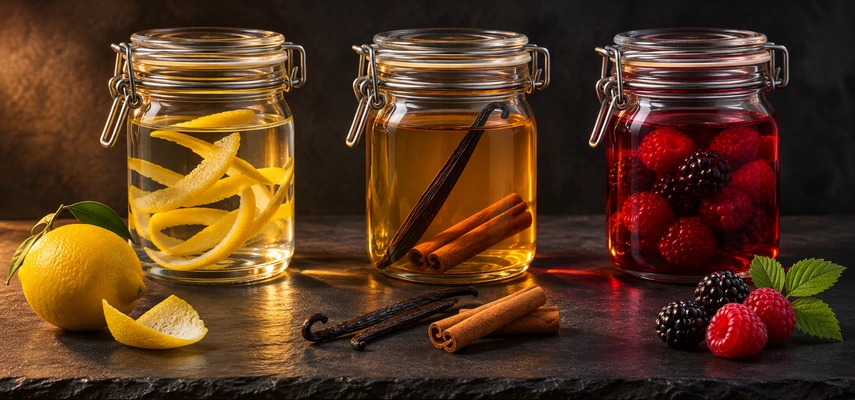

A clear lemon-flavoured spirit and a brown vanilla-spiced spirit can look as though they were made by completely different industries. In fact, their producers may choose from many of the same flavouring tools. The important differences lie in the base, the ingredients and the way those ingredients are extracted or added.
Flavoured vodka and spiced rum make a useful introduction because the added character is explicit. We are no longer trying to explain a faint vanilla aroma that may have come from oak. We are asking how a producer deliberately gives an alcoholic base a chosen flavour.
The central distinction is simple: soaking can extract a broad range of soluble material, while redistillation selects volatile material that travels through a still. Those routes can produce different flavour, colour, bitterness and texture even when they begin with the same botanical.
Flavoured vodka and spiced rum start with a base
Flavoured vodka commonly starts with a relatively neutral base. That gives fruit, herbs, spices or other chosen flavours room to become the main identity. Neutral does not mean that the original agricultural alcohol had no production history; it means that extensive rectification has made its own character comparatively restrained.
Spiced rum starts with a cane-derived spirit base. The base may already contain fermentation, distillation and maturation character, which can interact with the added ingredients. A strongly aromatic rum and a light rum do not necessarily make the same finished spiced drink when given the same flavouring dose.
Keep the category and the market in view. A product commonly called spiced rum may require a different legal description under a particular jurisdiction’s rules for unflavoured rum. A familiar shelf label is not evidence that every country uses one identical category definition.
The botanical recipe is a practical design
A botanical recipe specifies ingredients and their relationships. Peel, seeds, roots, leaves and pods contain different compounds in different parts of the plant. Choosing orange peel is not the same as adding orange juice; they bring different balances of volatile aroma, acidity and other material.
Quantity matters, but so do condition and preparation. Fresh versus dried material, particle size and storage history can change extraction. A finely broken ingredient may release material differently from a whole piece, so a recipe is more than a list of attractive nouns.
The producer also needs to consider how the ingredients behave together. One strongly aromatic spice can dominate a delicate fruit note. A botanical that smells pleasant on its own can become excessive at the concentration used in the finished spirit.
This is why a well-designed flavour profile is not simply a competition to include the most ingredients. The useful question is what each ingredient contributes, how it is obtained and whether it supports the intended balance.
Maceration: let the liquid extract the flavour
Maceration means soaking material in liquid so that soluble compounds move into the liquid. An alcoholic mixture can extract aromatic compounds as well as colour, bitterness and other substances. The exact result depends on the ingredient and the liquid’s alcohol-water composition.
A tincture is a concentrated alcoholic extract that can be prepared separately and dosed into a blend. Preparing extracts independently gives control over different ingredients: a producer need not leave a delicate peel in contact for as long as a tougher root merely because both appear in the same recipe.
Time and temperature affect extraction. More contact or warmth can increase the rate or extent of extraction, but more is not always better. An infusion can acquire unwanted bitterness, excessive colour or a less fresh aromatic character if the conditions do not suit the ingredient.
The producer eventually separates the solids and assesses the extract. This is flavour extraction, not alcoholic fermentation. Putting cinnamon into finished spirit does not mean yeast is producing new alcohol from the spice.
Redistillation selects a different set of compounds
In redistillation, an existing alcoholic base is distilled with or after contact with flavouring material. Volatile compounds can travel with the vapour and become part of the condensed distillate. Many non-volatile pigments and bitter substances do not follow in the same way.
That explains why an intensely aromatic spirit can remain colourless. The ingredient may have been brown, green or red, yet the selected volatile material is not equivalent to transferring its complete colour and composition into the bottle.
Botanicals can be distilled together, giving an integrated distillate from a combined recipe. They can also be distilled individually, then blended. Separate distillates allow different ingredients to receive different conditions and give the blender another opportunity to adjust proportions afterwards.
Neither arrangement automatically wins. Distilling together can suit an established recipe, while separate treatment can make particularly delicate or forceful ingredients easier to control. Explain the producer’s choice in terms of extraction and blending rather than assuming the more complicated diagram is necessarily superior.
Maceration can happen before distillation
Soaking and distillation are not mutually exclusive. A producer can macerate before distillation, extracting material into the alcoholic charge and then selecting what passes into the distillate. Sipsmith describes that combination for its gin production.
The example teaches a general technique rather than proving that a particular spiced rum follows the same recipe. It also prevents a false either-or question: a spirit can involve both soaking and redistillation without being made by two contradictory methods.
Vapour infusion and cuts shape aroma
With vapour infusion, alcohol-containing vapour passes through or over botanicals held in its path. Aromatic material is taken up and carried onwards to condensation. The botanicals need not sit submerged in the boiling liquid.
Bombay’s production account provides a familiar botanical-spirit example. The distinction from immersion is physical: where does the ingredient meet the liquid or vapour? Do not turn a marketing preference for one route into a rule that the other cannot make good spirit.
Cuts remain important during botanical redistillation. The distiller chooses which fractions to retain for the desired aromatic balance. A citrus component, for example, is not necessarily distributed identically throughout the run, so collecting the entire output indiscriminately can alter the result.
Vacuum changes the pressure-temperature relationship
Vacuum distillation reduces pressure inside the system, allowing boiling at lower temperatures than under otherwise comparable atmospheric conditions. This can be useful when a producer wants to handle delicate aromatic material with less heat exposure.
Greenhook describes using a vacuum-equipped copper still for its botanical spirit. The important mechanism is lower pressure and lower boiling temperature, not the elimination of distillation or a claim that no heat is used.
Vacuum is one available tool, not a requirement for all flavoured vodka or spiced rum. The chosen ingredients, equipment and intended character determine whether it offers a useful advantage. An expressive result can be achieved through several different routes.
Purchased flavours and cold compounding
Producers can buy natural flavourings, extracts or other permitted flavouring preparations instead of extracting every ingredient themselves. The purchased material still needs to be selected, dosed and blended carefully. Outsourcing an extraction stage does not make the final formulation happen automatically.
Cold compounding generally describes mixing flavouring materials into the base without a subsequent distillation of that complete mixture. The phrase does not mean the ingredients have never encountered heat anywhere in their earlier manufacture.
Other flavourings may also be permitted under the applicable product framework. Natural and other flavour descriptions concern ingredient origin and regulatory terminology; they do not supply a universal sensory ranking. A legal flavour claim and an attractive flavour balance are different things to verify.
Ask what is actually disclosed. A label naming vanilla does not necessarily reveal whether the producer used a pod maceration, a purchased extract or another allowed preparation. Do not invent an exact method just because one would make an appealing story.
Colour and sweetness can be separate adjustments
Natural colour can be extracted during maceration. It may also be added through a permitted colouring material, while artificial colour can be used where the relevant rules allow it. Appearance therefore does not establish the flavouring method by itself.
Caramel can adjust a spiced spirit’s colour. That is different from assuming all brown appearance came from long barrel ageing, and different again from measuring sweetness. A producer can make separate decisions about colour and sugar.
Sugar can soften perceived bitterness or change balance and texture. It does not erase bitterness chemically or turn every botanical-flavoured spirit into the same category. The legal name and applicable sugar conditions still need their own check.
Traditional and modern flavour directions
Traditional flavoured vodka styles include herbal, peppery and fruit-based directions; modern ranges can extend into confectionery and dessert-inspired profiles. These are broad style groupings rather than two legal production methods. A traditional ingredient can be added using a modern extract.
Spiced rum frequently uses vanilla and warm-spice directions. Captain Morgan’s US product description explicitly identifies rum, vanilla, spice and other natural flavours. It supports the ingredient connection without disclosing every extraction decision.
When comparing products, start with the base, added flavour identity, apparent sweetness and colour. Then ask which methods are known and which remain undisclosed. That last distinction keeps an explanation accurate without making it dull.
What to remember
Flavouring can involve maceration, tinctures, redistillation, vapour infusion, separate distillates or purchased preparations. Time, temperature, pressure and cuts influence what is obtained. Soaking and distilling together can be complementary steps.
Vodka supplies a comparatively neutral foundation; rum supplies a cane-spirit foundation with potentially more existing character. Colour and sugar are additional decisions. Follow the actual process rather than treating an ingredient name, a brown colour or the word natural as a complete explanation.
Continue your study
To revisit the vodka foundation, read Vodka Explained: Neutral vs. Characterful Styles, Raw Materials, and Filtration. To see botanical methods applied to gin, read Gin Explained: Juniper, Botanicals, London Dry, Distilled Gin, and Old Tom. To compare flavoured spirits with liqueurs, read Liqueurs Explained: Spirit Bases, Flavorings, Sweetness, and Cream Liqueurs.
Knowledge check: 10 original practice questions
Independent TFE questions, not official WSET examination items. Choose one answer per question; explanations follow separately.
1. What is cold compounding?
- Freezing yeast before fermentation
- Never using any previously heated ingredient
- Mixing flavours into a base without subsequent redistillation of the full blend
- Ageing rum in ice barrels
2. How should traditional and modern flavoured-vodka styles be understood?
- Separate legal still designs worldwide
- Broad flavour directions rather than two compulsory techniques
- Traditional always means no extracts
- Modern always means added sugar
3. Which visual observation proves an exact extraction method?
- Clarity proves no botanicals
- Brown colour proves pod maceration
- None without supporting information
- Red colour proves redistillation
4. What does vacuum distillation change?
- Pressure, allowing lower boiling temperatures
- Sugar turns directly into flavour
- The raw material becomes oak
- The need for all heat disappears
5. Why can a redistilled botanical spirit remain colourless?
- Many pigments do not travel with the selected vapour
- Every botanical is colourless
- Distillation adds bleach
- All flavour disappears
6. Which two conditions directly affect maceration?
- Cork colour and glass thickness
- Bottle shape and label font
- Country flag and price
- Time and temperature
7. What is a tincture?
- A concentrated alcoholic extract
- A mandatory colouring
- An oak-age statement
- A fermentation yeast
8. Which statement about spiced rum is accurate?
- All brown colour proves long age
- It is always legally identical to unflavoured rum everywhere
- It must start with grape wine
- Added flavour interacts with an existing cane-spirit base
9. Why might botanicals be distilled individually?
- To avoid alcohol in every distillate
- To guarantee every ingredient tastes alike
- To make fermentation unnecessary for the base
- To control their treatment and later blending proportions
10. What distinguishes vapour infusion?
- Vapour passes through or over botanicals in its path
- Botanicals must ferment in the bottle
- Every ingredient is ground into charcoal
- No distillation takes place
Answers and explanations
1. C — Mixing flavours into a base without subsequent redistillation of the full blend. The term describes the blending route, not a guarantee that no ingredient ever experienced heat. Mapping: LO3.
2. B — Broad flavour directions rather than two compulsory techniques. An ingredient’s historical association does not fix its extraction method or finishing recipe. Mapping: LO3.
3. C — None without supporting information. Colour can arise through multiple routes and cannot alone establish how the product was flavoured. Mapping: LO3.
4. A — Pressure, allowing lower boiling temperatures. Reduced pressure changes boiling behaviour and can help protect delicate aroma from excessive heat exposure. Mapping: LO3.
5. A — Many pigments do not travel with the selected vapour. Volatile aroma can pass into distillate without transferring the botanical’s entire pigment content. Mapping: LO3.
6. D — Time and temperature. Contact duration and temperature influence extraction, alongside ingredient preparation and solvent composition. Mapping: LO3.
7. A — A concentrated alcoholic extract. A tincture can be prepared separately and dosed to control the contribution of a botanical ingredient. Mapping: LO3.
8. D — Added flavour interacts with an existing cane-spirit base. The rum base can contribute character alongside added flavours, while legal names differ among frameworks. Mapping: LO3.
9. D — To control their treatment and later blending proportions. Separate distillates allow ingredient-specific conditions and adjustment at the blending stage. Mapping: LO3.
10. A — Vapour passes through or over botanicals in its path. The physical contact is with the passing vapour rather than necessarily with immersed boiling liquid. Mapping: LO3.












