










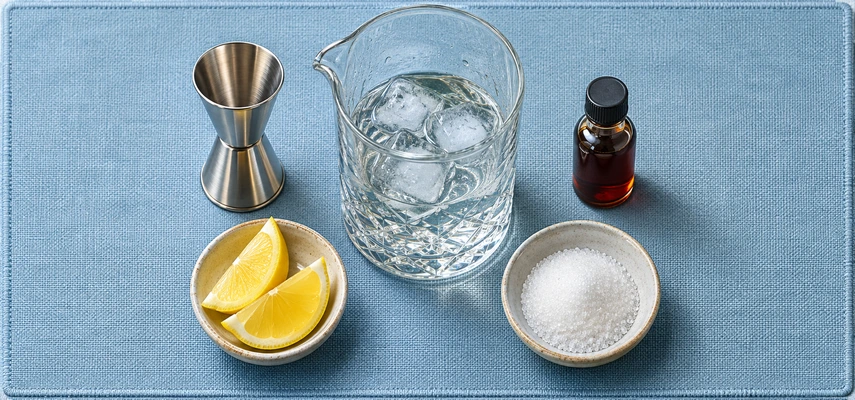

A cocktail can contain every correct ingredient and still feel wrong. Perhaps the citrus dominates, the alcohol feels disconnected or the drink becomes thin before it reaches the table. The answer is often a relationship between components rather than one missing exotic bottle.
Cocktail balance can be approached through two sets of scales: strong versus weak, and bitter and/or sour versus sweet. They are a practical study model, not a claim that every classic drink must taste equally sweet, sour and bitter.
The model becomes especially useful when one ingredient performs more than one role. A liqueur can add alcohol, sweetness and aroma. A mixer can dilute, sweeten and provide acidity. Reading those contributions explains more than simply dividing a recipe into spirit and everything else.
Cocktail balance begins with strong versus weak
The strong side concerns alcoholic contribution. A base spirit often supplies much of it, but other alcoholic ingredients contribute too. Vermouth, liqueur and bitter aperitif should not be treated as alcohol-free simply because their strength is lower than the base spirit’s.
The weak side includes water and lower- or non-alcoholic lengthening components. Water from melting ice is particularly important in a short drink. Juice, soda or another mixer can add further volume and reduce the alcoholic concentration of a long drink.
WSET’s educator explanation introduces those roles as a way to understand familiar cocktails. The useful principle is that dilution belongs to the formulation. It is not automatically evidence that the bartender made a mistake.
Strong in this model does not simply mean strongly flavoured. A non-alcoholic bitter ingredient can have enormous flavour intensity, while a restrained high-strength spirit can contribute substantial alcohol. Distinguish alcoholic strength from aromatic force.
Dilution changes concentration, not the starting alcohol quantity
Imagine 60 ml of a 40% ABV spirit. Before other ingredients, it contains approximately 24 ml of pure alcohol. Add 30 ml of water and the approximate total becomes 90 ml, giving about 26.7% ABV. The calculation ignores volume contraction and is a teaching illustration rather than a laboratory measurement.
The amount of alcohol has not vanished. It is distributed through a larger volume. That distinction prevents the misleading statement that dilution removes alcohol in the way a filter might remove a substance.
A real cocktail may contain additional alcoholic ingredients, sugar and other dissolved material, so its precise final strength requires more information. Ice melt also varies with preparation and conditions. Still, the simple arithmetic shows why ignoring water gives an incomplete account of the finished drink.
Dilution changes flavour concentration as well. More water can reduce intensity, but can also alter how aromas and alcoholic heat are perceived. The desired amount depends on the drink’s structure rather than one universal rule that less water is always better.
Ice is both a cooling medium and a water source
Ice cools the drink while melting contributes water. Stirring or shaking changes contact between liquid and ice, with the outcome influenced by temperature, quantity, shape and time. The same written ingredient list can therefore produce different serving conditions through different handling.
An ice-filled serving glass can continue changing the drink after preparation. A cocktail served without ice in the final glass follows a different trajectory. Neither presentation eliminates the need to consider the water already introduced during mixing.
The WSET preparation guide emphasises ice and measurement as practical tools. For study, the important connection is repeatability: controlling preparation makes it easier to judge whether an ingredient change or a dilution change caused the difference.
Do not make ice size do all the explanatory work. Large cubes can behave differently from small pieces, but starting temperature and handling also matter. A rule that one cube shape always produces an exact dilution percentage would promise more certainty than the conditions support.
The second scale: bitter and/or sour versus sweet
Sourness is associated with acidity, often supplied by lemon or lime juice. Bitterness is a different taste, supplied by ingredients such as bitter aperitifs or cocktail bitters. They belong on one side of this teaching model without being chemically or sensorially identical.
Sweetness can come from sugar, syrup, honey, liqueurs, sweet aromatised wines or sweetened mixers. It changes the perception of the sour or bitter contribution and can affect body. The model asks how those contributions fit together, not whether sugar chemically destroys acid or bitterness.
Not every cocktail needs a separate sour ingredient and a separate bitter ingredient. A sour can centre on citrus, while a spirit-forward drink may rely on a bitter-sweet relationship. The words and/or matter because they leave room for different structures.
Nor does balance require equal volumes. A highly concentrated bitter, a modestly sweet syrup and a sour juice do not have equal effects per millilitre. Proportion needs to follow the ingredients’ actual composition and intended role.
One ingredient can sit on both scales
An orange liqueur can add sweetness and alcoholic strength while contributing citrus aroma. It does not necessarily supply the same sourness as lime juice. That is why swapping equal volumes of those ingredients would not preserve the original structure.
Sweet vermouth contributes alcohol, sweetness, wine character and botanical bitterness. A bitter aperitif can likewise contain sugar as well as a strong bitter profile. Calling either ingredient only sweet or only bitter hides part of its role.
Juice also does several jobs. It can add water, acidity, aroma and some natural sugar. A grapefruit-based mixer can combine sweetness and bitterness as well as dilution. Work from the actual ingredient rather than assigning every bottle to only one box.
This is a useful reason to read a recipe functionally. First list what each ingredient contributes; then consider the combined strength and balance. The exercise can be done on paper without preparing or drinking alcohol.
A Daiquiri makes the relationships visible
The IBA Daiquiri uses rum, lime and sugar, with ice in preparation. Rum supplies the main alcoholic foundation and its own character. Lime supplies the principal sour component, sugar the sweet counterpart, and ice melt the dilution.
Now imagine using a more aromatic rum at the same strength. The drink’s flavour can change even if the two scales remain approximately similar. Balance is therefore a foundation, not a complete description of aroma or quality.
Next imagine using a sweeter syrup at the same volume. The sweet side changes because equal volumes do not guarantee equal sugar concentration. Increasing citrus to compensate also changes juice volume and aroma, so adjustments can affect more than one dimension.
Finally imagine the same recipe mixed with very different dilution. The alcohol concentration and flavour intensity change even though the measured rum, lime and sugar began identically. This is why the preparation belongs in the explanation.
Diagnose the actual imbalance
If a drink seems excessively sour, first ask whether the sweet-sour relationship is the issue. A measured adjustment to the sweetening component addresses a different problem from simply adding more spirit. The latter also increases alcohol contribution and can leave the sourness unresolved.
If the drink seems excessively sweet, ask about the intended sour or bitter counterpart and the concentration of the sweet ingredient. Adding an arbitrary dash of everything creates several simultaneous changes and makes the cause harder to identify.
If the alcohol feels too concentrated, consider dilution and overall formulation rather than assuming sugar is the only remedy. Sweetness may change perception while leaving the actual alcoholic concentration largely unchanged.
If the drink feels thin, examine over-dilution, low flavour concentration or a changed ingredient before concluding that it simply needs a higher-proof base. Diagnose the dimension that changed, then select an adjustment with a clear purpose.
Change one variable when comparing
Side-by-side comparisons are easiest to interpret when most conditions stay consistent. Keep ingredient brands, measures, preparation and serving temperature similar while changing one chosen factor. Otherwise a different lime batch, syrup strength and ice treatment can all compete to explain the result.
Record the intended change before evaluating it. More citrus, for example, should mean a specific measured difference rather than an undefined splash. Clear records make a later comparison more informative than relying on memory of which glass felt better.
Personal preference still matters. A deliberately bitter drink need not become a sweet sour to be balanced within its intended style. The useful question is whether the components form a coherent result for that structure, not whether every cocktail converges on one middle point.
Balance is broader than equal parts
Equal-parts recipes can be memorable, but their success depends on the ingredients chosen. A sweeter liqueur, a stronger base or a different bitter aperitif can change the result even when the measuring pattern stays the same.
Conversely, an unequal recipe can be carefully balanced. The numerical ratio is a tool for reproducing a result, not a mathematical guarantee of harmony. Understand what the ingredients contribute before using the ratio as an explanation.
For an exam answer, identify the two scales and then name the components performing each role. Add the mechanism: ice introduces water, citrus supplies acidity, sweetener provides a counterpart, and alcoholic ingredients contribute strength. That is much more informative than saying everything balances everything else.
What to remember
Use strong versus weak and bitter and/or sour versus sweet as two related scales. Dilution from ice is part of the recipe, and dilution lowers concentration without removing the original alcohol quantity. Bitterness and sourness are different sensations.
Ingredients can perform several roles at once. Compare actual strength, sweetness, acidity, bitterness and flavour contribution rather than assuming equal measures or one familiar ratio guarantee balance. A clear diagnosis leads to a more useful explanation than adding ingredients at random.
Continue your study
To identify the multiple roles of a liqueur, read Liqueurs Explained: Spirit Bases, Flavorings, Sweetness, and Cream Liqueurs. To consider wine-based cocktail ingredients, read Aromatised Wines Explained: Vermouth, Quinquina, Chinato, and Americano. To apply balance to the four required families, read The Four Cocktail Families Explained: Spirit-Forward, Short Sour, Highball, and Long Sour.
Knowledge check: 10 original practice questions
Independent TFE questions, not official WSET examination items. Choose one answer per question; explanations follow separately.
1. Which two scales organise this lesson?
- Dark versus clear; old versus young
- Pot versus column; wood versus steel
- Natural versus artificial; hot versus expensive
- Strong versus weak; bitter and/or sour versus sweet
2. Why is adding more spirit not a precise remedy for excessive sourness?
- It changes alcohol contribution without directly correcting the sweet-sour relationship
- Citrus becomes sugar
- Spirit always removes acid
- Spirit contains no alcohol
3. Do equal-parts recipes guarantee balance with any ingredients?
- No, component strength and composition still matter
- Yes, arithmetic overrides ingredients
- Only if the glasses match
- Only if there is no ice
4. Which ingredient supplies the principal sour element in a classic Daiquiri?
- Ice alone
- Lime juice
- Rum alone
- Sugar alone
5. What improves a controlled comparison?
- Judge only the darkest glass
- Use no records
- Change every ingredient and the ice simultaneously
- Change one measured variable while keeping other conditions similar
6. Which role does melting ice perform?
- Only decoration
- Only botanical extraction
- Cooling and dilution
- Only sugar addition
7. What can an orange liqueur contribute?
- Only dilution with no alcohol
- Alcohol, sweetness and citrus aroma
- Only bitterness without any sugar
- Only acidity identical to lime
8. What happens when water is added to a fixed quantity of spirit?
- New ethanol is fermented
- All alcohol disappears
- Alcohol concentration falls while the original alcohol quantity remains
- ABV necessarily rises
9. Why can equal volumes of two syrups behave differently?
- Their sugar concentrations may differ
- All syrups have no water
- Volume determines identical sweetness universally
- Their bottle colours determine acidity
10. Which statement distinguishes bitter from sour?
- Sourness proves quinine
- They are chemically identical
- They are different tastes despite sharing one side of the model
- Every bitter liquid has the same acidity
Answers and explanations
1. D — Strong versus weak; bitter and/or sour versus sweet. The model concerns alcoholic concentration and bitter/sour-sweet relationships rather than colour or age. Mapping: LO4.
2. A — It changes alcohol contribution without directly correcting the sweet-sour relationship. A targeted adjustment should address the dimension identified rather than change several roles blindly. Mapping: LO4.
3. A — No, component strength and composition still matter. A ratio reproduces proportions but does not guarantee identical sensory effects from different products. Mapping: LO4.
4. B — Lime juice. Lime provides the main sour component while rum, sugar and ice contribute other functions. Mapping: LO4.
5. D — Change one measured variable while keeping other conditions similar. Controlled conditions make the cause of a difference easier to interpret. Mapping: LO4.
6. C — Cooling and dilution. Ice can change temperature and water content, so preparation affects the finished drink. Mapping: LO4.
7. B — Alcohol, sweetness and citrus aroma. A liqueur can perform several roles, and peel aroma is not equivalent to juice acidity. Mapping: LO4.
8. C — Alcohol concentration falls while the original alcohol quantity remains. Dilution spreads the same alcohol through a larger volume, ignoring losses or other processes. Mapping: LO4.
9. A — Their sugar concentrations may differ. Composition, not volume alone, determines the sweetening contribution. Mapping: LO4.
10. C — They are different tastes despite sharing one side of the model. The model groups their balancing role without making the sensations or ingredients interchangeable. Mapping: LO4.












