











Many beginner skiing mistakes are perfectly understandable attempts to solve the wrong problem. Sliding feels uncertain, so you lean away from it. The skis won’t turn, so you twist harder with the shoulders. Your feet feel cold, so you add another thick pair of socks.
The intention makes sense. The result may make the original task harder.
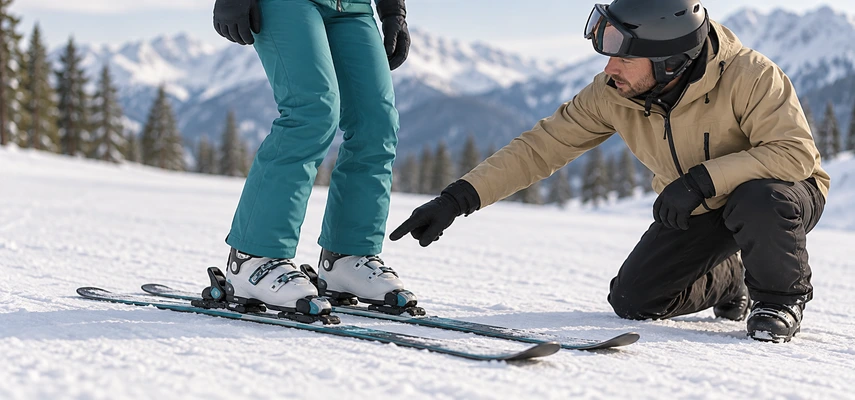
Useful correction begins by noticing the pattern, understanding what the movement is trying to achieve, and choosing one manageable change. Work with an instructor on appropriate terrain, and have equipment concerns assessed by qualified staff. This isn’t a checklist to carry into a harder run and attempt all at once.
Leaning backward to feel safer
When the slope seems to pull you forward, moving backward can feel protective. But letting the feet run ahead of the body can make the skis harder to guide and leave the legs bracing rather than moving usefully.
Don’t fix that by throwing the shoulders forward. Ask the instructor to assess the relationship between your feet, lower joints, hips, and support. The correction should restore a coordinated stance, not replace one strained pose with another.
On level snow or a very gentle task selected by the instructor, explore comfortable movement and support through the feet. Keep the adjustment small enough to notice. The REI beginner stance guide provides a useful starting framework, but feedback helps identify what you’re actually doing.
Bending the knees while the rest of the body freezes
“Bend your knees” is memorable because it is short. Unfortunately, it can send the hips backward into a deep squat while the ankles remain unhelpfully rigid. You may feel busy and exhausted without becoming more mobile.
Think coordinated flexion through ankles, knees, and hips rather than maximum knee bend. The objective is available movement and useful support. A lower silhouette isn’t automatically a better stance.
Have the instructor watch a small taller-and-lower movement in a safe stationary setting. If the boots make a comfortable range difficult, ask for a fitting assessment. Ron LeMaster’s alignment discussion explains why body organization matters more than one isolated joint position.
Trying to turn with the shoulders
Everyday movement often begins by turning toward the destination. On skis, a large shoulder swing can rotate the upper body without producing the useful leg steering and edge changes the task requires.
The fix is not to make the torso immovable. It is to give the feet and legs room to guide the skis while the upper body stays appropriately quiet and supported.
Ask the instructor for a short task that makes lower-body steering recognizable. Watch the demonstration, then describe what you feel at the skis rather than only whether the shoulders faced the intended way. A smaller movement on easier terrain can clarify more than a forceful attempt on a slope that already feels overwhelming.
Making an enormous wedge instead of managing the path
The wedge is a useful beginner tool, but increasing its size indefinitely isn’t a universal speed-control system. A very wide stance can become tiring and make steering or matching the skis harder.
If speed keeps building, look at terrain, balance, edge engagement, and turn shape with an instructor. Don’t assume the only missing ingredient is pushing the tails farther apart.
SkierLab’s braking-plow progression places the task on short gentle terrain and notes its limitations as demands increase. Return to a setting where you can stop reliably, then develop the specific missing skill. A larger problem doesn’t become a better lesson because the wedge looks more determined.
Flicking the skis left and right while continuing downhill
Quick direction changes can feel like plenty of turning, yet leave the overall route pointed mostly down the fall line. Speed may accumulate because the path never develops enough useful shape.
Work on manageable rounded turns and controlled snow interaction in the corridor available. Let the instructor choose the task and assess where the turn needs to develop. Don’t respond by suddenly traversing the entire run across other users.
The PSIA-AASI Eastern framework connects turn shape, steering, and speed across its tasks. Notice whether the pace stays manageable from one turn to the next, not merely whether a final emergency-looking stop happens to succeed.
Treating skidding as something to eliminate immediately
Clean carved tracks look satisfying, but controlled skidding is a useful technique. It lets the skis brush sideways through snow and can help manage speed. Parallel turns can skid; parallel and carved aren’t interchangeable words.
If the goal is a slower, more manageable descent, forcing an efficient carve may preserve more speed than you want. Choose the ski performance appropriate to the task and develop carving through its own progression later.
Ask the instructor to explain the intended track and purpose. A basic brushed turn isn’t a failed advanced turn. It may be exactly the useful skill you’re learning. The same is true of a wedge used appropriately: technique serves an outcome, not a hierarchy of fashionable shapes.
Staring at the tips and missing the route
It’s natural to watch the unfamiliar objects attached to your feet. But a gaze fixed on the tips leaves less awareness for people ahead, a trail junction, or a change in width and surface.
Look into the space you’re about to use and maintain awareness around it. Don’t replace tip-staring with a rigid stare at one distant point. The information you need changes as you move.
If you need to read a map or use a phone, stop in a suitable visible place clear of traffic. Plan the next manageable section before starting again. Early information gives you more options than a sudden discovery midway through a turn.
Choosing terrain by pride, company, or run count
Completing several green runs doesn’t automatically qualify you for a blue. A friend calling a route easy describes their experience, not a complete assessment of your stopping and turning skills.
Ratings are relative to the resort, and conditions can alter a familiar route. Ask an instructor about the specific next progression, including the whole descent and suitable current snow. Aspen Snowmass’s level descriptions illustrate how developed skills, rather than a run count, inform teaching choices.
If you need more room or a gentler pitch to make movements reliable, use it. Easier terrain is a productive place to learn, not a punishment for failing to display sufficient ambition.
Solving equipment discomfort with extra force or extra layers
Boot pain, numbness, excessive movement, or unusual pressure can change how you stand and steer. Don’t assume every awkward movement is a technique failure when the equipment may need attention.
Tell the rental technician or fitter exactly where the problem occurs. Avoid adding thick sock layers blindly, stuffing fabric into the cuff, or changing safety-critical binding settings yourself. More material can alter fit without solving the cause.
The Canadian Ski Council’s rental guidance emphasizes accurate information and a conversation with staff. Bindings require appropriate professional setup and testing; clicking a borrowed boot into an old ski isn’t proof that the combination is ready for use.
Practicing past the point of useful attention
Fatigue can turn a previously manageable task into stiff, late reactions. Cold, discomfort, and frustration can contribute too. Repeating the same deteriorating attempt isn’t necessarily productive practice.
Take a break, change to a simpler task, address the equipment problem, or finish. Big Sky’s safety guidance explicitly includes awareness and fatigue alongside speed and space. The lift still running doesn’t create an obligation to take another run.
When you return, choose one clear objective. Ask the instructor what to repeat and what successful performance should look like. A short session of understandable movements can be more useful than a long session measured only by how tired you become.
Check whether the correction is actually helping
A useful change should produce an observable result: easier steering, more reliable stopping, a steadier pace, or better awareness. Feeling that you’re trying harder isn’t sufficient evidence.
Change one thing at a time in a manageable setting. If several cues arrive together, ask which one to prioritize. You don’t need an internal committee debating ankles, shoulders, and courage during every turn.
Keep shared-space responsibilities in place while practicing. The NSAA responsibility code requires control, avoidance of people ahead, visible unobstructive stops, and uphill checks before starting. A learning task must fit those duties.
If a correction makes the movement painful, confusing, or less controlled, tell the instructor. A cue is a tool for a particular learner and task, not a command to obey harder regardless of the result.
Leave the lesson with one better question
Instead of concluding that you’re simply bad at turns, notice something specific: one ski catches at the same point, the speed builds after the second turn, or the right boot changes how you stand. That gives an instructor something useful to observe.
The next improvement may be a small movement, an easier setting, or a fitting adjustment. It needn’t be a dramatic technical revelation. The pleasure comes when the skis begin responding more predictably and you understand why.
Beginner mistakes are most useful as information. Notice the pattern, find an appropriate correction, and practice it where control remains available. That’s how an understandable attempt at self-protection becomes a more effective way to ski.












