










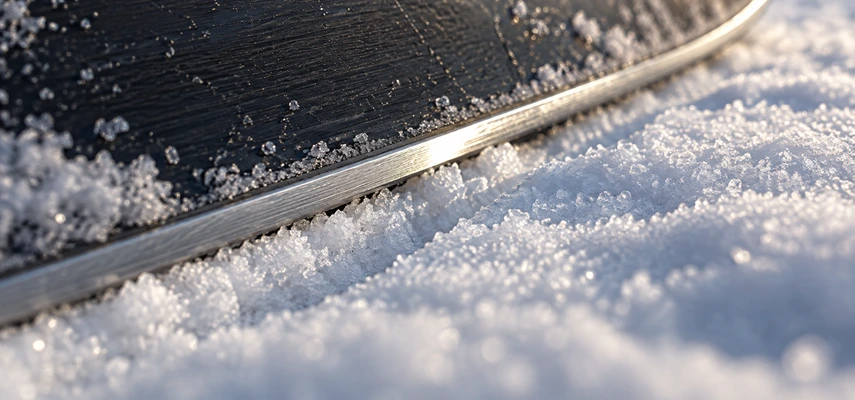

A ski edge can help a slippery object hold a line. It can also make that same object reluctant to move where you want if you keep it engaged at the wrong moment. Grip is useful; permanent grip would be a rather awkward way to change direction.
Good edging includes both engagement and release. You tip the skis relative to the snow, organize support, and adjust that relationship so the skis can follow an appropriate path. Sometimes the result is a clean arc. Sometimes it is a controlled brush or sideslip.
Learn those adjustments with an instructor on terrain within your stopping and turning ability. Edging isn’t a trick that makes harder slopes suitable before the rest of your skiing is ready.
Find the edge before assigning it magical powers
An alpine ski has metal edges along the sides of its base. When the ski tips, an edge can engage the snow more strongly than when the base lies relatively flat. The effect depends on the surface, load and movement, not just the presence of metal.
Think of changing the angle of a scraper against a soft surface. Its behavior changes with angle and force. A ski is a flexible moving platform rather than a hand tool, but the comparison helps separate edge angle from simply pushing harder.
The base still matters, and both skis remain part of the system. Boots and bindings transmit movement while the body stays organized over its support. An edge isn’t an independent brake lever you operate without affecting balance or direction.
PSIA-AASI Eastern’s skiing tasks blend edge changes with steering and pressure. That coordination is more useful than treating every problem as a shortage of grip.
Understand edge angle as a relationship to the snow
Edge angle describes how much the ski’s base is tipped relative to the snow surface. It isn’t the same thing as how far the skier appears to lean relative to the camera or horizon.
A slope can tilt beneath you, and the body’s joints can arrange themselves in different ways. Two photographs with similar torso angles may therefore show different ski-snow relationships.
Inclination refers broadly to leaning the body into a turn. Angulation involves bends between body segments that help manage ski angle and support. Those are useful descriptions, not instructions to maximize either movement at every speed.
Ron LeMaster’s alignment explanation connects body organization to the forces of skiing. The practical point is that a useful edge angle needs a body position that can support and adjust it.
Begin by noticing small tipping movements
In a stationary setting chosen by the instructor, explore a modest change through the feet and lower legs. Notice how the skis respond without forcing the knees into a collapsed position or throwing the shoulders sideways.
The boot limits and transmits ankle movement, so the sensation differs from standing in shoes. Don’t expect a large visible ankle bend to be necessary for every small ski response.
Keep a comfortable stance width and enough joint mobility to return toward a neutral arrangement. A deep rigid crouch or skis pressed together can make that exploration harder to interpret.
An instructor can identify whether your movement changes the ski angle or simply moves the upper body. If something hurts or equipment prevents a comfortable range, stop and seek an assessment rather than treating pain as proof of effective practice.
Learn why releasing an edge helps steering
An engaged edge resists some sideways movement. If you want to guide the ski in a new direction, reducing that engagement appropriately can create the freedom needed for steering.
This is why pulling harder with the shoulders may fail when the old edges remain locked into the snow. The effort increases, but the relevant relationship hasn’t changed enough.
Release doesn’t mean abandoning control. It means regulating the old engagement as part of the transition toward a new path. The amount and timing should fit the task, the slope and the skier.
PSIA-AASI Central’s basic-garland description uses controlled changes between slipping and more engaged travel to develop awareness. Such activities need appropriate terrain and instruction; they’re not invitations to start sliding sideways wherever you happen to be.
Feel the difference between gliding and holding
An instructor may choose a short sideslip-related task so you can notice how reducing the edge angle permits movement and re-engaging it changes the slide. The setting needs clear space and a manageable runout.
The point is finesse. A small change that gives a predictable response can teach more than a sudden edge set that produces a catch. Keep the task short enough that you can remain aware of the result.
You may discover that a ski is already tipped more than you thought. Or you may be moving the body without creating enough change at the ski. Observation and feedback help distinguish those cases.
The PSIA-AASI Northwest sideslip resource treats release and edging as controllable movements. It illustrates an underlying skill, not a universal body cue to repeat without regard for your own situation.
Use edges in a brushed turn as well as a carve
Skidding doesn’t mean the edges have stopped working. A brushed turn combines sideways displacement with a managed ski-snow relationship. The angle must permit the intended steering and resistance rather than prevent all lateral motion.
Carving uses a more strongly guided arc with limited sideways displacement, supported by ski shape, bending and snow response. More edge angle isn’t automatically a better version of the brushed turn; it can change the outcome substantially.
Choose the performance you need. If the objective is a slower, adaptable path, forcing the skis into a clean efficient arc may preserve more speed than intended. If the objective is introductory carving, an abrupt pivot can smear the track you’re trying to understand.
SkierLab’s discussion of objectives makes that connection between ski performance and useful results. Edging is valuable because it offers choices, not because it removes every skid.
Avoid the all-or-nothing edge habit
Some developing skiers alternate between very flat skis and a sudden hard grip. The result can feel like acceleration followed by a catch, with little useful adjustment in between.
Work with an instructor on a smoother change in the selected easy setting. The correction may involve balance, steering or timing as well as the edge movement itself. Don’t assume the only answer is more pressure.
Similarly, keeping the skis strongly edged throughout the transition can make the next turn difficult to start. If the skis feel stuck, ask where release should occur rather than twisting more forcefully around them.
Change one relevant ingredient at a time. Repeating a small interpretable task gives the instructor and learner better evidence than changing edge angle, speed, turn size and terrain together, then guessing which part caused the result.
Let the surface influence the demand
Firm snow can require refined engagement and an appropriate equipment condition. Soft, broken snow may not support the same edge response. The surface is part of the turn, not merely a backdrop.
There is no universal rule to tip more aggressively whenever grip is uncertain. An abrupt input on a difficult surface can create a different problem. Reduce the terrain demand and ask for technique or equipment advice as appropriate.
A qualified shop can assess edge and base condition. Don’t run bare fingers along a sharp edge or improvise a major tune to fix an issue you haven’t identified. Maintenance choices have their own tools and procedures.
Remember that changing snow, traffic and visibility affect the appropriate path and speed. An edge skill practiced successfully on one easy surface isn’t a certificate for every hard patch elsewhere on the mountain.
Keep the whole turn in view
Edging is one part of a sequence. The previous turn releases, the skis move toward the new path, support develops, and the engagement changes again as you prepare to move on.
Different tasks blend those elements differently. A wedge, a basic parallel turn and a carved arc don’t require identical movements, even though all involve some relationship between edges and snow.
Ask the instructor which part of your turn needs attention. If the issue appears at the entrance, adding a stronger late edge set may miss the cause. If the ski loses support later, a different adjustment may be needed.
The NSAA responsibility code continues to govern practice: remain in control, avoid people ahead, and choose visible unobstructive stops. A technique task must fit the space available.
Aim for a response you can regulate
Useful progress means being able to create a little more or less engagement when the task calls for it. It is less about producing the largest angle and more about obtaining a predictable result.
Practice the specific movement your instructor recommends, in the environment they select, and describe how the skis respond. If the task becomes unpredictable, return to a simpler step rather than adding speed or force.
The satisfying discovery is that grip isn’t merely on or off. You can manage how the skis meet the snow, let them move when movement is useful, and engage them when the path requires it. That adjustable relationship is what turns a sharp strip of metal into a skiing skill.












