










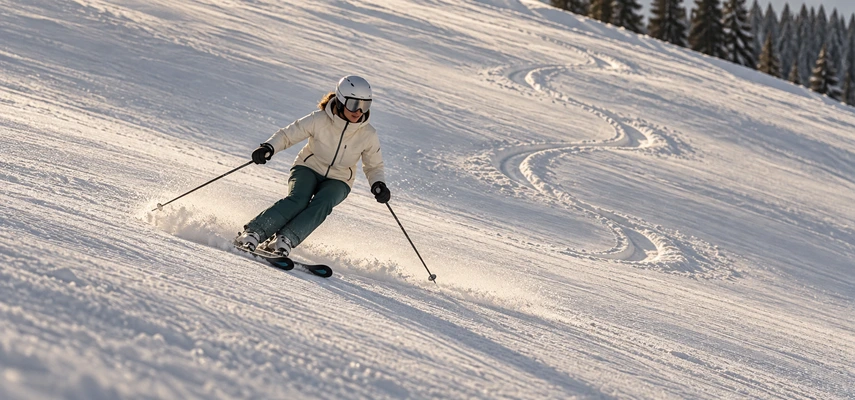

A short turn is a small curve, not a large turn performed in a panic. That distinction becomes particularly useful when the slope gets steeper and there isn’t much room for a leisurely route across the hill.
Watch an accomplished skier make a compact sequence and the movements may seem quick but unhurried. Each turn produces enough direction change and control to make the next one available. The skier isn’t simply flicking the skis from side to side and hoping friction will handle the rest.
Learning that coordination starts on easier terrain. This is an advanced progression for skiers who already have reliable parallel turns and stopping skills, best developed with a qualified instructor. It isn’t a first response to finding yourself on a slope you cannot manage.
Give “short” a useful meaning
A short turn occupies a smaller path than a medium or long turn. Its timing is often quicker, but speed of movement alone doesn’t define it. If the skis swivel rapidly while the skier travels almost straight downhill, the feet are busy without necessarily producing the intended route.
The PSIA-AASI Central short-radius assessment describes linked, rounded turns with controlled pace and substantial steering. That professional assessment isn’t a public-run prescription, but it clarifies an important point: short turns can leave brushed tracks rather than clean carved grooves.
The practical objective is a compact arc that suits the available space and preserves control. Its exact size changes with the skier, snow, pitch, and task. There is no universal width in meters that every reader should try to impose on the hill.
Think of handwriting. Making letters smaller doesn’t mean making random faster strokes. You still need the shape, just organized within less space. On snow, the shape must also work with forces, balance, and the terrain beneath you.
Establish the pattern where you have choices
Begin on an open, appropriately gentle groomed slope selected with an instructor. You need enough room and predictability to work on the movements without also negotiating the maximum challenge you can currently tolerate.
An instructor can help you gradually reduce the size of controlled parallel turns. If the smaller version becomes abrupt or accelerates, the task may need simplifying. Holding the same difficulty and demanding faster feet isn’t a reliable repair.
Use a short sequence rather than an entire run as a test. Notice whether the turns remain rounded, whether pace stays manageable, and whether you can stop deliberately. These observations matter more than achieving a particular number of turns.
Only after the skill is reliable in that environment should you consider transferring it to a modestly steeper section. Keep the snow and visibility suitable, and let the instructor select the progression. Compact turns learned on easy snow aren’t automatically ready for every firm, narrow, advanced route.
Guide the skis through the arc
Leg steering helps direct the skis along a compact curved path. That means managing how they turn relative to the body and snow, rather than using a large shoulder swing to drag everything into the next direction.
The PSIA-AASI Eastern assessment descriptions distinguish leg-guided short turns from other tasks and connect movement to consistent shape and pace. For a recreational learner, the useful takeaway is the relationship between a movement and the resulting path.
Ask your instructor whether you are actually shaping the arc or pivoting and then braking. Both a turn’s entrance and its completion affect what follows. If you rush through one portion and depend on a hard finish, the sequence may become increasingly reactive.
Don’t try to force the same steering amount everywhere. Snow resistance and available grip change. A useful short turn blends steering with edging and pressure management to obtain the response the situation needs.
Release the old turn in time
On a steeper pitch, holding the old edges may feel reassuring. Yet a ski that remains committed to the previous turn can’t freely enter the next one. Waiting too long can leave you trying to manufacture a hurried direction change.
Practice the release your instructor recommends on suitable terrain. It may involve coordinated changes through the feet, legs, and body rather than one dramatic action. What matters is whether the skis can move into the new arc while you retain support and control.
Avoid interpreting release as abandoning control or flinging yourself downhill. It is a managed change in the ski-snow relationship. You should be able to explain what the cue is intended to make the skis do.
If you cannot release without an abrupt upper-body movement, tell the instructor. They may adjust the terrain, turn size, or progression. A larger effort at the same blocked movement usually produces a larger blocked movement.
Keep the body available for the next turn
Compact turns require movements that leave you ready to change direction again. Sitting well behind the skis, bracing rigidly, or collapsing into a deep crouch can restrict the options you need.
Use enough flexion to remain adaptable, rather than trying to achieve a prescribed knee angle. The appropriate relationship between feet and body changes through the turn. “Get forward” becomes more useful when an instructor explains when, how, and toward what result.
REI’s professional-instructor guidance on steeps discusses active movement and balance as part of managing steeper terrain. It doesn’t make an aggressive lean or a fixed pose a universal solution.
A relatively organized upper body can help the legs do their work, but organized doesn’t mean frozen. If you hold the shoulders rigid while everything below them struggles, you may simply hide tension behind a respectable-looking jacket.
Use poles as part of coordination
A well-timed pole touch can help organize a short-turn sequence. It provides a reference associated with the change toward the next turn, rather than acting as a brake that stops the skier’s movement.
The movement is generally more modest than an emphatic stab. Large arm swings or a pole planted where it catches can disrupt balance. An instructor can help match the touch, hand position, and timing to your turn and terrain.
Don’t build the entire skill around counting pole plants. If the skis aren’t producing controlled arcs, adding a louder rhythm doesn’t fix the path. First establish the ski response, then use the pole movement in support of it.
If pole use itself feels confusing, separate the learning task on easier terrain with guidance. You shouldn’t need to solve pole timing, edge release, balance, and a new steep pitch all in the same few seconds.
Preserve shape instead of chasing cadence
Short-turn practice can become a competition with an imaginary metronome. The turns get quicker, the direction changes get smaller, and speed begins to build. That isn’t necessarily the rhythm you intended to learn.
Notice whether each turn still creates a useful curved path. Depending on conditions, you may need more completion, a different corridor, or a slower overall task. The correct adjustment is a response to the situation, not a rule to make every turn identical.
On suitable easier terrain, an instructor might compare a short sequence at different manageable turn sizes. That can reveal whether reducing the path makes you rush the entrance or lose control at the finish.
The goal is adaptability. If the slope changes or someone moves into your intended space, you need to change the pattern. A short-turn sequence is a tool for navigating, not an obligation to keep ticking regardless of what happens ahead.
Read common problems as clues
If the tails repeatedly wash out in a hard late push, ask whether earlier shaping or better support is missing. Don’t assume the remedy is pressing harder at the exact moment the skis already feel overloaded.
If turns are easy in one direction and awkward in the other, an observer can help identify differences in timing, support, or terrain. Forcing the difficult side more aggressively may disguise the cause rather than address it.
If the skis become light or leave the snow unexpectedly, simplify the task and seek feedback. This article isn’t teaching hop turns. Deliberately airborne advanced maneuvers have their own prerequisites and appropriate settings.
If the sequence deteriorates with fatigue, stop practicing it. More repetitions are useful only while the task remains manageable and your attention includes the people around you. A break can preserve the quality of what you’re learning.
Keep the corridor inside your responsibilities
Choose practice space that fits the trail and current traffic. A corridor suggested in a professional assessment doesn’t grant you that width on a public run, and another skier isn’t required to preserve your pattern.
Under the NSAA responsibility code, you must remain in control, avoid people ahead, and stop where you are visible without obstructing traffic. Look uphill before restarting and obey all closures and warnings.
If the terrain leaves you unable to maintain those responsibilities, change the task or route. Short turns aren’t a way to make an unsuitable slope suitable by sheer determination.
Build the compact shape on easier snow, understand the movement that produces it, and transfer it gradually with an instructor. The reward is a small turn with a complete purpose: enough direction, enough control, and enough freedom to choose the next one.












