










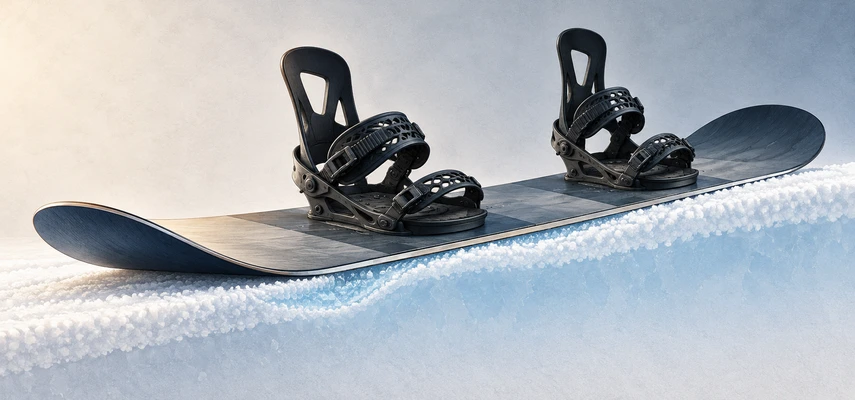

A snowboard has no steering wheel, no brake pedal and no helpful little lever marked turn left. Yet a rider can guide it through a remarkably precise curve. The controls are there; they happen to be your body and the way the board meets the snow.
The apparent contradiction is what makes snowboarding interesting. You need the board to slide, but you also need enough resistance to change its direction. You need balance, but not the frozen stillness of someone posing for a photograph. And you need to use the edges without assuming that more edge always means more control.
The mechanics become clearer when you separate three questions: where is your body relative to the board, how is the board positioned, and what is the snow doing in response? They interact continuously. Understanding them won’t replace a lesson, but it can make an instructor’s feedback much less mysterious.
Balance means keeping options available
When you stand on level ground, you can often regain balance by taking a step. With both boots attached to a snowboard, that option disappears. Instead, your body must adjust around a moving platform, and your platform must be guided underneath your body.
The center of mass is a useful shorthand for how your body’s mass is distributed. You don’t need to locate an exact anatomical dot. The important relationship is between your body and the support coming through your boots, bindings and board. Reach far beyond that support without an appropriate movement and recovery becomes difficult.
But riding isn’t simply keeping your torso directly above the board in every photograph. During a turn, you can incline inward while the snow supplies forces that help redirect your motion. What works depends on speed, turn shape, equipment and conditions. A still image doesn’t show all those relationships.
Think of balance as maintaining room to respond. Bent, mobile joints can absorb terrain changes and allow pressure adjustments. Locked legs leave less room for either. A low position isn’t automatically better, though: an exhausted crouch can be just as unhelpful as standing rigidly upright.
The AASI technical performance guide treats pressure along and across the board as distinct but related fundamentals. That distinction explains why moving toward the nose is different from moving toward the toe edge. Both change balance, but they ask different things of the board.
Gravity provides motion; snow provides a conversation
On a slope, part of gravity’s pull acts downhill. If nothing else intervened, you’d keep accelerating down the fall line—the direction of greatest downhill steepness at that point. Snow resistance, air resistance and the route you take all influence the actual motion.
Turning changes the route. Rather than spending the entire run pointed downhill, you guide the board across the slope and into another curve. The snow pushes back against the board and helps change your direction. Your body doesn’t turn the mountain; it organizes the contact that lets the mountain redirect you.
The base and edges do different jobs within that contact. The broad base provides a sliding surface. The metal edges allow more concentrated engagement with the snow when the board is tilted. Neither works independently of the other parts of the system, including the rider supplying movements through the bindings.
Snow itself is an active part of the problem. Firm packed snow, loose powder and wet spring snow respond differently to loading. A movement that produces useful grip in one condition can produce a different result in another. This is why changing conditions can make a familiar board feel unexpectedly unfamiliar.
Tilt changes which part of the board engages
Tilt is the angle of the board across its width relative to the snow surface. A relatively flat board places more of its base toward the snow. A more tilted board emphasizes one edge. The toe-side edge lies beneath the toes; the heel-side edge beneath the heels.
That sounds like two settings, but the adjustment is continuous. Riders use a range of edge angles, not merely an on/off switch. The useful angle changes with the maneuver and conditions. A controlled sideslip and a clean carve can require quite different relationships to the snow.
An edge concentrates contact into a narrower region, but grip isn’t guaranteed by making that region narrow. Snow can break away. The edge can be dull or damaged. The board can be loaded poorly for the intended movement. More tilt isn’t a universal remedy when a rider feels insecure.
The PSIA-AASI Eastern adaptive snowboard workbook also separates board performance into tilt, pivot, twist and pressure. They’re useful categories because they describe what the board is doing without pretending that a single body movement explains every outcome.
Pivot changes where the board points
Pivot is rotation of the board around an axis roughly perpendicular to its base. In ordinary language, its nose changes direction across the snow. A snowboard can point somewhat across its actual direction of travel, which is part of how a skidded turn works.
Picture sliding a book diagonally across a table while its long side points elsewhere. Direction of travel and direction of the object aren’t necessarily identical. On snow, that difference matters because the board’s edges can interact with the surface abruptly if they engage inappropriately.
Pivot doesn’t mean flinging the upper body around and waiting for the board to follow. The legs and body can contribute rotation in coordinated ways, while the amount of edge engagement affects how freely the board can change orientation. Instruction helps match the movement to the task.
A novice often notices the dramatic part—the shoulders moving—and misses the smaller actions below. An experienced rider may produce a visible change of direction with much less theatrical movement. Efficiency tends to look uneventful from the lodge window.
A snowboard can twist as well as bend
Longitudinal bending changes the board’s shape along its length. Torsional twist changes how the front and rear portions are tilted relative to one another. These are different kinds of deformation, and both influence how the board contacts snow.
Because each boot connects at a different place, coordinated leg movements can produce different effects at the two ends. This helps explain why a snowboard isn’t simply a rigid plank that must always change edges everywhere at precisely the same moment.
Twist is not a command to wrench your knees. The board’s response comes through a coordinated, comfortable range of movement. Equipment stiffness and rider size influence how readily it deforms. A stiff board may resist a movement that feels relatively easy on a more compliant one.
Pressure is also broader than where you feel your weight while standing still. Forces change as you turn, move over terrain or adjust your body. Riding over a dip or crest alters the interaction even if you didn’t consciously decide to press harder or softer at that instant.
Why a curved board can make a curved track
Many snowboards are narrower at the waist than near the ends. This curved outline is called sidecut. When a tilted board engages and bends against snow, its geometry helps it follow a curved path. The board’s design provides possibilities that the rider and surface bring into play.
The resulting turn isn’t dictated by one advertised sidecut number. Edge angle, flex, pressure, speed and snow response all matter. A board doesn’t draw the same circle on every slope simply because its specifications list a particular radius.
In a carve, the tail follows closely along the path made by the nose, leaving a relatively clean track. In a skid, the board also slips sideways and brushes snow out of its way. REI’s carving explanation illustrates the difference in the tracks and board use.
Skidding isn’t a failed version of all snowboarding. It’s useful for managing speed and adapting to confined space or changing terrain. A beginner learning controlled skidded turns is building a real skill, not merely waiting for the proper sport to begin.
Stopping and edge catches use the same ingredients differently
To slow down, riders combine suitable turn shape with an appropriate amount of sideways slipping and edge engagement. Snow resistance dissipates energy. A controlled stop develops from these relationships, rather than a separate emergency brake hidden under the rear binding.
An edge catch is a much less welcome form of engagement. If an edge bites abruptly while the board is moving across it, the board can slow suddenly while the rider’s upper body continues. The problem isn’t that edges are bad; the timing and orientation are wrong for the movement.
Changing edges therefore involves managing the transition, not snapping from one extreme position to another. Gentle terrain, controlled speed and qualified feedback give beginners room to learn that relationship. Attempting to solve it by adding speed can make the consequences much less forgiving.
These mechanisms explain why useful coaching often sounds modest: change the task, soften a joint, adjust pressure, choose a rounder path. The instructor is altering a relationship within a system, not handing out a universal pose.
The next time you watch a rider make a smooth turn, look for the conversation beneath the quiet appearance. The board tilts, bends, twists and changes direction; the snow supports, yields and redirects. Your job is to learn how to participate in that exchange, one controlled movement at a time.












