










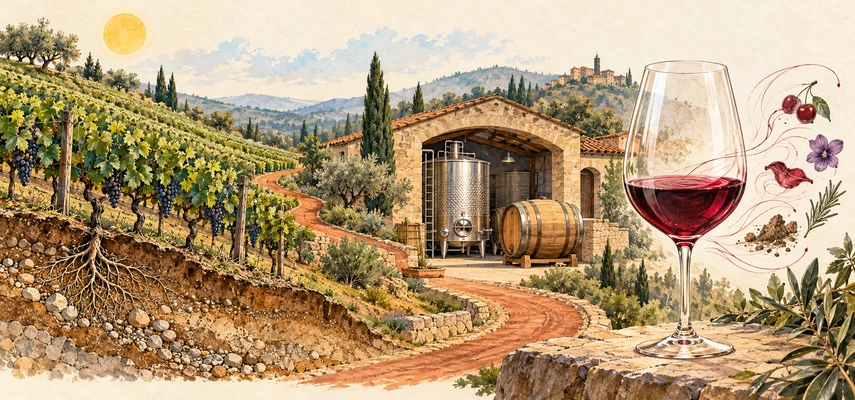

Why can two wines made from the same grape taste different—and cost wildly different amounts? A WSET Level 3 wine student learns to follow the decisions and growing conditions that connect a vineyard to a glass. Knowing the grape is useful. Explaining what happened to it is where the subject gets interesting.
Article #1 · Part I: Wine Science, Viticulture, and Winemaking. Start with Level 2 knowledge of grape varieties, wine styles and basic production. By the end, aim to distinguish style, quality and price, build a causal explanation, and answer a written question within its actual scope.
This is an independent TFE study resource, without WSET affiliation or endorsement. Its baseline is the WSET Level 3 Award in Wines specification, 2022 Issue 2. Confirm the applicable specification with your course provider. All questions and indicative marking points below are original TFE practice material.
What changes at WSET Level 3?
Level 2 gives you a useful map of wine. Level 3 asks you to explain the traffic: why particular grapes suit a location, why a grower picks today rather than next week, and why a winemaker chooses one vessel over another. Facts remain essential. The new habit is connecting them.
A regional name isn’t a complete explanation. “Mendoza has high vineyards” identifies a feature. An answer must then show how the conditions at a particular site influence grapes and wine. Likewise, “Burgundy grows Chardonnay” doesn’t explain why one Chardonnay tastes brisk and another feels broader.
Think of a wine as the result of several interacting choices. Climate affects the available growing conditions; grape variety affects how the vine responds; harvest timing determines what arrives at the winery. Fermentation and maturation then shape that material. No single fact gets to take all the credit.
Style, quality and price answer different questions
Style describes the wine’s characteristics: its sweetness, acidity, tannin, alcohol, body, aromas and flavours. Body means the sense of weight in the mouth; tannin contributes a drying sensation. A dry, light-bodied red with fresh red-fruit flavours has a different style from a full-bodied red with riper dark fruit and noticeable oak.
Quality requires an assessment supported by observations. Consider whether the components work together, how long pleasant flavours persist, their intensity, and the range of distinct characteristics. Balance doesn’t require equal amounts of everything. A wine can have high acidity and remain balanced when its fruit and other components support that acidity.
Price is a commercial result. Grapes, labour, equipment, maturation, packaging, transport and margins all cost money. Demand and available supply also affect what buyers pay. A prestigious name can attract a premium, but a price tag cannot supply sensory evidence of quality.
These distinctions matter in an answer. “Full-bodied” describes style; it doesn’t prove superior quality. “Expensive” describes price; it doesn’t explain whether the wine is balanced. A simple, refreshing wine may suit its purpose very well without the complexity of a wine assessed at a higher quality level.
The framework: Factor → Mechanism → Consequence
A factor is a relevant condition or decision. A mechanism explains what that factor changes. A consequence connects the change to wine style, quality or price. The middle step does the heavy lifting.
Suppose grapes contain more sugar at harvest. If that sugar ferments completely, the yeast can produce more alcohol. That can increase alcoholic strength and contribute to body. The qualification matters: higher grape sugar doesn’t automatically mean a sweeter finished wine. Residual sugar depends on what remains after production.
UC Davis explains alcoholic fermentation as yeast converting grape sugars into ethanol and carbon dioxide. Use that mechanism to build the answer, rather than jumping from “ripe grapes” to “sweet wine.” The same starting material can lead to different outcomes when production decisions change.
| Incomplete statement | Missing bridge | Stronger explanatory answer |
|---|---|---|
| A higher site can be cooler. | What does that change in the fruit? | Where cooler conditions reduce malic-acid loss during ripening, grapes can retain more acidity, contributing freshness to the wine. |
| This Chardonnay underwent malolactic conversion. | Which substance changed? | Bacteria converted malic acid into lactic acid, reducing acidity and potentially giving a softer impression on the palate. |
| Hand selection costs money. | Why does cost per bottle change? | Employing people to select fruit adds labour expense; rejecting fruit can also reduce the volume over which costs are spread. |
The table contains conditional explanations, not universal promises. A cooler vineyard may struggle to ripen its fruit. Extra labour may improve selection without guaranteeing a better wine. Always ask what else must be true for the proposed result to follow.
Natural factors meet human decisions
Natural factors include temperature, sunlight, water availability and soil conditions. Human factors include variety selection, canopy management, harvest timing and winery methods. They interact constantly. A grower cannot order a cooler summer, but can choose a suitable site and adapt how the vines are managed.
Canopy management means arranging and managing the vine’s shoots and leaves. It changes the light, airflow and exposure around the fruit. That makes it a decision with tradeoffs: removing leaves may improve exposure in one setting but expose berries to damaging heat in another. The location and season belong inside the explanation.
Harvest is another negotiation. Sugar usually accumulates during ripening while acidity declines, but flavour development and tannin maturity need attention too. The British Columbia wine industry’s maturity guide stresses that no single maturity measure works for every variety and growing condition. A sugar reading is useful evidence, not a complete harvest decision.
Three regional examples worth understanding
Mendoza: altitude needs a mechanism
In Mendoza, higher vineyard sites can provide cooler conditions and cool nights. Lower temperatures can slow the respiratory loss of malic acid in the berries. With sufficient ripening, the resulting fruit can combine developed flavours with retained acidity. The Catena Institute’s research overview describes this temperature-and-acid relationship in its high-altitude work.
The answer is stronger than “mountain wines are fresh” because it names a process. Still, altitude alone doesn’t determine quality. Aspect, local air movement, water supply and harvest timing can change the result. Don’t assume that every higher vineyard is better, or that every Mendoza wine tastes alike.
Burgundy: separate the winery’s effects
For a white Burgundy, distinguish malolactic conversion from oak use. In malolactic conversion, bacteria transform malic acid into lactic acid, reducing acidity. Oak can contribute a different set of aroma and maturation effects. One process doesn’t require the other; a wine can undergo malolactic conversion in a tank.
The Bourgogne wine board’s production guide shows both vessels and the acid conversion. The Australian Wine Research Institute also explains how bacterial activity can affect aroma. Buttery character can occur, but it isn’t an automatic outcome or proof of oak ageing.
Bordeaux: blending is a decision, not a magic word
Bordeaux supplies a useful setting for thinking about Cabernet Sauvignon and Merlot together. Imagine two separately made parcels: one is firm and tannic; the other feels rounder and fruitier. A trial blend may produce a more balanced whole by changing their relative contributions. That is a hypothetical example, not a claim about every Bordeaux blend.
“They blend for quality” leaves the mechanism blank. A better answer specifies the components and the intended change. Blending can also serve consistency or a chosen house style. It cannot be assumed to repair every weakness, and the final result still needs assessment in the glass.
Explain price without using it as a shortcut
Imagine two wines from similar starting fruit. One is bottled relatively quickly from a large tank. The other receives individual barrel handling and longer storage before sale. The second route can add vessel, space, labour and financing costs. Those costs help explain price; they don’t by themselves establish a higher quality level.
Keep cost and selling price distinct. A producer may face higher costs yet lack the demand needed to recover them. Conversely, scarce wine with strong demand may command more than production costs alone suggest. In an examination, choose the relevant commercial mechanism rather than writing “better wine costs more.”
Read the command verb before writing
Identify calls for the requested name or fact. Describe asks for characteristics or features. Explain requires how or why, connecting a cause with its effect. If asked to compare, make direct similarities and differences on the same dimensions. Match the answer to the actual wording, rather than unloading everything remembered about the region.
WSET’s guidance on Level 3 examination technique emphasises command verbs, scope and causal links. A practical routine is to underline the task, locate its boundaries, note the available marks, then plan relevant points. Give each explanatory chain enough space to be understood.
For example, a question about winery decisions cannot be answered entirely with climate facts. A question about acidity doesn’t need a tour of every local appellation. Marks indicate the expected amount of relevant detail; don’t assume that every sentence, or every word such as “because,” earns a mark.
Study for the task you will actually face
The specified theory assessment combines 50 multiple-choice questions and four written questions, each worth 25 marks, in two hours. The tasting assessment lasts 30 minutes and uses one white and one red still wine. You need 55% separately in each theory component and across the combined tasting assessment.
Train both recognition and explanation. After learning a fact, close the notes and write a short causal chain. Then check it for a missing mechanism or an unsupported leap. During tasting, describe what is observed before drawing a conclusion about quality and drinking readiness. Knowing a famous label isn’t a substitute for evidence.
Knowledge check: 12 original practice questions
Choose one answer per question. These test the introductory reasoning in this lesson; they are not a complete mock paper or official WSET questions.
1. Which statement describes style rather than price or a quality conclusion?
2. Which response best completes an explanation of cool nights helping retain acidity?
3. Grapes contain more fermentable sugar, and fermentation proceeds to dryness. What is the most relevant likely consequence?
4. A question asks you to identify a grape variety. What should the response principally provide?
5. Which statement correctly separates malolactic conversion from oak use?
6. Why can labour-intensive fruit selection increase cost per bottle?
7. Which sentence contains a mechanism rather than merely naming a factor?
8. What is the strongest reason not to use price alone to judge quality?
9. A question asks about winery influences on style. Which answer is most directly relevant?
10. What best explains why a hypothetical Bordeaux blend might improve balance?
11. Which claim about altitude is appropriately qualified?
12. How should an analytical tasting conclusion be supported?
Answers and explanations
1. B — Style. Dryness, body and acidity describe characteristics. Cost and scarcity concern commerce, while reputation cannot establish a quality conclusion.
2. C — Acid retention. Cooler conditions can slow malic-acid respiration. They neither manufacture sweetness nor turn tannin into sugar; ripening still needs assessment.
3. A — Alcohol potential. Yeast converts fermentable sugar into alcohol. The question specifies dryness, so higher residual sugar is not the stated outcome.
4. D — Identify. Supply the requested name. A regional essay does not improve a response that fails to give the required fact.
5. B — Distinct processes. Bacterial acid conversion does not require an oak vessel. Its sensory effects vary, so pronounced butteriness cannot be assumed.
6. C — Cost mechanism. Paid selection adds expense, and a smaller usable volume may spread costs over fewer bottles. Neither improved quality nor a higher selling price is guaranteed.
7. A — A process is explained. The conversion connects a production event with an acidity change. The other choices identify conditions without explaining their effects.
8. D — Commercial influences. Supply, demand and costs affect price. Assessing quality requires evidence about the wine itself, rather than treating those influences as tasting observations.
9. B — Relevant scope. A winery method and its effects answer the requested task. Unrelated geography and opening hours do not explain the production influence.
10. C — Relative contributions. Changing proportions changes the combined wine. This may improve balance, but must be assessed; blending is not a universal remedy for faults.
11. A — Context matters. Altitude can alter conditions, while site and human decisions influence the eventual result. The other choices make unjustified universal claims.
12. D — Observations first. Tasting conclusions need descriptive evidence. A price or guessed identity cannot replace observations of the wine in the glass.
Written exercise 1: connect temperature with style
Question: Two hypothetical Mendoza Malbec sites have the same variety and comparable management. Site H has cooler nights during ripening than Site L. Explain one way this could affect grape acidity and the style of dry wine produced. State one reason the difference would not by itself prove higher quality. Suggested marks: 4. Learning outcomes: Unit 1 LO1, criterion 1; introductory application to LO2, criterion 3.
Indicative marking points: Award up to one point each for linking cooler nights with slower malic-acid respiration; explaining greater potential acid retention in grapes; connecting retained acidity with a fresher or more acidic wine, other things equal; and explaining that quality also depends on factors such as adequate ripeness and balance. Accept an accurate equivalent explanation. These are TFE practice points, not an official marking key.
Model answer: Cooler nights at Site H can slow the respiratory loss of malic acid, so its grapes may retain more acidity. If later production is comparable, the dry wine may consequently taste fresher or have higher acidity. This does not establish superior quality: the fruit still needs adequate ripeness, and the finished wine’s acidity must be assessed alongside its other characteristics.
Why it earns credit: The response follows temperature through a berry process to grape composition and wine style. It also separates a style difference from a supported quality judgment. Common mistake: “H is higher quality because it is cooler” omits both the mechanism and the need for balance.
Written exercise 2: explain a winery decision and its cost
Question: A producer divides the same dry Chardonnay between two treatments. Wine A remains in stainless steel without malolactic conversion. Wine B undergoes malolactic conversion, then receives additional cellar storage and handling before sale. Explain how conversion can affect B’s acidity and how the additional storage and handling can increase costs. Suggested marks: 6. Learning outcomes: Unit 1 LO1, criterion 3; LO2, criterion 2.
Indicative marking points: Allow one point each for bacteria carrying out the conversion; malic acid becoming lactic acid; reduced acidity or a potentially softer acid impression relative to A; additional storage occupying cellar space; extra handling requiring labour; and longer holding tying up money before the producer receives sales income. Cap at six; do not count the same cost twice. These are original teaching allocations.
Model answer: Bacteria convert malic acid into lactic acid in Wine B, reducing its acidity and potentially making its acid impression softer than A’s. Additional cellar storage requires space, while extra handling adds labour costs. Keeping the wine longer also ties up working capital before sale. These costs can help explain a higher asking price, but neither the treatment nor the price proves higher quality.
Why it earns credit: Each technical point builds the acid explanation, and each commercial point identifies a distinct resource or financing consequence. Common mistakes: attributing conversion to oak, claiming all converted wines taste strongly buttery, or assuming additional cost automatically increases what customers will pay.
Revision: make every arrow earn its place
Style is the wine’s character; quality is an evidence-based assessment; price reflects commerce as well as production. For explanations, write Factor → Mechanism → Consequence, then test the chain with “under what conditions?” Match the command verb and scope before adding detail. In your next study session, take one fact about a familiar wine and supply its missing middle. If the mechanism is unclear, that is the gap to study next.












