










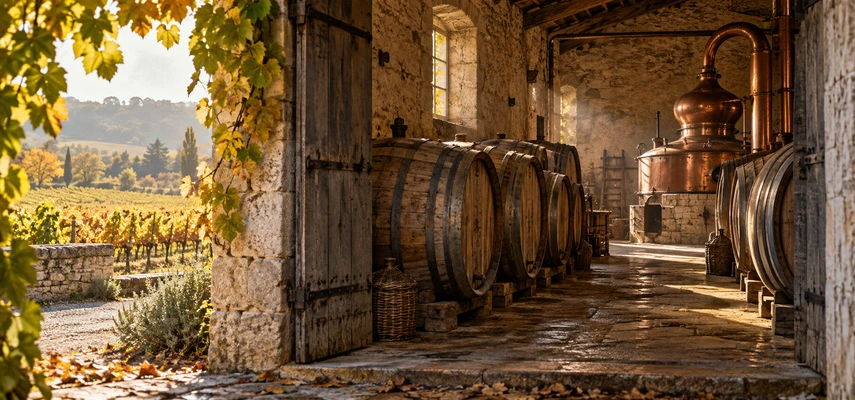

A bottle marked XO can contain spirit older than ten years. A bottle marked VSOP can contain spirit older than four. The letters aren’t misleading; they answer a narrower question than many drinkers assume. They set a minimum for the youngest spirit in the blend, rather than announcing an average age.
That distinction is a useful entry into Cognac explained through production. Its identity depends on grapes, a defined origin, double pot distillation and oak maturation. Its individual style then reflects the producer’s decisions within that framework. The familiar letters tell part of the story, while the journey from wine to barrel explains why it tastes like a spirit at all.
A brandy with an address
Cognac is a grape-based brandy from a defined French production area. The name is protected: making a fine grape spirit somewhere else doesn’t turn it into Cognac. Origin and production requirements work together. Think of the name as an address attached to a rulebook, rather than a generic description of brown brandy.
The Cognac interprofessional authority’s production guide identifies the delimited origin and follows grapes through winemaking, distillation, ageing and blending. For Level 1, the essential geographical point is that the grapes must come from the defined Cognac area. Memorising a long list of villages is less useful than understanding the protected-name principle.
Brandy is the wider category; Cognac is a particular example with its own requirements. This relationship resembles a family name and a specific member of the family. “Cognac is brandy” works. “All brandy is Cognac” does not. The distinction stops a correct ingredient fact from becoming an incorrect labelling claim.
Grapes first, wine next
Grapes supply sugars in their juice. After pressing, alcoholic fermentation creates a wine that can be distilled. Yeast produces ethanol before the still concentrates it. The wine is therefore an intermediate product with a practical job, rather than a finished table wine that someone happens to repurpose.
The base matters because it brings both alcohol and aroma-related material to distillation. Production choices favour a wine suited to this next stage. The beginner’s lesson is the sequence: grapes become juice, juice becomes wine, and wine feeds the still. Skipping fermentation in that explanation leaves the still with no ethanol to concentrate.
A grape origin also doesn’t mean the final Cognac should smell exactly like a bowl of fresh grapes. Fermentation creates new compounds, distillation changes the volatile mixture, and oak ageing develops the spirit further. Fruity impressions can remain relevant without resembling a simple transfer of grape-juice flavour into a bottle.
Why two pot distillations matter
Cognac uses double pot distillation. The first run distils wine to an intermediate distillate, called brouillis. The second distils that liquid again, with the producer selecting the appropriate portion for the spirit. This is batch distillation: the equipment processes charges rather than operating as a continuously fed column.
The two runs concentrate alcohol and shape the mixture of volatile compounds. They don’t create ethanol from scratch. Nor does the word “double” promise that all the original wine’s aromas survive intact. Selection and concentration are the mechanisms linking the alcoholic wine with the spirit that will enter oak.
For revision, compare this with the general still lesson. Pot stills are associated in the Level 1 framework with lower-strength, characterful spirit. Cognac is a named category using that approach under its own requirements. It supplies a memorable application of the principle without making double distillation a rule for every pot-distilled drink.
The spirit emerging from distillation hasn’t yet acquired its familiar oak-derived amber appearance. That comes later. Describing Cognac as “wine made brown by a still” therefore confuses two stages. Distillation and maturation have different roles, even though both help establish the eventual sensory profile.
Oak adds more than a birthday
Cognac must mature in oak for at least two years. Oak can contribute colour and aromas while the spirit develops in the barrel. The familiar associations may include vanilla, spice, toast and dried fruit alongside other characteristics. They are useful descriptive possibilities, not a mandatory checklist for every bottle.
Barrels differ in their ability to contribute wood-derived material. Newer or more active oak can make a stronger contribution than repeatedly used wood, all else being equal. The cellar environment and the spirit’s time in particular casks also matter. A producer manages those influences rather than simply filling a barrel and waiting for a calendar alarm.
Time is consequential, but it isn’t a universal quality score. An older component may offer characteristics useful to one blend and less suited to another. A younger style may be selected for a different purpose. The age designation sets a minimum condition; it doesn’t tell every reader which bottle they will prefer.
Colour is an especially unreliable shortcut. Oak contributes colour, but permitted caramel colouring can also adjust appearance. Looking at two glasses won’t establish their relative ages with certainty. If the question asks about an age category, use the verified designation and its minimum rather than deciding which liquid looks more mature.
Blending creates the intended style
Many Cognacs are blended from suitable wine spirits of different ages or origins within the permitted framework. The blender can pursue consistency, complexity, or both. One component might supply a fresh fruit impression, another a particular oak contribution, and another depth. The intended result is the whole composition.
The BNIC production account also makes a useful qualification: blending is traditional but isn’t compulsory for every Cognac. That matters because “commonly blended” and “must be blended” are different claims. A good examination answer preserves the distinction rather than turning a widespread practice into a universal legal requirement.
Blending for consistency doesn’t mean the component list must remain identical forever. Casks vary, so selection may change to maintain a recognisable house style. Imagine adjusting a musical arrangement for different voices while keeping the intended sound. The craft lies in the result rather than in pretending the raw components never change.
What VS, VSOP and XO actually promise
The Cognac authority’s age guidance identifies three core minimums for this lesson: VS, two years; VSOP, four years; XO, 10 years. The relevant age is that of the youngest eau-de-vie in the blend. Older components may be present without changing the youngest component’s age.
| Designation | Minimum age of youngest spirit | What it does not tell you |
|---|---|---|
| VS | Two years | The average age of the blend |
| VSOP | Four years | That every component is exactly four |
| XO | 10 years | That every component is exactly ten |
Suppose a hypothetical blend contains spirits aged four, eight and twelve years. Its youngest component is four. An older component does not pull the younger one up to an average-age classification. On age grounds, it meets the VSOP minimum, while it does not meet the XO minimum.
Now imagine a blend whose youngest spirit is ten years old and whose other components are older. It meets the XO minimum on age grounds. You don’t need the exact proportions to answer that minimum-age question. You need the youngest age and the correct threshold. Other requirements of the protected category still apply.
The numbers describe qualifying maturation, not years since the shop sold the bottle. Keeping a sealed VSOP at home for six more years doesn’t convert its oak maturation into ten years or make it XO. Bottle storage and maturation in a cask aren’t interchangeable operations.
Sweetness and strength are separate decisions
The Level 1 syllabus includes caramel colouring and notes that Cognac is often sweetened. “Often” is the useful word: it doesn’t say every Cognac contains the same addition or that sweetening defines its identity. Applicable rules govern what may be done, while the producer decides the intended style within those limits.
A vanilla-like aroma isn’t proof of added sugar. Oak can produce associations with sweet-smelling foods even when the question concerns aroma rather than measured sweetness. Likewise, a soft impression doesn’t establish an exact age. Avoid using a tasting adjective as a substitute for production evidence.
Water can be used to bring the spirit towards its intended alcoholic strength. That operation differs from sweetening and colouring, although all belong among the later decisions shaping the bottle. Ask what feature is changing: ethanol proportion, sweetness, colour, or aroma. Naming the specific purpose makes the process easier to explain.
Cognac becomes easier to explain when its category rules are connected with fermentation and oak and blending.
What to remember
Build a compact Cognac chain: grapes from the defined area → wine fermentation → double pot distillation → oak ageing → producer’s final style decisions. Attach the age minimums to the youngest component: two, four, ten. Keep blending, caramel colouring and common sweetening in the picture without calling every practice compulsory.
Then practise separating label facts from sensory expectations. Fruit and oak associations help describe character; the designation establishes a minimum age condition. Neither colour nor price replaces the protected origin and production requirements. With those links clear, Cognac becomes a category you can explain rather than three sets of letters to memorise.
Knowledge check: 12 original practice questions
Independent TFE questions, not official WSET examination items. Choose one answer per question; explanations follow separately.
1. What is the minimum oak maturation for Cognac?
- Six months
- One year
- Four years for every style
- Two years
2. What happens to a VSOP age designation merely through years of home bottle storage?
- It does not acquire additional oak maturation
- It automatically becomes XO
- Its youngest component becomes ten
- It changes to VS
3. Which statement about the protected name is correct?
- Any grape spirit can use it
- Any brandy aged two years can use it
- Defined origin and production requirements apply
- Only the colour matters
4. What minimum applies to the youngest spirit in VSOP?
- Two years
- Four years
- Six years
- Ten years
5. A hypothetical blend has four-, eight- and twelve-year-old spirits. Which minimum age governs?
- Four years
- Eight years
- Twelve years
- The arithmetic mean
6. What does a darker Cognac colour prove on its own?
- XO status
- No precise age designation
- A higher youngest age
- A higher average age
7. What minimum applies to the youngest spirit in XO?
- Four years
- Eight years
- Ten years
- Twelve years
8. Which wording accurately reflects the Level 1 syllabus on sweetening?
- Sweetening never occurs
- All Cognac is equally sweetened
- Sweetness replaces geographical origin
- Cognac is often sweetened
9. Which raw material is used for Cognac?
- Blue agave
- Grapes
- Molasses
- Rye
10. What must happen before Cognac wine can be distilled?
- Ten years in oak
- Final caramel adjustment
- Alcoholic fermentation
- Bottling
11. Which distillation approach is required for Cognac?
- Double pot distillation
- High-strength column distillation only
- No distillation
- A single compulsory continuous pass
12. Which statement about blending is accurate?
- Every Cognac must be blended
- Blending eliminates all differences in raw material
- Blending proves inferior quality
- Blending is traditional but not compulsory for every Cognac
Answers and explanations
1. D — Two years. The base minimum is two years in oak, with higher minimums for designations such as VSOP and XO. Mapping: LO2.
2. A — It does not acquire additional oak maturation. Time in a bottle is not the qualifying oak maturation used to establish Cognac age designations. Mapping: LO2.
3. C — Defined origin and production requirements apply. Cognac depends on its protected geographical origin and production framework as well as its raw material. Mapping: LO2.
4. B — Four years. VSOP requires the youngest eau-de-vie to meet the four-year minimum, not the average age. Mapping: LO2.
5. A — Four years. The youngest component governs the age minimum; older components do not raise that component’s qualifying age. Mapping: LO2.
6. B — No precise age designation. Oak and permitted caramel colouring can influence colour, so appearance alone cannot establish an age designation. Mapping: LO2.
7. C — Ten years. XO requires a minimum age of ten years for the youngest spirit in the blend. Mapping: LO2.
8. D — Cognac is often sweetened. The syllabus describes common sweetening without asserting that every Cognac receives an identical addition. Mapping: LO2.
9. B — Grapes. Cognac is a grape-based brandy from a defined origin, not an agave, cane or grain spirit. Mapping: LO2.
10. C — Alcoholic fermentation. Fermentation first produces the wine and its ethanol; distillation then concentrates alcohol from that wine. Mapping: LO2.
11. A — Double pot distillation. Double batch distillation in pot stills is a defining production requirement in the syllabus. Mapping: LO2.
12. D — Blending is traditional but not compulsory for every Cognac. The Cognac authority distinguishes a traditional common practice from a compulsory production requirement. Mapping: LO2.











