










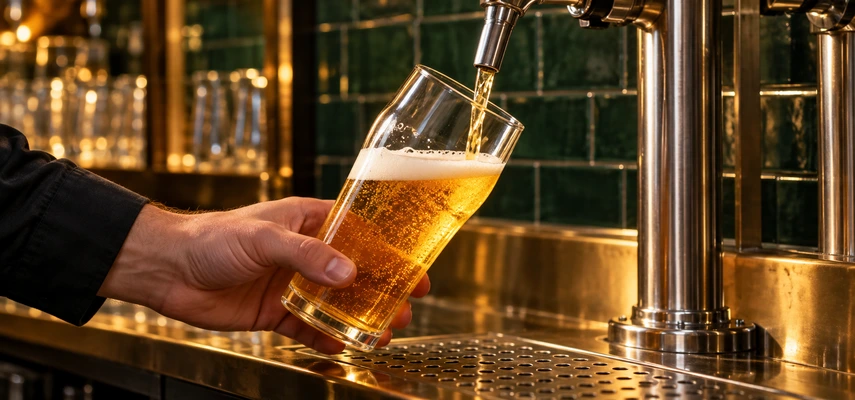

Knowing how to serve beer means making several small decisions well. The right temperature, a clean glass and a controlled pour preserve the intended aroma, texture and appearance. An elaborate glass cannot rescue a dirty line, and a dramatic pop is not the goal of opening a pressurized bottle.
This lesson covers the service requirements in the WSET Level 2 Beer specification. It includes all twelve prescribed glass shapes, plus keg, cask and bottle handling. Learn the reason for each action so the method still makes sense when the product changes.
Temperature changes the immediate impression
Very cold beer can seem less aromatic, while warming can reveal more aroma and alcohol expression. Carbonation behavior and perceived texture also change with temperature. An appropriate serving choice depends on the style, product guidance and the drinker’s preference.
Lighter refreshing beers are commonly served colder than richer strong examples, but one temperature does not suit every pale beer or every dark beer. WSET’s storage and service guidance connects temperature with expression. Storage for preservation remains a separate question from the final temperature in the glass.
Avoid a frozen glass as a universal solution. Frost and ice can disturb pouring and presentation. For comparison exercises, keep conditions consistent so a colder sample is not mistaken for an inherently less aromatic style.
Clean means free of residue as well as visible dirt
Oil, detergent residue, lipstick and other contamination can damage foam and introduce unwanted aromas. A glass that looks transparent is not necessarily suitable. Cicerone’s home-service guidance explains the importance of removing both soil and oily residue.
Use an appropriate cleaning and rinsing process, allow hygienic drying and handle away from the rim. Inspect before filling. Random streams of bubbles attached to dirty spots can be a clue, but no single visual sign replaces a reliable cleaning routine.
Glass choice then becomes useful. Shape changes headspace, the presentation of foam, handling and how aroma is approached. Tradition also matters, but no named glass chemically transforms an unsuitable beer into the correct style.
Bowls, stems and aromatic presentation
A chalice has a broad bowl on a stem or foot and suits the generous presentation associated with many Belgian beers. A stemmed tulip curves inward before flaring at the rim, combining bowl space with a distinct lip. Both accommodate foam and an aromatic presentation, with capacity chosen for the actual serving.
A snifter usually has a rounded bowl and narrower opening. It is familiar for smaller servings of strong aromatic beer, although cupping it in warm hands is not compulsory. A thistle has a distinctive bulbous lower section and flared upper form, associated with Scottish beer service.
The teku is an angular stemmed tasting glass with a shaped rim. Baladin describes its design intention as a broadly useful beer glass. That makes it a useful comparison tool, not proof that all other shapes are inferior. Cleanliness, capacity and consistent conditions still come first.
Tall glasses and straightforward pints
A footed pilsner has a tall tapered profile on a foot, displaying pale beer and its rising bubbles. A Stange is a narrow straight-sided cylindrical glass associated with Kölsch service. The tall curved Weizenglas provides room for wheat beer and its generous head.
A shaker is the familiar plain tapered pint form. A nonic pint adds a bulging band near the upper section, making it visually distinct from the simpler shaker. Both are practical serving forms, but neither name specifies the exact beer recipe or alcohol strength.
For revision, identify the shapes from silhouettes rather than memorizing one brand illustration. Then connect capacity and headspace with the intended presentation. A large wheat-beer head needs room, while a small strong-beer portion need not fill an oversized pint.
Handled mugs make another recognizable group
A dimpled mug combines a handle with textured depressions in the glass. A Masskrug is the substantial handled vessel associated with a litre serving in German beer culture. The handle changes how it is held; it does not guarantee the beer inside will remain cold indefinitely.
These two complete the twelve prescribed forms alongside chalice, footed pilsner, nonic pint, shaker, snifter, Stange, stemmed tulip, teku, thistle and Weizenglas. Familiarity should include appearance and practical use, without inventing mandatory glass laws for every style.
Serving size deserves separate thought. A traditional vessel can be large, but stronger alcohol may call for a smaller portion. Accurate strength information and responsible service matter more than copying a photograph of a full glass.
Keg service depends on the whole system
A draught keg is connected to a compatible coupler and gas system, with temperature, pressure and line resistance working together. The Brewers Association’s draught manual provides the technical context. A warm line or incorrect setup can create foam even when the keg itself is sound.
Open the faucet fully for a controlled pour rather than throttling it halfway. Begin with a suitable glass angle, then straighten as required to form the intended head. Keep the faucet outside the beer and away from the rim to reduce contamination and damage risks.
If pouring repeatedly fails, investigate temperature, cleanliness, gas and system balance. Arbitrarily increasing or decreasing pressure can change carbonation and create further problems. A trained operator should correct the cause rather than hide it by discarding excessive foam.
Nitrogen presentation has specific equipment
Some products use a nitrogen-containing gas blend and an appropriate restrictor faucet to produce a fine-bubbled presentation. The familiar cascade and dense head can create a different texture from a conventionally carbonated pour. The beer and system must be designed to work together.
Follow the product’s pouring method, including any settling stage where specified. Do not generalize one brand ritual to every stout or every dark beer. Darkness comes from ingredients, while nitrogen presentation comes from the gas and dispense arrangement.
This distinction is useful in theory questions: a pale beer can use nitrogen, and a dark stout can use ordinary carbon dioxide presentation. Color and gas choice answer different production and service questions.
Cask service includes living condition
Cask-conditioned beer develops its intended gas through fermentation in the cask. It is not simply a keg with a different name. CAMRA’s explanation connects the living product with its handling needs.
The cask needs suitable positioning, settling, venting and temperature management before service. Beer may be served by gravity or through a beer engine, depending on the arrangement. Movement can disturb sediment, while air entering during conventional service limits the freshness window.
Lower carbonation can be appropriate, but unintended flatness, staling or dirty dispense is not made acceptable by tradition. Follow cellar guidance and turnover requirements. Cask condition is something to manage, not an excuse for any result in the glass.
Open each closure with the right method
Inspect the bottle and keep it pointed away from people. For a standard pry-off crown cap, use a suitable opener without levering against or chipping the glass. A twist-off closure should be treated according to its design rather than forced with an unsuitable tool.
For a crown cap plus cork, remove the crown carefully, then assess and remove the cork with the appropriate tool and controlled technique. Do not assume the first closure’s removal eliminates pressure. Keep control and follow the producer’s instructions for that bottle.
For a mushroom cork with cage, keep a hand over the cork as the retaining wire is loosened. Ease it out under control while keeping the bottle directed safely away; avoid launching it. The Cicerone service syllabus emphasizes closure-specific methods and cork control.
Pour bottles with a sediment decision
For a clear presentation, let sediment settle and pour smoothly in one movement, watching the approaching deposit. Leave an appropriate final portion behind rather than tipping all sediment into the glass automatically. Avoid touching the bottle mouth to the rim.
Some products are intended to include yeast, and a producer may recommend rousing or a staged pour. Confirm that instruction rather than applying it to every cloudy beer. Sediment is evidence of material in suspension or settlement, not a universal signal to shake the bottle.
Form the intended head without excessive agitation. Highly carbonated bottles need particular care, while low-carbonation products require another expectation. If a package is damaged or behaves abnormally, stop and assess rather than forcing a theatrical service.
Explain the service choice
A useful revision exercise pairs a product with a practical problem. For a bright bottle-conditioned beer, explain sediment management. For a lively draught lager, explain why temperature and line balance matter. For an aromatic strong ale, explain portion size and the choice of a suitable bowl. Each answer should connect an action with its purpose, rather than claiming that one famous glass or pouring ritual solves every service problem.
One-page revision summary
Match temperature and serving size to the product, use clean glassware and recognize the twelve prescribed shapes. Keg service needs balanced equipment, nitrogen presentation needs the appropriate system, and cask service needs living-condition management.
Open crowns, crown-and-cork bottles and mushroom corks with their own controlled methods. Decide how to handle sediment before pouring. Good service makes the intended beer easier to appreciate; it should not introduce a new fault between package and glass.
Continue your beer studies
Explore the related lessons on pale lagers alongside dark lagers alongside malt-driven ales to extend the ingredient, process or sensory reasoning in this article.
Knowledge check: 10 original practice questions
Independent TFE questions, not official WSET examination items. Choose one answer per question; explanations follow separately.
1. Which glass has a bulging band near its upper section?
- Shaker
- Nonic pint
- Stange
- Snifter
2. Which is the narrow straight-sided Kölsch-associated glass?
- Chalice
- Thistle
- Stange
- Dimpled mug
3. Which form accommodates a generous wheat-beer head?
- Weizenglas
- Only a tiny snifter
- Only a flat dish
- Only a sealed bottle
4. What should happen while loosening a mushroom cork’s cage?
- Point it at the guest
- Shake the bottle
- Remove all control from the cork
- Keep control over the cork and point away
5. Which is the best response to persistent excessive draught foam?
- Investigate temperature and system balance
- Always double gas pressure
- Always halve gas pressure
- Submerge the faucet
6. Which feature is associated with a Masskrug?
- A narrow stemmed angular bowl
- A substantial handled litre vessel
- A straight tiny Kölsch cylinder
- A tulip rim without a handle
7. What distinguishes nitrogen-style presentation from dark color?
- Both come from roast
- Both come from wheat
- Gas and equipment create the presentation, while ingredients create color
- Neither can vary
8. Which practice supports a clear bottle-conditioned pour?
- Shake vigorously
- Always add every deposit
- Touch the bottle mouth to the rim
- Settle sediment and pour smoothly while watching the deposit
9. Which glass is angular and stemmed for broad tasting use?
- Teku
- Dimpled mug
- Masskrug
- Shaker
10. What should be assumed after removing a crown over a cork?
- Pressure must be zero
- The cork still needs controlled, appropriate removal
- The bottle should be shaken
- The cork should be launched
Answers and explanations
1. B — Nonic pint. The nonic band distinguishes it from a plain tapered shaker and a straight cylindrical Stange. Mapping: LO4 AC2.
2. C — Stange. Stange identifies the slim cylindrical form; the other shapes have distinctly different bowls or handles. Mapping: LO4 AC2.
3. A — Weizenglas. The tall curved Weizenglas provides room for wheat beer and foam, while capacity must still match the pour. Mapping: LO4 AC2.
4. D — Keep control over the cork and point away. The retaining wire may release a pressurized closure; controlled handling prevents an uncontrolled launch. Mapping: LO4 AC2.
5. A — Investigate temperature and system balance. Several causes can create foam; arbitrary pressure changes can alter carbonation and worsen the system. Mapping: LO4 AC2.
6. B — A substantial handled litre vessel. The Masskrug is the large handled German service form; responsible portion choice remains separate. Mapping: LO4 AC2.
7. C — Gas and equipment create the presentation, while ingredients create color. A dark beer need not use nitrogen and a pale one can; these are independent variables. Mapping: LO4 AC2.
8. D — Settle sediment and pour smoothly while watching the deposit. A controlled clear pour leaves sediment where appropriate; specific products may instead recommend yeast inclusion. Mapping: LO4 AC2.
9. A — Teku. The Teku is the angular stemmed tasting design; its utility still depends on clean condition and appropriate capacity. Mapping: LO4 AC2.
10. B — The cork still needs controlled, appropriate removal. Removing the crown does not prove all pressure is gone; the remaining closure requires its own controlled method. Mapping: LO4 AC2.












