











Greece can put a floral white, a firm tannic red and an amber sweet wine on the table without asking the same grape to do three jobs. Its diversity begins with varieties and landscapes: mountain plateaus, continental-influenced northern vineyards, exposed islands and warmer sheltered sites all complicate the phrase Mediterranean wine.
For Diploma study, compare Macedonia, the Peloponnese and the islands through specific examples. Use Xinomavro, Agiorgitiko, Moschofilero and Assyrtiko as reference points, then ask how exposure, elevation, water and cellar decisions change the result. Local identity supplies questions; it doesn’t replace tasting evidence.
Macedonia: Xinomavro with several addresses
Macedonia is northern Greece’s broad wine setting, not a single appellation. Naoussa lies around the southeastern slopes of Mount Vermio, with varied soils, elevations and exposures. Its PDO red wines use Xinomavro. The combination can produce significant acidity and tannin with relatively pale colour, so colour alone is a poor measure of substance.
Amyndeon adds an elevated plateau, lakes and sandy sites, with Xinomavro supporting red, rosé and sparkling rosé PDO styles. A northern location and elevation can influence ripening, but don’t assume every Amyndeon wine must be lighter or sharper than every Naoussa. Crop, exposure, season and production still intervene.
Goumenissa combines Xinomavro with Negoska, making a useful contrast with Naoussa’s varietal rule. The broader region also contains PGI wines and other grapes. Don’t transfer a Naoussa recipe to all Macedonia or treat PGI identity as evidence of lesser sensory quality.
For a fictional Naoussa lot, a grower may achieve ripe fruit while retaining substantial tannin. That doesn’t justify unlimited extraction. A producer making an Amyndeon rosé faces a different question: how much colour and phenolic material suits the chosen style? The grape is shared; the cellar brief isn’t.
Peloponnese: altitude changes the southern story
The Peloponnese is the large peninsula of southern mainland Greece. Nemea centres on Agiorgitiko, with considerable elevation and site variation. Its red wines can range from fresh and fruit-led to more structured, and sweet categories also exist. A broad regional reputation shouldn’t flatten that range into one ripe red style.
Mantinia provides a particularly helpful contrast: an elevated Arcadian plateau and surrounding slopes, strongly associated with Moschofilero. Floral whites, fresh acidity and a still or sparkling programme make more sense when altitude and local conditions enter the explanation. Pink-grey grape skins don’t require the finished wine to be red.
Farther west, the Achaia regional wine organisation distinguishes Roditis-based Patra from Muscat and Mavrodaphni sweet-wine appellations. A fresh Roditis white and a concentrated sweet wine illustrate different uses of the same broader regional setting. A wine labelled with a familiar grape name still needs its specific category checked.
Compare a high-site aromatic white with an Agiorgitiko intended for structured red wine. Harvest timing, pressing, fermentation and maturation should follow different targets. Neither the latitude of the peninsula nor the ambition of the producer settles which wine is better.
Islands: begin with Santorini, then change the reference
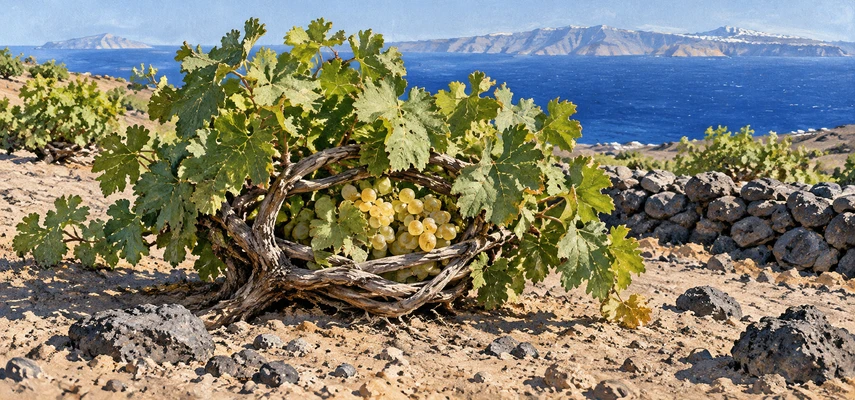
Santorini and Thirasia form the Santorini PDO setting. Assyrtiko dominates its dry whites, with Athiri and Aidani also relevant. Volcanic materials, dry conditions and strong winds help explain low training, including the basket-like kouloura that shelters bunches. This is a locally adapted living vine, not a harvesting basket set on the ground.
Assyrtiko can retain marked acidity alongside substantial ripeness and body. Lees work or wood may shape texture, while dry wines and Vinsanto require separate production explanations. Vinsanto concentrates grapes by drying and involves extended oxidative maturation; don’t infer that every Santorini wine is sweet, or that the Tuscan name Vin Santo describes an identical wine.
Morning humidity contributes to the island setting, but it shouldn’t become a claim that mist solves drought. Domaine Sigalas’s 2025 harvest report describes severe accumulated water stress and uneven vine performance. That is evidence from one producer and season, not a permanent island-wide quality verdict. Reduced yield can accompany concentration, damaged vines or both; it doesn’t guarantee outstanding wine.
Samos offers a different island reference through Muscat Blanc and terraced vineyards. Its sweet wines include different concentration and fortification routes. The national profile also records cooperative and private production since 2016, so an old statement that only the cooperative may produce the island’s wine is incomplete.
Crete broadens the comparison again. Its regional variety guide includes Vidiano, Vilana, Kotsifali, Mandilari and Liatiko among others. The regional map and grape guide links these with varied white and red programmes. Neither all islands being volcanic nor every island wine tasting like Assyrtiko is a useful assumption.
Use growing conditions as causes rather than slogans
Temperature affects growth, ripening and acid retention. Sunlight supports photosynthesis and influences bunch conditions. Water availability depends on rainfall, soil reserves, rooting and drainage; nutrient availability influences vigour and crop balance. Apply those mechanisms to Macedonia’s northern sites, the Peloponnese’s altitude differences and the islands’ varied exposure and water situations.
Weather brings frost, hail, heat, drought and harvest-rain risks. Downy and powdery mildew and bunch rot require monitoring. A Mantinia spring frost and a Santorini drought create different problems, while rain near a northern red harvest can change fruit health and picking decisions. Greece isn’t uniformly hot, dry and free of disease.
Soil descriptions need physical explanation. Sandy, clay-rich, calcareous and volcanic-influenced sites can differ in water retention, drainage and rooting conditions. The effect depends on actual soil depth and weather, not just the rock name. Calling a wine mineral doesn’t demonstrate that particular geological particles became its flavour.
Match vineyard work to slope and target style
Vineyard establishment considers access, training, row arrangement, slope stability and permitted production. Planting materials should match variety, vigour, soil and water conditions. A low Santorini basket form and an upright-trained Macedonian parcel answer different conditions; neither should be copied everywhere simply because it is traditional somewhere.
Nutrient and water management follows observation, analysis and applicable rules. Canopy management balances effective leaf area, airflow and bunch protection. Opening a canopy can improve drying in a damp northern site, while excessive exposure can damage fruit in a hot Peloponnese parcel. Wind protection shouldn’t come at the expense of ignoring the vine’s productive leaf area.
Harvest timing balances flavour, sugar, acidity, health and style. Hazard management includes erosion control, secure access and appropriate frost precautions. Pest and disease management combines monitoring, canopy work and justified interventions. For dried-grape sweet wines, concentration adds another stage of selection and risk rather than turning any overripe harvest into suitable material.
Compare cellar choices through white, red and sweet styles
Winemaking approaches range from aromatic fresh whites to structured reds and concentrated sweet wines. Careful grape transportation limits crushing, heat and oxidation. Reception should separate origin, variety, maturity and health. Processing and pressing affect juice fractions, phenolics and yield. Moschofilero destined for a delicate white needs a reasoned pressing plan, not accidental colour extraction.
Pre-fermentation clarification adjusts solids for the intended white fermentation. Must adjustments require analysis and legal permission. Alcoholic fermentation decisions include yeast, temperature, nutrition and vessel. Cooler controlled conditions may support a particular aromatic target, but temperature management isn’t an instruction to ferment every Greek white identically.
Malolactic conversion changes acidity and character, so its suitability depends on the wine. Extraction and pressing for reds should follow skin and seed maturity, concentration and style. A tannic Xinomavro lot doesn’t automatically benefit from more cap work; an Agiorgitiko intended for early drinking may need a different balance of fruit and tannin.
Lees maturation can add texture to whites, while wood influences oxygen exposure and potentially flavour. Blending eligible lots can improve balance or consistency within the claim’s conditions. New oak should be judged by integration, whether the wine is Macedonian red or Santorini white. The cost of a barrel isn’t evidence that it suited the fruit.
Sweet wines need their own explanations. Drying concentrates grapes before fermentation; adding spirit can stop fermentation and retain sugar in a fortified style. These are different mechanisms. The Santorini EU single document distinguishes categories of raisined-grape sweet wine and a minimum 24 months of oxidative oak maturation for Vinsanto. Don’t generalise one bottle’s method to every island sweet wine.
Preserve the chosen character and verify the claim
Post-fermentation clarification removes unwanted material. Stabilisation considers protein, tartrate and microbial risks as appropriate. Finishing adjustments, sulfur dioxide and filtration should suit analysis, sweetness and distribution. A retained-sugar wine needs refermentation control, while a dry aromatic white still needs sound oxidation and spoilage management.
Packaging and closures should protect youthful freshness or intended development. Wine transportation needs suitable temperature and handling. An export wine can lose quality after leaving an excellent cellar; a prestigious origin cannot reverse heat damage. Evaluate the bottle’s condition before explaining every unusual aroma through local tradition.
International and EU protection frameworks, national Greek law and local appellation specifications interact. A geographical indication ties a wine’s origin to defined conditions. The national appellation directory distinguishes PDO and PGI origins. Wines without GI follow another category of claim and cannot borrow a protected origin by using the same grape elsewhere.
Industry associations such as Wines of Greece and regional bodies inform and promote, with different roles from regulators. Appellation names, permitted varieties, style and maturation terms need checking for the specific wine. PDO identity isn’t an outstanding tasting grade, and PGI flexibility can accommodate an ambitious wine outside a narrower appellation’s recipe.
Follow the wine from vineyard cost to customer
Supply depends on harvest, usable fruit, selection and production allocation. Demand differs between familiar Santorini Assyrtiko, specialist Xinomavro, aromatic whites and sweet wines. Costs include difficult vineyard work, selection, cellar resources, maturation and inventory. A low-yield island parcel and an accessible mainland vineyard may face quite different economics.
Legislation affects production, labels and destination compliance. Currency exchange changes an importer’s landed cost without altering wine quality. Importing adds freight and intermediary costs. Retail needs understandable grape and origin information; HoReCa buyers require staff education and suitable serving contexts. Direct-to-consumer sales can retain revenue but require hospitality and fulfilment. Mature and emerging markets contain varied customers rather than one appetite for Mediterranean wine.
A grower may supply grapes, an estate can coordinate vineyard and cellar, and a winery provides production capacity. A merchant sources wine or fruit; a broker connects parties without necessarily owning stock. A virtual winery contracts production under its brand, while a custom crush facility supplies agreed services. These are comparisons of responsibility, not assertions that every model is equally common in each Greek region.
A cooperative can share resources and market access, as Samos illustrates. A conglomerate may coordinate businesses and channels. Fruit standards, selection and inventory risk matter more than a simplistic ownership-based quality ranking. Wine brands can emphasise place, variety, producer or style.
Marketing concepts start with a defined customer and credible promise. Marketing options include comparative tastings, restaurant training, wine tourism and clear digital explanations. The five Ps connect product, price, place, people and promotion. Explaining the difference between Xinomavro and Agiorgitiko helps a buyer more than treating unfamiliar spelling as a luxury feature.
Compare the evidence here with Barolo and Barbaresco as a regional case, then apply the regional comparison framework to the comparison. Compare growing conditions, production decisions, style, quality and the commercial reasons for price. Establish the differences rather than assuming that one familiar name must be better.
Original Diploma practice
These original questions and indicative points are teaching material, not official WSET questions or marking allocations.
Question 1: challenge a national climate assumption
A fictional buyer expects a Mantinia white to have low acidity because it comes from southern Greece. Evaluate the reasoning.
Indicative points: latitude, altitude, local climate, grape, season, harvest and cellar.
Outline answer: Altitude and continental influences qualify the broad latitude assumption. Moschofilero, site and season help explain the fruit; harvest and fermentation choices influence the final balance. Assess the actual palate and technical information rather than assigning acidity from a national map.
Question 2: evaluate colour as quality evidence
A buyer dismisses a fictional Naoussa because it is paler than a softer red wine. Assess the comparison.
Indicative points: grape, extraction, tannin, concentration, balance, complexity and ageing.
Outline answer: Pale colour can coexist with substantial acidity and tannin. Assess fruit, integration and persistence rather than rewarding colour alone. Extraction and maturation influence the result, but greater tannin isn’t automatically better either. Ageing requires evidence of remaining fruit and structural support, not merely a stern young palate.
Question 3: interpret a low island yield
A fictional importer assumes a very small Santorini crop guarantees outstanding quality and an unlimited selling price. Evaluate both claims.
Indicative points: water stress, vine performance, usable fruit, selection, tasting, demand and margin.
Outline answer: A restricted crop may reflect concentration, damaged vines or uneven ripening. Evaluate usable material and the actual wine before concluding quality. Costs can rise as volume falls, but customers still need a credible product and price. Scarcity doesn’t remove route-to-market costs or demand risk.
Analytical tasting preparation: compare a Greek white and red
The official Diploma specification, PDF page 26, calls for any Greek white, such as Santorini, of good or very good quality and any Greek red of very good or outstanding quality. It doesn’t require a separate flight from every Greek region. Propose a suitable Assyrtiko or Moschofilero and a Xinomavro or Agiorgitiko, recording the actual selection after blind assessment.
These are proposed study wines, not actual tastings, automatic grades or examination predictions. Write full systematic descriptions covering sweetness, acidity, alcohol, body, tannin where relevant, aroma, development and finish. Justify quality through balance, concentration, complexity and desirable persistence. Assess bottle-ageing suitability separately through retained fruit, structure and development. Explain why each wine succeeds in its style before attempting to identify its birthplace.











