










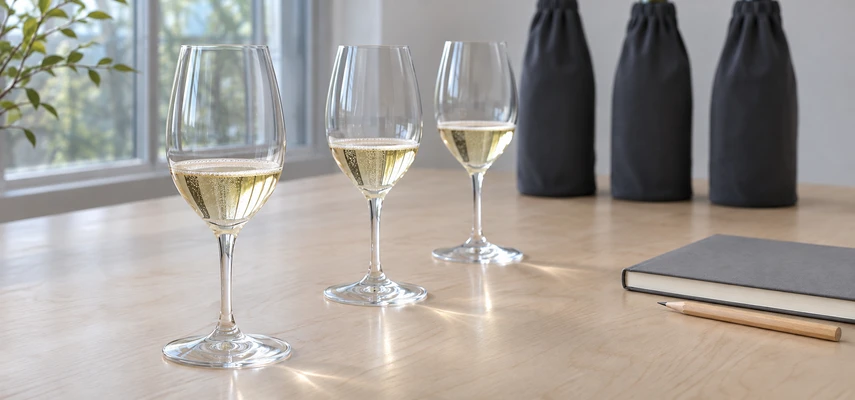

The D4 Sparkling Wine exam rewards two related skills: explaining how a wine came to be and judging what is actually in the glass. Revision works best when those skills meet regularly. Memorising ageing figures without applying them leaves an explanation unfinished; guessing a famous origin without recording the wine leaves a tasting conclusion unsupported.
Start with the confirmed format, build a realistic practice session and use the results to choose the next revision task. A useful rehearsal reveals specific weaknesses. It doesn’t need to look impressive on the table.
Know the format before dividing your time
The official Diploma qualification page confirms a closed-book examination combining open-response questions with blind tasting of three sparkling wines in ninety minutes. The Issue 1.4 specification supplies the formal unit requirements. This isn’t a separate ninety-minute theory paper followed by another ninety-minute tasting paper.
For an independent rehearsal, use one uninterrupted ninety-minute session. Prepare three concealed wines and original written tasks, then decide a provisional division of time before starting. That division is a personal practice tool, not an official allocation or a prediction of question numbers. In the real examination, follow the instructions and available marks on the paper.
Make room within the session to read instructions and check the answers. A plan that assigns every second to writing ignores the practical need to compare wines, return to an uncertain observation and notice an omitted part of a question. Test a workable allocation repeatedly rather than assume one timetable suits everybody.
Build explanations around causes and consequences
A strong written answer connects a factor to its effect. Instead of saying that altitude is important, explain how a cooler growing setting can help retain acidity and why a sparkling producer might value that fruit. Then recognise the limit: insufficient ripeness, disease or an unsuitable crop can still undermine the result.
Use the same approach in the cellar. Gentle pressing can limit unwanted phenolic extraction; blending can combine components with different strengths; lees contact can contribute texture and developed character. Each statement needs a relevant consequence for the wine. Naming an operation without explaining its purpose rarely shows the full understanding you are trying to demonstrate.
Separate style, quality and price. A fresh, fruit-led wine has a different style objective from a developed traditional-method example. Quality requires evidence that the result is successful, while price involves production costs, demand, brand position and the route to the customer. More expensive equipment doesn’t automatically make a better-balanced drink.
Answer the question’s command and scope
Before writing, identify the task: explain a causal relationship, compare two situations or evaluate an argument. A comparison needs both subjects and the significance of their differences. An evaluation needs a judgement supported by reasons, including relevant limitations. A long description of one wine doesn’t become a comparison just because another name appears in the introduction.
Mark the scope in a brief plan. If a question asks about growing conditions and production, cover both; if it asks about costs and demand, don’t spend the whole answer retelling fermentation. Use the evidence you know to address the actual request rather than write the essay you hoped would appear.
In practice, take a broad claim such as “traditional method produces better wine” and dismantle it. Explain what the method permits, which costs it creates and which sensory outcomes remain dependent on fruit and decisions. A balanced conclusion is more useful than either unqualified praise or an equally sweeping rejection.
Revise method distinctions that change the answer
Traditional and transfer routes both involve bottle fermentation, but their later sediment-removal and bottling operations differ. Tank fermentation keeps the relevant fermentation in a pressure vessel. Carbonation adds gas; an ancestral route captures gas from a continuing fermentation. The WSET production-method guide offers a starting point for reviewing these contrasts.
For each route, practise explaining the implications for fruit preservation, lees character, handling, scale and cost. Avoid a rigid ladder in which every bottle-fermented wine outranks every tank-fermented wine. The intended product and the quality of its execution matter.
Also separate tirage from dosage, lees contact from later bottle storage, and a minimum rule from a producer’s actual practice. These distinctions prevent an apparently precise answer from being precisely wrong. When revising numerical rules, record the event that starts the clock and the event that ends it alongside the number.
Use regional knowledge as an explanation, not an identity shortcut
Practise contrasting Champagne with Cava, Prosecco with Asti, and traditional-method Riesling Sekt with a broader commercial Sekt. Add the prescribed global regions, including England and Wales, the American groups, South Africa and the Australian and New Zealand settings. A revision schedule should expose gaps rather than repeatedly revisit only favourite wines.
Keep origin, method, grapes and label category separate until you have established each. A broad GI may permit varied sourcing; a protected appellation can impose specific conditions; a private hallmark adds another kind of claim. Similar wording doesn’t establish identical rules across countries.
When tasting blind, treat origin as a hypothesis to test against several observations. High acidity alone doesn’t identify a cool country, and bread-like character doesn’t establish Champagne. If a hypothesis requires you to ignore the wine’s sweetness, body or fruit, reconsider the hypothesis rather than edit the observations to fit it.
Record a complete tasting before narrowing the explanation
Use the official Level 4 tasting resources for the required approach. Begin with clarity, colour depth and hue, plus visible bubbles or sediment. Appearance provides observations, not a complete identity or quality judgement. Glass condition and serving conditions can also affect what you see.
Assess nose condition before aroma strength and specific character. Distinguish primary fruit or floral impressions from fermentation-related and developed notes where the evidence supports it. Don’t add toast to every wine because it is sparkling, or label every unfamiliar aroma a fault without considering the whole wine.
On the palate separate sweetness, acidity, tannin quantity and texture where relevant, alcohol warmth and body. Carbon dioxide adds a tactile dimension; record mousse and other tactile features without confusing them with flavour concentration. Sparkling reds may show meaningful tannin, while a pale wine doesn’t require an invented tannic structure.
Distinguish flavour strength from flavour character and follow the persistence of identifiable flavour on the finish. Make one scale choice where instructed; illustrative descriptors suggest possibilities rather than require every example. Revisit an uncertain judgement using the wine, not the prestige you suspect may be hiding under the sleeve.
Support quality and ageing as separate judgements
Explain quality through the evidence taken together. Does the fruit support the acidity? Does sweetness contribute to balance? Is the mousse comfortable within the style? Are flavours defined and persistent? A developed note can add interest, but it doesn’t compensate automatically for tired fruit or an abrupt finish.
Justify bottle-ageing suitability independently. Identify what could improve, which components support that development and whether the wine is already at a satisfying stage. High acidity, low dosage, a vintage date and long lees ageing aren’t individual guarantees of further improvement after purchase.
Keep the conclusion proportionate. A straightforward wine may be well made and best enjoyed for its current fruit. A more complex wine may show both present pleasure and room to develop. Explain the distinction rather than force every successful wine into the same drinking trajectory.
Choose study bottles from the actual recommended-sample table
The specification’s recommended samples distinguish essential selections from optional extensions and preserve alternatives within rows. Build a sourcing record with the intended category, target quality, method information and whether the bottle fills an essential row or an optional comparison. Don’t silently turn an “or” into two compulsory purchases.
For example, Franciacorta or Trentodoc targeting very good quality forms one essential choice. English traditional-method wine of any quality is optional. The optional prestige-cuvée Champagne comparison relates to the same producer as the specified very-good non-vintage essential example; it isn’t a free-standing requirement for every rehearsal.
Three wines are enough for one timed rehearsal, but one flight cannot replace the entire recommended study programme. Rotate styles across sessions. A sourcing target is also not a grade you have already established: assess the bottle’s actual condition and quality when you taste it.
Review mistakes in a way that changes the next session
After the reveal, classify each problem. Was it a missing observation, an unsupported conclusion, a factual production error, an incomplete comparison or a time-management failure? Those problems need different remedies. Buying another expensive bottle won’t necessarily fix an answer that never addressed demand.
Rewrite one weak paragraph while the issue is fresh. Replace a bare fact with a causal explanation, add the omitted comparison or remove an assumption that the wine didn’t support. Keep the original answer beside the revision so that improvement is visible rather than remembered vaguely.
Maintain a short error log with an action and a review date. “Check current Cava Reserva minimum and its timing” is actionable; “learn sparkling better” is an invitation to procrastinate. The next practice should test the correction and include something less familiar, so revision expands as well as deepens.
Connect sparkling production methods with global sparkling wines when testing the explanation: trace a production choice into the wine’s sensory evidence, then distinguish its contribution to style from its implications for quality and cost.
Original Diploma practice
These original exercises and the proposed ninety-minute rehearsal are independent study tools, not official questions, marks, predicted groupings or an official time allocation. No actual tasting or verified bottle grades are claimed.
Question 1: explain two production routes
Compare traditional bottle fermentation with tank second fermentation for two hypothetical sparkling whites. Explain effects on style, production operations, costs and the evidence needed to assess quality.
Indicative points: gas source; vessel; sediment handling; lees decisions; scale and capital; tasting. Outline answer: Different routes create different production possibilities and costs. Their success depends on fruit and execution, so a method comparison supports explanation rather than an automatic quality ranking.
Question 2: evaluate a price claim
A producer argues that a longer maturation period guarantees both a higher selling price and better quality. Evaluate the argument using production finance, demand, distribution and sensory evidence.
Indicative points: stockholding; financing; storage; customer willingness; margins; balance and persistence. Outline answer: Longer holding can increase cost and affect style without guaranteeing demand or quality. A defensible conclusion separates the costs incurred, the price achievable and the wine’s actual performance.
Question 3: correct a blind-tasting conclusion
A taster identifies Champagne solely because a wine is dry, high in acidity and shows bread-like notes. Explain the weaknesses and propose a more complete assessment before choosing an origin hypothesis.
Indicative points: nonexclusive features; complete appearance and palate; method possibilities; quality; ageing; uncertainty. Outline answer: Several origins can produce those features. Record the complete wine and test competing explanations rather than allow an early guess to determine the notes.
Analytical tasting preparation: rehearse three wines within one session
Prepare one concealed three-wine flight within the same ninety-minute rehearsal as the written tasks. A possible independent flight is good-to-very-good Cava, good-to-very-good Prosecco and very-good New World traditional-method sparkling wine, each addressing an essential study selection. This grouping is a practice choice, not a predicted examination flight.
Indicative points: one combined clock; three wines; full notes; supported quality; separate ageing; written coverage. Outline answer: Set a personal time plan, complete the session without pausing for research, then reveal and review. Record where evidence or timing failed and choose a specific correction for the next rehearsal.











