










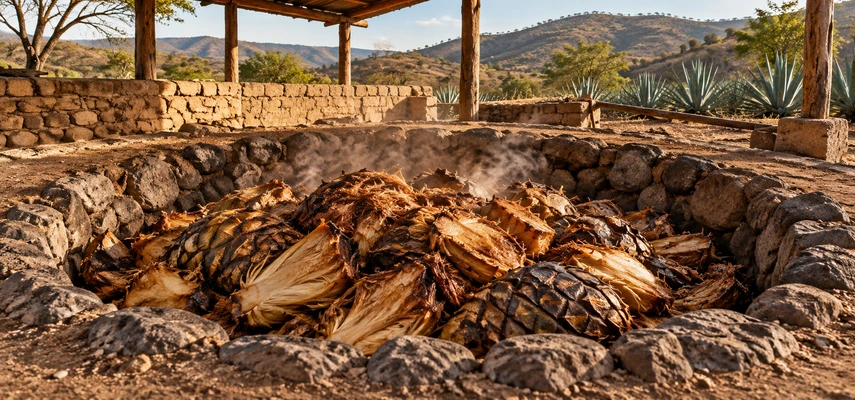

Mezcal production rewards anyone willing to look past the word smoky. Smoke can matter, especially when agave is cooked in an earth oven, but it is only one part of the explanation. The plant, producer, fermentation, still and finishing choices can be just as revealing.
This is also a category in which familiar tequila vocabulary can mislead. Both spirits come from agave, yet mezcal is not simply tequila with extra smoke. Its geographical framework, permitted raw materials and production categories need their own explanation. Even shared words such as reposado should be checked in the correct framework.
For Level 2 revision, keep Oaxaca, Espadín, Mezcal, Mezcal Artesanal and Mezcal Ancestral close at hand. Then connect those names to production choices rather than treating them as five disconnected flashcards.
Mezcal production begins with plant and place
Mezcal is a Mexican spirit with a specified geographical area and a regulated production identity. Oaxaca is a central reference point and a particularly important producing state, but the category is not restricted to Oaxaca alone. Avoid replacing a geographical framework with either made anywhere in Mexico or made only in one state.
The raw-material range is wider than tequila’s single permitted blue-agave variety. That does not mean every agave harvested anywhere qualifies. The official standard ties raw materials to the denomination area, registration and applicable extraction permissions.
Agave angustifolia Haw., commonly associated with Espadín, is especially important in commercial production. Other agaves contribute additional variety. Species names, local common names and the names used on bottles do not always fit a simple one-word-to-one-species system, so precision matters when making a botanical claim.
For the exam, identify Espadín confidently without trying to memorise every local name. For a real bottle, read the producer’s specific disclosure. A clearly identified agave helps explain the raw material, but it does not supply all the information about fermentation, cooking or distillation.
Agave variety is a starting point, not a finished tasting note
Different plants can have different growth patterns, composition and handling needs. Those differences may contribute to the resulting spirit. Yet two Espadín mezcals can differ substantially because the production choices after harvest differ.
Conversely, a similarity in aroma does not prove that two spirits came from the same agave. A fruity impression can reflect fermentation, while smoke can come from cooking conditions. Keep the botanical information and the sensory observation connected without making one a substitute for the other.
Harvesting and cooking prepare the heart
Harvesting removes the leaves and exposes the heart or piña. The material is cut and prepared for cooking. As with tequila, agave’s stored fructans need conversion into sugars that yeast can ferment; the plant is not a container of ready-made spirit.
Many traditional mezcal routes use a pit oven lined with heated stones. Agave is loaded, covered and cooked over time. This can combine carbohydrate conversion with flavour development and exposure to smoke from the fuel and cooking environment.
The Producer Mezcal describes an earth-oven route followed by crushing, fermentation and distillation. It is a useful concrete example of a familiar Oaxacan method. Its specific timings should not be imposed on every producer or every category of mezcal.
Smoke intensity varies with the complete process. A strongly smoky sample does not prove a longer maturation, and an elegant, less smoky one is not automatically less authentic. The purpose of the cooking stage is broader than making the loudest possible smoke aroma.
Crushing and fermentation create a complex starting liquid
Cooked agave is broken down to make its sugars accessible in the fermenting mixture. Hand mallets, a tahona or other equipment may be used, depending on the production category and the producer’s methods. Mechanical appearance alone is not enough to identify a formal category.
Water is introduced as appropriate, and fermentation can include both liquid and agave fibre. Microorganisms use sugars to generate alcohol and additional compounds. The presence of fibre, vessel material, temperature and fermentation management can all influence the mixture that reaches the still.
Open fermentation can draw on the producer’s maintained environment and local practice. It should not be described as no human control or as permission to ignore undesirable contamination. Experienced producers make decisions even when the process does not resemble a closed industrial fermentation system.
Fruity, floral, savoury and herbal impressions can emerge without adding those foods or plants after distillation. A mezcal that suggests pineapple or olives is not necessarily a pineapple- or olive-flavoured drink. Aroma language describes resemblance before it establishes ingredients.
Copper and clay are different distillation routes
Many mezcals are batch distilled in copper pot equipment. Copper contact, still shape, heating and cuts influence the resulting spirit. Distillers select and manage the fractions collected; a traditional method is not simply a matter of boiling the mixture and retaining everything indiscriminately.
Other producers use clay pots, often with distinctive arrangements for collecting and condensing vapour. Clay equipment can support a different production character and local working tradition. It does not mean the spirit was aged in pottery or that clay aroma must be the dominant tasting descriptor.
Mezcal Vago’s product information offers useful contrasts: copper-distilled Espadín examples alongside Tío Rey’s hand-crushed, clay-distilled production. The producer and method are disclosed separately from the agave, making it possible to compare more than one variable honestly.
Avoid a universal rule that every mezcal must use exactly the same two-pot sequence. Equipment arrangements can achieve separation differently, and the broader Mezcal category permits a wider range of systems. Describe the actual process rather than borrowing a diagram from one producer and calling it compulsory.
Three categories describe production constraints
The formal categories are Mezcal, Mezcal Artesanal and Mezcal Ancestral. They distinguish permitted production methods, not maturation time. An ancestral example does not have to be old in a barrel, and artesanal is not simply a compliment meaning someone liked the craftsmanship.
The category named Mezcal allows the broadest equipment range, including more modern cooking, milling and continuous distillation options. It is a formal category within the wider name, rather than a declaration that the product has no production rules.
Mezcal Artesanal has tighter constraints. Pit or elevated masonry cooking can be used, with permitted crushing methods and direct-fired copper or clay distillation. Mezcal Ancestral requires pit cooking, more restricted crushing methods and direct-fired clay-pot distillation with specified head materials.
The full framework also specifies fermentation vessels and other details. The teaching point is to connect ancestral particularly with pit cooking and clay equipment while remembering that compliance involves the whole process. One picturesque still is not sufficient evidence of every required stage.
These names are independent of quality ranking
More restrictive methods can preserve particular traditions and impose different practical demands. They do not make an objective sensory ranking appear automatically. A well-made spirit in the broad category and an individual ancestral batch still need to be assessed on their own merits.
Likewise, a smaller production volume is not itself a flavour. Ask what the equipment and handling actually change: fermentation character, separation, retained compounds, consistency or the producer’s available choices. This keeps the explanation informative instead of replacing technique with romance.
Blanco, joven, reposado and añejo describe another axis
Blanco or Joven identifies the familiar unaged class. Many mezcals are presented this way so their agave, fermentation and distillation character remains central. Young in this context does not establish that the producer omitted careful preparation or resting decisions elsewhere in the process.
Reposado means between two and twelve months in the qualifying wooden vessels. Añejo requires more than twelve months, with vessel capacity below 1,000 litres. These mezcal conditions should not be silently replaced by tequila’s different age and cask rules.
The standard also recognises madurado en vidrio, controlled storage in glass for more than twelve months. This is a useful reminder that time in a container and extraction from wood are not the same thing. Glass does not add oak-derived vanilla and tannin merely because a calendar has advanced.
Additional classes cover permitted added ingredients or distillation with ingredients. They reinforce another useful distinction: fermentation-derived fruit aroma is not the same thing as an ingredient deliberately added to flavour a product. Read the actual designation before assuming which route produced an unusual note.
Compare tequila and mezcal without shortcuts
Begin with the similarity: both are Mexican agave spirits requiring carbohydrate conversion, fermentation and distillation. Then name the differences. Tequila’s permitted blue variety is narrower than mezcal’s raw-material range, and their geographical areas are not interchangeable.
Next compare actual methods. A steam-cooked tequila and a pit-cooked mezcal may differ in smoke exposure, but that is a comparison of disclosed production routes, not a rule that every tequila is entirely unsmoky and every mezcal intensely smoky. Fermentation and still choices can add further distinctions.
Finally read the labels on their own terms. Tequila’s 100% agave category and mezcal’s artesanal or ancestral categories answer different questions. Reusing a word from one framework without checking its meaning in the other is an easy way to turn partial knowledge into a confidently wrong answer.
What to remember
Connect mezcal with a defined Mexican origin framework, a wider permitted agave range and Oaxaca as a key study reference. Espadín is particularly important. Cooking, fermentation and distillation explain far more than smoke alone.
Keep the three production categories separate from the maturation classes. Ancestral highlights pit cooking and clay distillation under a broader set of conditions; joven describes a different part of the story. Read both axes, then connect the producer’s actual decisions to the character they can help create.
Continue your study
To compare the Tequila framework, read Tequila Explained: Blue Agave, Jalisco, Production, and Ageing Labels. To revisit batch distillation and selection, read Pot Still Distillation Explained: Heads, Hearts, Tails, and Double Distillation. To organise a focused agave comparison, read How to Taste and Compare Spirits: A WSET Level 2 Revision Guide.
Knowledge check: 10 original practice questions
Independent TFE questions, not official WSET examination items. Choose one answer per question; explanations follow separately.
1. Which class can a clay-distilled ancestral mezcal also have?
- Automatically extra añejo
- Necessarily reposado
- Only a twelve-year age statement
- Joven
2. What does Mezcal Ancestral principally identify?
- One guaranteed flavour descriptor
- A higher sugar class
- A constrained production category
- A minimum twenty-year age
3. What can pit cooking contribute besides carbohydrate conversion?
- Smoke-related character depending on conditions
- A guaranteed barrel age
- Alcohol without fermentation
- Mandatory added sugar
4. Which geographical statement is accurate?
- Oaxaca is important, but mezcal has a wider specified area
- All Mexican agave spirit automatically qualifies
- Mezcal can be made anywhere in the world
- Only one Oaxacan village is permitted
5. Which agave is especially associated with Espadín?
- Agave angustifolia Haw.
- Juniperus communis
- Sugar cane
- Only Agave tequilana variety azul
6. Which mezcal maturation statement is correct?
- Reposado at least three years
- Reposado two to twelve months; añejo more than twelve months
- Añejo exactly two months
- All mezcal must remain unaged
7. What is the strongest way to explain a smoky mezcal?
- Assume every mezcal is identical
- Treat darkness as proof of smoke intensity
- Infer added liquid smoke without evidence
- Connect smoke to disclosed cooking and other production choices
8. Which contrast correctly separates Artesanal and Ancestral?
- Artesanal permits copper or clay distillation; Ancestral requires clay under its conditions
- Both mean exactly the same process
- Ancestral requires neutral steel columns
- Artesanal always requires Bourbon barrels
9. What does madurado en vidrio distinguish from wood maturation?
- Mandatory caramel colouring
- Ageing inside a copper still
- Storage in glass rather than wood extraction
- Fermentation after bottling
10. Why is the statement any agave from anywhere makes mezcal incorrect?
- Origin and applicable raw-material permissions matter
- Every mezcal must use molasses
- Only cactus leaves are permitted
- Fermentation is forbidden
Answers and explanations
1. D — Joven. Production category and maturation class are independent axes; ancestral production does not require wood ageing. Mapping: LO2.
2. C — A constrained production category. Ancestral concerns permitted methods including pit cooking and clay distillation, rather than an age statement. Mapping: LO2.
3. A — Smoke-related character depending on conditions. Earth-oven cooking can introduce smoke-related character, whose intensity depends on the actual production process. Mapping: LO2.
4. A — Oaxaca is important, but mezcal has a wider specified area. The denomination has a defined territory extending beyond Oaxaca, and other compliance conditions still apply. Mapping: LO2.
5. A — Agave angustifolia Haw.. Espadín is an important mezcal reference associated with Agave angustifolia, rather than a synonym for every agave. Mapping: LO2.
6. B — Reposado two to twelve months; añejo more than twelve months. The mezcal framework has its own time and vessel conditions, which should not be substituted with tequila rules. Mapping: LO2.
7. D — Connect smoke to disclosed cooking and other production choices. A causal explanation starts with actual methods and recognises variation rather than reducing the whole category to smoke. Mapping: LO2.
8. A — Artesanal permits copper or clay distillation; Ancestral requires clay under its conditions. The categories have different equipment constraints, with ancestral requiring the specified clay-pot route. Mapping: LO2.
9. C — Storage in glass rather than wood extraction. Glass storage can involve time and controlled conditions without supplying oak-derived extraction. Mapping: LO2.
10. A — Origin and applicable raw-material permissions matter. The category has geographical and raw-material controls rather than unrestricted use of any plant from any location. Mapping: LO2.












