










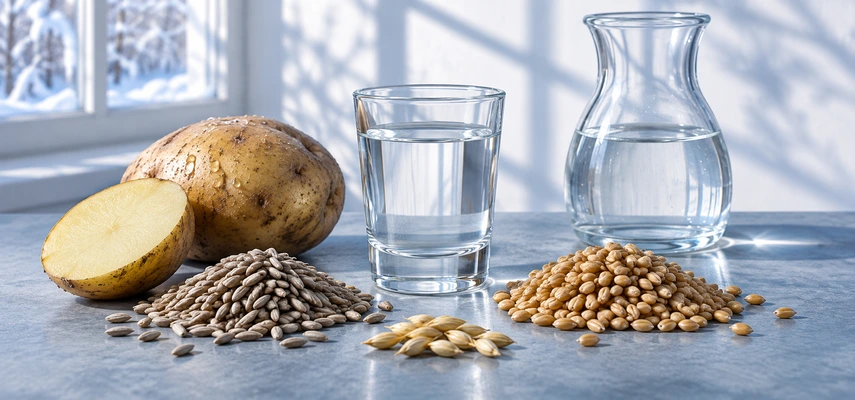

If vodka is neutral, why do producers talk about rye, wheat and potatoes? The apparent contradiction disappears when neutral is understood as a production direction rather than a promise that every bottle is indistinguishable. High-strength distillation removes much of a fermented liquid’s character, but small differences can still matter.
Vodka styles range from deliberately restrained to comparatively characterful. Those differences are usually subtler than the contrast between a smoky mezcal and an oak-aged Bourbon. They are still worth explaining through raw materials, fermentation, separation, filtration and bottling strength rather than through the elegance of the bottle.
For Level 2, keep two ideas together: vodka is made using extensively rectified spirit, and raw-material or processing choices can leave sensory distinctions. Neither all vodka tastes identical nor every grain has an unmistakable flavour fingerprint is a satisfactory answer.
Vodka styles begin with agricultural raw materials
Barley, wheat, rye and potatoes are important examples. Other agricultural materials can also provide fermentable sugar or starch. Vodka is therefore not necessarily a potato spirit, even though the potato has become a particularly persistent shorthand for the category.
The raw material supplies the basis for fermentation. Grain and potatoes contain starch that must first be converted into sugars. A sugar-containing material can require different preparation, because it does not begin with the same starch-conversion problem. Name the starting material before describing how the fermentable liquid is prepared.
At Chopin’s Polish distillery, potatoes, rye and wheat form distinct product routes. This is a concrete example of variety within one producer’s work. It does not establish that every Polish vodka uses those three materials or that every potato spirit must resemble Chopin.
The useful distinction is between a recipe fact and a tasting prediction. A disclosed rye base is a fact about production. A spicy or cereal impression is an observation or reasonable expectation that still needs to be checked against the actual spirit.
Grain preparation: open the starch, then convert it
Grain is crushed or milled and mixed with water. Cooking helps make starch accessible, with the precise conditions depending on the cereal and process. Enzymes, supplied through malt or other permitted enzyme preparations, break starch into fermentable sugars.
Cooking and enzyme conversion should not be collapsed into the statement yeast eats grain. Yeast principally uses accessible sugars; it does not make a pile of dry wheat turn directly into alcohol. The preparation stages create the liquid and sugar supply needed for fermentation.
This sequence resembles the foundation of other grain spirits, but the distillation objective can differ. A whisky producer may deliberately preserve substantial cereal and fermentation character. A vodka producer typically applies much more extensive separation before preparing the spirit for bottling.
The same grain can therefore support quite different spirit styles. It is the entire production chain, not the crop alone, that makes a high-strength vodka base different from a characterful grain whisky distillate destined for oak.
Potatoes need conversion too
Potatoes are cleaned and broken down, then cooked to prepare their starch. Enzymes convert that starch into sugars before fermentation. A potato is not a ready-made sugar solution simply because it is soft enough to mash after cooking.
The familiar phrase potato mash can hide several stages, so make them explicit when explaining the process. Cleaning protects raw-material handling, breaking up and cooking help prepare the starch, conversion provides fermentable sugars, and yeast then makes alcohol.
Raw-material quality and process control remain relevant even when a producer intends to rectify extensively. Distillation is a separation process with practical limits and costs; it is not a reason to dismiss every decision made before the still.
A useful comparison with grain starts with the shared need for starch conversion, then identifies the different physical raw materials and preparation. The comparison does not require inventing a unique yeast reaction for potatoes: the basic sugar-to-ethanol process remains familiar.
Fermentation provides alcohol before the still
Yeast produces ethanol, carbon dioxide and secondary compounds. Some of those compounds may be reduced substantially during rectification, but fermentation still determines what enters the distillation system. A clean, well-managed fermented liquid makes an appropriate foundation for the intended product.
Fermentation strength is much lower than the high-strength spirit obtained later. If a label discusses repeated distillation, it is describing separation after fermentation, not multiple occasions on which yeast creates another batch of alcohol inside the same finished bottle.
Do not confuse neutrality with absence of a fermented origin. Even an exceptionally restrained vodka remains an agricultural spirit whose alcohol has been produced biologically before concentration. The still selects and concentrates existing components rather than generating ethanol from nothing.
High-strength distillation explains the neutral direction
The important study thresholds are 95% ABV in the USA for neutral spirit and 96% ABV in the EU for ethyl alcohol of agricultural origin used in this context. These refer to production strength, not the strength at which someone buys a normal bottle of vodka.
The US standard and EU framework use different category wording and conditions. Keep the threshold attached to its jurisdiction. A one-percentage-point difference should not become a claim that every US vodka is necessarily more aromatic than every EU vodka.
Column stills provide repeated vapour-liquid interactions. Extensive rectification separates ethanol from many other compounds, supporting the comparatively neutral profile. The number of stages, reflux, equipment configuration and collection choices matter more than a simplistic count of tall tubes in a distillery photograph.
Marketing statements about being distilled many times need context. A stage within a continuous system is not necessarily equivalent to a separate batch run through a pot still. More impressive arithmetic does not establish a universal quality ranking.
Activated charcoal is a tool, not a compulsory explanation
Activated charcoal has a large internal surface that can adsorb certain compounds. Passing spirit through an appropriate filter can reduce unwanted characteristics and help shape the intended profile. Adsorption refers to material associating with the surface, not charcoal fermenting or distilling the liquid again.
Filtration can also remove compounds the producer might otherwise wish to retain. The relevant question is what the treatment is intended to achieve, using which material and under which conditions. A distinctive filtration story does not by itself establish a measurable improvement over every alternative.
Not every vodka follows an identical charcoal treatment. Some producers place more emphasis on their distillation and retain a different balance of compounds. A filter’s existence, absence or exotic advertised material cannot replace tasting or reliable process information.
Keep particle filtration separate from selective treatment with activated carbon. Removing visible solids and changing the concentration of dissolved aroma compounds are different tasks, even if a producer uses filters for both at different points.
Water, additives and bottling create the finished presentation
Water reduces the high-strength spirit to bottling strength. Its suitability and treatment matter, but a picturesque source is not proof that a particular mineral flavour survives every stage. A useful explanation identifies the producer’s actual water handling rather than assuming a mountain image tells the chemistry.
The US framework permits limited sugar and citric-acid treatment in vodka; other additions can change classification. EU rules have their own limits and conditions. Therefore neither every vodka contains additives nor no vodka can contain any permitted adjustment is a safe universal statement.
Distinguish an unflavoured vodka with permitted finishing from a deliberately flavoured vodka. A strong added citrus, vanilla or fruit identity belongs to a different discussion from subtle cereal character retained after distillation. Familiar aromas alone do not reveal which route was used.
Resting or blending spirit batches before bottling can support consistency. Those handling decisions should not automatically be called barrel ageing, particularly when legal conditions restrict wood storage. Identify the vessel and applicable category before importing an explanation from whisky.
Neutral and characterful do not mean good and bad
A comparatively neutral style can be chosen to minimise competition with other cocktail ingredients. A characterful style may preserve more cereal, savoury or textural distinction. Both are production objectives rather than automatic quality grades.
When comparing, use similar glassware and strength where possible, and avoid a heavily chilled sample for one bottle against a warm sample for another. Serving conditions can obscure or exaggerate differences. Actual alcohol tasting is optional; production records can support a written comparison without drinking.
Distinguish aroma, texture and alcoholic heat. A fuller-feeling sample need not have a stronger aroma, and a warmer sensation need not establish a particular raw material. Sensory precision prevents one broad word such as smooth from carrying more information than it can support.
Traditional countries are reference points
Poland, Russia, Sweden and Finland are important vodka-producing traditions in this syllabus. Treat them as geographical references, not four compulsory flavours. Producers within a country can choose different crops, rectification systems and finishing approaches.
Absolut’s Swedish production account connects winter wheat with continuous distillation. Together with the Polish potato and cereal example, it shows why vodka cannot be reduced to one universal raw material. Neither example supplies a rule for every bottle from its country.
What to remember
Vodka’s agricultural raw materials may require starch conversion before fermentation. Extensive rectification, often in columns, explains the relatively neutral direction; remember the US95% and EU96% production references separately from bottling strength.
Charcoal, water and permitted finishing can further shape the result. Neutral and characterful describe a range, not competing quality ranks. Explain subtle differences through the complete process while keeping country, recipe and actual sensory observation distinct.
Continue your study
To revisit starch preparation and fermentation, read How Spirits Begin: Raw Materials, Sugar Conversion, and Fermentation. To understand high-strength rectification, read Column Still Distillation Explained: Reflux, Rectification, and Continuous Production. To follow neutral vodka into flavoured styles, read Flavored Vodka and Spiced Rum Explained: How Spirits Gain Added Flavor.
Knowledge check: 10 original practice questions
Independent TFE questions, not official WSET examination items. Choose one answer per question; explanations follow separately.
1. What does activated charcoal mainly do here?
- Supplies juniper oil
- Converts potato starch
- Adsorbs selected compounds
- Creates ethanol
2. What can supply enzymes for cereal conversion?
- Oak tannin
- Activated charcoal
- Malt or appropriate enzyme preparations
- Glass bottles
3. What distinguishes characterful unflavoured vodka from flavoured vodka?
- All clear spirits have identical recipes
- Retained character does not necessarily involve added flavourings
- Every cereal note proves added spice
- Characterful means barrel-aged whisky
4. Which set contains the syllabus vodka-country references?
- Scotland, France, Spain and Portugal
- Cuba, Jamaica, Guyana and Barbados
- Poland, Russia, Sweden and Finland
- Brazil, Peru, Chile and Mexico
5. Which production-strength reference belongs to EU agricultural ethyl alcohol?
- 20% ABV
- 60% ABV
- 96% ABV
- 37.5% ABV
6. Which neutral-spirit production threshold applies in the US reference?
- 15% ABV
- 40% ABV
- 95% ABV
- 55% ABV
7. Why do columns help make a restrained vodka base?
- They require wood ageing
- Repeated interactions support extensive separation
- They add cereal flavour automatically
- They ferment ethanol
8. Which vodka material requires starch conversion?
- Bottling water
- Distilled ethanol
- Potatoes
- Already fermentable sugar solution
9. Which statement about additives is accurate?
- Any addition leaves classification unchanged
- All vodka rules prohibit every adjustment
- Every vodka contains vanilla
- Permissions depend on the category and jurisdiction
10. Which comparison method is most useful?
- Control serving conditions and describe specific differences
- Assume potatoes guarantee identical flavour
- Rank quality by distillation-count advertising
- Use smooth as the only note
Answers and explanations
1. C — Adsorbs selected compounds. Carbon treatment can selectively alter the spirit; it is not fermentation or starch conversion. Mapping: LO2.
2. C — Malt or appropriate enzyme preparations. Enzymes break starch into fermentable sugars; charcoal and wood perform different roles. Mapping: LO2.
3. B — Retained character does not necessarily involve added flavourings. Raw material and production may leave subtle character without deliberately adding a named flavour. Mapping: LO2.
4. C — Poland, Russia, Sweden and Finland. These are the relevant geographical traditions, without requiring one fixed flavour for each. Mapping: LO2.
5. C — 96% ABV. The EU96% threshold relates to the high-strength alcohol base, not a normal serving strength. Mapping: LO2.
6. C — 95% ABV. The 95% reference concerns distillation strength, while normal bottled vodka has been diluted. Mapping: LO2.
7. B — Repeated interactions support extensive separation. Rectification can remove many congeners, while actual operation determines the retained profile. Mapping: LO2.
8. C — Potatoes. Potato starch must be made accessible and converted into sugars before yeast can ferment it. Mapping: LO2.
9. D — Permissions depend on the category and jurisdiction. Limited treatments may be permitted, while stronger flavour additions can change the category. Mapping: LO2.
10. A — Control serving conditions and describe specific differences. Comparable conditions and precise observations support a more defensible explanation than marketing arithmetic. Mapping: LO2.












