










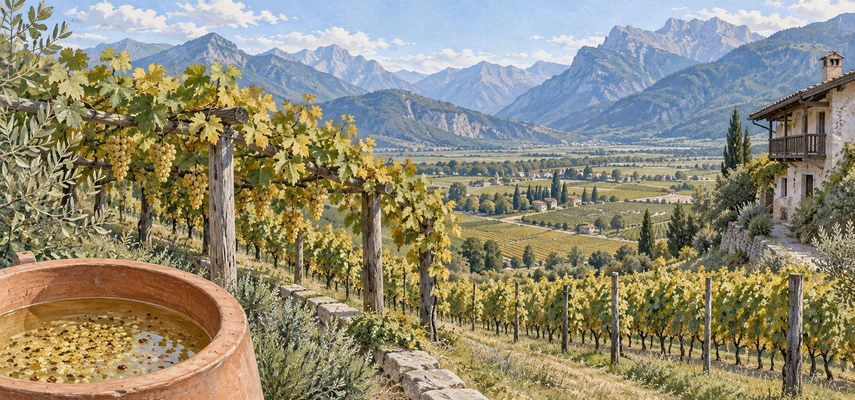

A mountain on the label doesn’t tell you how cold the vineyard was. In Trentino-Alto Adige, a warm valley parcel suited to a deeply coloured red can sit within sight of much cooler white-wine sites. Farther east, Friuli-Venezia Giulia offers another set of contrasts: plains and border hills, pale freshly pressed whites and amber wines fermented with their skins.
For Diploma study, keep the two regions distinct. Compare the decisions behind their wines rather than memorising a single northeastern Italian style. Pinot Grigio provides a useful bridge, but it shares this landscape with plenty of grapes that deserve their own introductions.
Place Trentino-Alto Adige along the valleys
Trentino-Alto Adige lies in northern Italy, with Trentino to the south and Alto Adige, also called Südtirol or South Tyrol, farther north. The Adige corridor and its side valleys connect vineyards with very different elevations, aspects and exposures. The Alto Adige consorzio describes Alpine shelter alongside warmer southern influences. An Alpine setting doesn’t mean every parcel struggles to ripen grapes.
Temperature affects growth and acid retention: higher or cooler sites can preserve freshness, while sheltered lower slopes and valley sites can help later-ripening red fruit mature. Sunlight supports photosynthesis, but aspect, mountain shading and bunch exposure affect the useful light received. Water availability depends on rainfall, rooting and the drainage of individual soils, including the alluvial settings of the valley floor. Nutrient availability influences vigour; neither gravel nor elevation automatically means low yields.
Weather creates frost, hail, heat, drought and harvest-rain risks. Downy and powdery mildew and bunch rot remain relevant even when a brochure emphasises sunshine. Vineyard establishment considers slope access, erosion, machinery and the intended training system. Planting materials should match variety, soil and water conditions, rather than simply copying a successful neighbour’s higher vineyard.
Nutrient and water management follows vine performance and analysis within applicable rules. Canopy management balances productive leaves, airflow and protection from excessive exposure; pergola and upright systems offer different arrangements, not ready-made quality rankings. Harvest timing balances flavour, acidity, sugar and health. Hazard management includes safe slope access and suitable frost precautions. Pest and disease management combines monitoring, canopy work and justified interventions.
Give the Alpine grapes different jobs
Alto Adige’s whites include Pinot Grigio, Pinot Bianco, Chardonnay, Sauvignon Blanc and Gewürztraminer. Cooler valley branches also give grapes such as Kerner and Sylvaner a role. Don’t assign the same expected aroma, body or acidity to all of them. Gewürztraminer’s pronounced perfume and potentially broad palate present a different balance problem from a more restrained Pinot Bianco.
Schiava, also known as Vernatsch, offers a useful relatively light red reference; Lagrein supplies a different colour and structural proposition, particularly associated with the Bolzano area. Pinot Nero requires its own site, crop and extraction decisions. Darker colour doesn’t establish better quality, and a lighter Schiava needn’t apologise for being itself.
Trentino adds distinctive local anchors. The regional Nosiola account connects the grape with dry whites and the dried-grape sweet wine Vino Santo. That’s a specific production choice, not proof that every Nosiola is sweet. Cantina Sociale di Trento identifies Teroldego with the Piana Rotaliana and Marzemino with Vallagarina. Chardonnay, Pinot Grigio and other internationally familiar grapes also matter; Trentino isn’t a museum containing only local varieties.
Follow Alpine fruit through the cellar
Winemaking approaches begin with the target style: an aromatic fresh white, a textured lees-aged white, a fragrant red or a more structured Teroldego needs different handling. Careful grape transportation limits crushing and premature oxidation. Reception should separate varieties, origins, health and ripeness so that a sound parcel isn’t diluted by unsuitable material.
Processing and pressing affect yield and phenolic pickup. Pre-fermentation clarification adjusts solids for the intended fermentation rather than pursuing the clearest possible juice at any cost. Must adjustments require analysis and legal permission. Alcoholic fermentation decisions include yeast, temperature, vessel and nutrient management; cool controlled fermentation can protect a white’s fruit, but temperature control doesn’t manufacture complexity from weak grapes.
Malolactic conversion and subsequent maturation should fit acidity and style. Extraction and pressing should suit skin ripeness: gentle handling can preserve Schiava’s fragrance, while Teroldego may support more structure without benefiting from aggressive, drying tannins. Finishing adjustments, sulfur dioxide and filtration depend on analysis and stability needs. Lees maturation can build texture in a white without requiring prominent new oak.
Blending eligible lots can improve balance while retaining label entitlement. Post-fermentation clarification removes unwanted solids, and stabilisation considers protein and tartrate risks. Microbiological safeguards should fit analysis, retained sugar and distribution. Packaging and closures should protect the intended drinking period. Wine transportation requires suitable temperature control; a carefully preserved Alpine white can still arrive tired after poor freight handling.
Read Alpine origin and business together
International and EU protection frameworks, national Italian law and local appellation specifications interact. Industry associations such as the consorzi explain origin and coordinate promotion, while official controls establish compliance. A geographical indication ties a place to prescribed production conditions. DOC and DOCG sit within the PDO framework; PGI/IGT wines have their own requirements, and wines without GI don’t inherit DOC vineyard claims.
Alto Adige’s UGA system adds 86 designated geographical units from the 2024 vintage for eligible DOC wines meeting the conditions. This is a more precise origin claim, not an automatic outstanding tasting grade. Alto Adige, Trentino and Teroldego Rotaliano labels should each be interpreted through their own specifications rather than treated as interchangeable names.
Supply depends on yields, health and suitable fruit, with small difficult parcels limiting expansion. Demand differs between familiar Pinot Grigio and less familiar Nosiola. Costs include slope labour, sorting and cellar time. Legislation affects yields, origin claims and release choices; currency exchange changes the margin on an export sale even when the local production bill is unchanged.
A grower may supply fruit, while an estate can coordinate vineyard and cellar decisions. A broker connects parties; a merchant sources wine or grapes; a winery provides production capacity. A virtual winery contracts production, and a custom crush facility supplies agreed production services. These are possible business functions, not claims that each dominates locally. A cooperative can share equipment and market access, as the Trento example illustrates. A conglomerate may coordinate businesses while retaining separate brands.
Importing adds freight, currency and compliance costs. Retail needs clear variety and origin information; HoReCa buyers require staff able to explain a Schiava beside Pinot Nero. Direct-to-consumer sales can retain revenue but require hospitality and fulfilment. Mature and emerging markets contain varied customers. Wine brands can lead with regional origin or a familiar variety. Marketing concepts begin with a target customer; marketing options include comparative flights and grower visits. The five Ps connect product, price, people, place and promotion: an expensive small-parcel white needs an audience and route to sale that can explain its price.
Locate Friuli-Venezia Giulia beyond one hill
Friuli-Venezia Giulia occupies Italy’s northeastern border, adjoining Austria and Slovenia and extending towards the Adriatic. The regional consortia directory distinguishes appellations including Collio, Friuli Colli Orientali, Friuli Grave, Friuli Isonzo and Carso. Don’t substitute the fame of Collio for the geography of the whole region.
In Friuli, temperature and ripening respond to elevation, aspect and differing inland or coastal influences. Slope orientation changes the sunlight available to leaves and fruit. Rainfall, soil depth and drainage determine the water a vine can actually use; gravelly plains and marl-and-sandstone hills aren’t identical rooting environments. Soil nutrition also shapes vigour and canopy density. The regional Collio account identifies the layered material called ponca, which helps explain physical soil conditions rather than a compulsory flavour of crushed rock.
Frost, hail, heat, drought and wet harvests can damage the crop. Persistent moisture increases concern about downy mildew, powdery mildew and rot. When establishing a vineyard, compare slope drainage, erosion and access with the relative ease of working flatter parcels. Choose healthy planting material suited to the site and intended wine; a prestigious hill address can’t rescue an unsuitable variety or diseased vines.
Observe vine growth and analyse the site before adding nutrients or changing water management. Open a vigorous canopy enough to improve airflow without leaving bunches vulnerable to sunburn. Picking decisions weigh flavour, acid and health, including phenolic maturity for skin-fermented whites. Use ground cover or other suitable erosion controls, assess frost precautions, and monitor pests and disease before intervening. Diseased grapes don’t become more suitable simply because the intended wine will spend longer on skins.
Compare pale, copper and amber whites
The Friuli DOC grape account includes Friulano, Ribolla Gialla, Malvasia Istriana, Pinot Grigio, Sauvignon Blanc and Chardonnay. Friulano’s former Tocai name doesn’t make it Hungarian Tokaji; Hungarian Tokaj also makes dry wine. Ribolla can appear in different production styles, so the variety alone doesn’t identify an orange wine.
The intended white style sets the cellar programme. Carry grapes promptly in suitable containers, then sort and keep varieties and origins separate at reception. Processing affects colour and texture: promptly separating Pinot Grigio juice from its grey-pink skins gives a different result from deliberately retaining skin contact for a copper-toned ramato. Time, temperature and extraction matter, not just the word traditional.
Settle or otherwise clarify juice to the desired solids level, then assess any legally permitted must adjustment from analysis. Choose yeast, fermentation temperature and vessel for the desired outcome. A pale fruit-led white may ferment away from skins, whereas a skin-fermented white extracts phenolics during fermentation. Decide whether malolactic conversion and later maturation will improve balance, rather than assuming every white needs either. Skin condition should guide extraction and pressing, with excessive bitterness a possible cost of prolonged contact.
Before bottling, consider permitted finishing adjustments, sulfur dioxide and filtration against the wine’s actual stability needs. Ageing on lees can broaden texture; combining eligible lots may improve balance. Clarify after fermentation where appropriate, and evaluate protein and tartrate stability. Microbial protection depends on analysis, retained sugar and the intended distribution chain. Choose packaging and closures to limit unwanted oxygen and contamination, then protect the wine from freight heat whatever the winemaking philosophy.
Radikon’s own wine descriptions illustrate differing skin-contact and ageing programmes, rather than one universal regional recipe. A clay vessel isn’t required for skin fermentation. Orange, natural and certified organic describe different questions and shouldn’t be used as synonyms. Evaluate the resulting balance, complexity and condition rather than awarding points for unconventional equipment.
Keep Friuli’s red and label identities visible
Friuli also produces Merlot, Cabernet varieties and local reds including Refosco dal Peduncolo Rosso, Schioppettino and Pignolo. Match extraction and maturation to their fruit and tannin rather than applying a single robust-red formula. Sweet regional wines such as Ramandolo and Picolit add another category; Rosazzo’s dry white identity prevents the mistaken rule that every regional DOCG must be sweet.
Protected origins here depend on the interaction of international agreements, EU provisions, Italian legislation and each local specification. The consorzi help communicate these identities. DOC and DOCG belong to the PDO category, while the PGI/IGT route includes Venezia Giulia with its separate entitlements. A wine sold without a GI cannot borrow protected origin claims. The broad Friuli DOC and smaller appellations aren’t synonyms or an automatic sensory league table.
The available supply reflects suitable sites, the harvest and stock still maturing. A recognisable Pinot Grigio faces different demand from a skin-fermented local variety. Sorting, barrel storage and delayed payment all cost money; legislation constrains origin and production choices, while exchange-rate movements alter export returns. Long ageing requires finance before it becomes a selling point.
Growers selling fruit give up some control over its eventual use, whereas an estate joins growing and winemaking decisions. Brokers arrange transactions; merchants buy and sell wine or grapes; wineries supply cellar capacity. Contracting allows a virtual winery to operate without owning all that equipment, with custom crush providers selling specified services. Cooperative ownership shares resources among members; a conglomerate can spread investment across businesses. Assess these as potential routes with different control and margin, not a census of local ownership.
Importers budget for freight and compliance; retailers need clear style information so an amber wine doesn’t surprise a customer expecting pale Pinot Grigio. Hotels, restaurants and caterers need service training, while selling directly requires fulfilment and education. Neither a mature market nor an emerging one contains a single type of buyer. A brand might emphasise appellation, grape or production approach. Start marketing with the customer: a skin-contact comparison and transparent technical notes can explain a specialist bottle. Product, price, people, place and promotion must work together, with storage time and explanation reflected in the commercial plan.
Compare the evidence here with Tuscany’s Sangiovese wines as a regional case, then apply the regional comparison framework to the comparison. Compare growing conditions, production decisions, style, quality and the commercial reasons for price. Establish the differences rather than assuming that one familiar name must be better.
Original Diploma practice
These original exercises practise explanation and evaluation. They aren’t official examination questions, marking schemes or reports of bottles tasted.
Question 1: challenge an Alpine shortcut
An importer proposes describing all Trentino-Alto Adige wines as light, cool-climate and unoaked. Evaluate the claim and suggest a better range.
Reasoned outline: Separate warm valley sites from cooler exposures, then distinguish fragrant Schiava, structured Teroldego and aromatic or textured whites. Explain site and canopy effects, selective harvesting and different extraction or maturation choices. Offer a Pinot Grigio plus a contrasting white and a regional red, with individual technical notes. Elevation alone doesn’t establish body, oak use or quality.
Question 2: compare Friuli white-wine routes
A producer can promptly press healthy Pinot Grigio or ferment a suitable white variety on its skins. Compare the production and commercial implications.
Reasoned outline: Link pressing to colour and phenolic extraction; discuss health, temperature, skin maturity, oxygen and microbial control. Compare texture and bitterness risks, not a guaranteed quality difference. Longer maturation increases storage and finance needs, while specialist restaurant customers may value explanation and distinctiveness. Skin contact changes the wine’s demands without guaranteeing superior balance.
Question 3: assess a more precise origin claim
A retailer argues that an Alto Adige UGA white must be better than a Friuli DOC white. Evaluate the argument.
Reasoned outline: Establish the separate regions and actual label entitlements. Explain that the UGA system adds defined origin and production conditions to eligible Alto Adige DOC wines, not a cross-regional tasting score. Compare producer ambition, fruit, winemaking and price in each bottle. More precise geography provides information rather than a substitute for assessing quality.
Analytical tasting preparation: compare northeastern white and red choices
The official recommended-sample programme, printed page 22, includes a very good Pinot Grigio from Alto Adige, Trentino or Friuli, plus another very good white from those regions that isn’t Pinot Grigio. Select, for example, a Pinot Grigio and a Friulano or Pinot Bianco, checking actual quality and origin rather than assuming either from the name. The Veneto essential selections belong alongside them in the broader northeastern Italian programme.
Optional selections include a very good natural or orange wine, very good Alto Adige Pinot Nero, and a very good indigenous-variety red from Alto Adige, Trentino or Friuli. A suitable Teroldego or Refosco can serve the last purpose. These are proposed selections, not assertions that every example reaches that level; the optional Bardolino comparison sits with Veneto.
For both Trentino-Alto Adige and Friuli-Venezia Giulia, write full systematic descriptions blind before checking labels. Compare acidity, body, flavour intensity, phenolic texture and any maturation evidence. Justify quality through balance, length, intensity and complexity with actual observations, separating concentration from harshness or oxidation. Assess bottle-ageing suitability separately: a wine needs sufficient fruit and structure, not just an unusual colour, protected place-name or expensive release price.












