










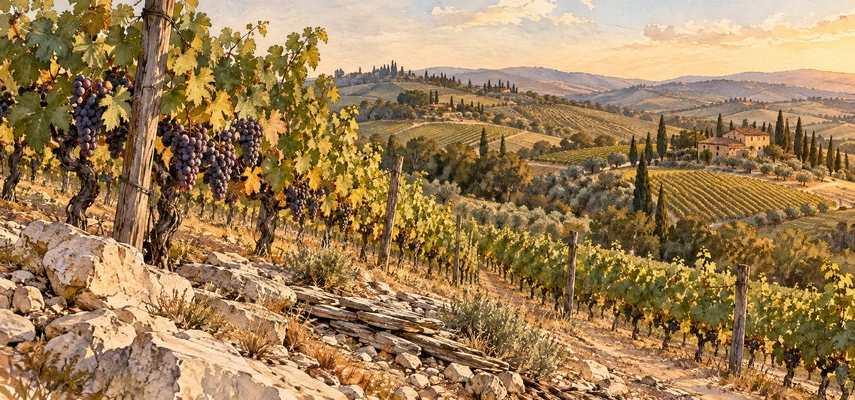

Sangiovese has a useful knack for making its surroundings matter. A fragrant, brisk red for supper and a tightly structured wine intended for years in the cellar can share the grape without sharing the same growing conditions or production plan. Tuscany gives Diploma students several opportunities to explain that difference.
Begin with three distinct geographical frameworks: Chianti and Chianti Classico, Montalcino, and Montepulciano. Then connect site, grape handling and maturation to the wine actually produced. A famous Tuscan name supplies context; it doesn’t write the tasting conclusion for you.
Locate Tuscany’s inland Sangiovese settings
Tuscany lies in central Italy, with an inland hill country and a western coast. Chianti Classico occupies a delimited area between Florence and Siena. The wider Chianti appellation has its own separate rules and subzones; Classico isn’t simply a reserve category available to every Chianti producer. Brunello belongs to Montalcino, south of Siena, while Vino Nobile belongs to the separate town and surrounding production area of Montepulciano.
That last name needs care. Montepulciano is a place in this Tuscan discussion, whereas the Montepulciano grape associated with Abruzzo is a different subject. Vino Nobile’s central grape is Sangiovese, locally called Prugnolo Gentile. Brunello is likewise a local name associated with Sangiovese, not permission to add any dark grape that happens to ripen nearby.
The Montalcino consorzio’s territory account describes varied elevations, aspects and soils within the historical production boundary. Consequently, the broad observation that Montalcino offers relatively warm growing conditions shouldn’t turn into a claim that every Brunello vineyard is hotter than every Chianti Classico parcel. Compare the actual sites and season.
Explain the vineyard before the label
Temperature affects growth, the pace of ripening and acid retention. Sunlight supports photosynthesis, while aspect and canopy exposure alter bunch conditions. Sangiovese can retain conspicuous acidity and develop substantial tannin, so achieving flavour and skin maturity without excessive sugar is an important balancing act. A cooler elevated site can help in a hot year and create a ripening challenge in a cooler one.
Water availability depends on rainfall, soil depth, drainage and rooting. Nutrient availability influences vigour and crop balance. Galestro and alberese are useful regional soil terms, but the practical questions concern structure, drainage and water supply. A tasting note describing stony character doesn’t prove that a particular rock dissolved into the wine.
Weather creates frost, hail, heat, drought and harvest-rain risks. Downy and powdery mildew and bunch rot can reduce healthy fruit, especially when moisture persists. Long-awaited autumn ripeness is less useful if the bunches deteriorate before picking. Conversely, very dry conditions can restrict vine function rather than merely concentrating everything into excellence.
Vineyard establishment considers slope stability, exposure, access and the intended training system. Planting materials should match the parcel: healthy vines, suitable rootstocks and appropriate Sangiovese selections matter more than treating the grape’s local names as self-contained quality guarantees. Other permitted varieties need their own ripening assessment where blending is allowed.
Nutrient and water management follows observation and analysis within the rules. Canopy management balances active leaf area, airflow and bunch protection; removing more leaves isn’t always beneficial during heat. Harvest timing balances flavour, sugar, acidity, tannin and health. Hazard management includes erosion control and suitable frost precautions. Pest and disease management combines monitoring, canopy work and proportionate intervention rather than relying on the reputation of a sunny region.
Read Chianti and Chianti Classico separately
The June 2026 Chianti specification changes a common textbook shortcut. For the 2026/27 harvest campaign, its red-wine vineyard composition permits 60–100% Sangiovese, with complementary varieties subject to conditions. The older 70% minimum shouldn’t be presented as timeless. The update also introduces Chianti Rosé and the Terre di Vinci subzone. Vintage and transitional provisions therefore matter when interpreting a particular bottle.
Chianti Classico retains a different framework. The ministry’s consolidated Classico specification sets 80–100% Sangiovese for the standard wine and Riserva, with eligible red complements. White varieties aren’t the answer to a modern Classico blend. Gran Selezione’s stricter 90% minimum Sangiovese, completed only by specified local red varieties, applies from the 2027 harvest under the transition; don’t retroactively impose it on every older release.
Classico Riserva requires at least 24 months’ maturation and Gran Selezione 30, including prescribed bottle time. Gran Selezione also uses fruit from vineyards under the producer’s control. Its additional geographical units refine origin for eligible wines; they don’t rank villages from best to worst. Neither Riserva nor Gran Selezione obliges every producer to use a conspicuous dose of new small oak.
A lighter, fruit-led Chianti and a more ambitious Classico can therefore differ in crop selection, extraction, maturation, cost and audience. These are comparisons to investigate rather than automatic quality conclusions. A balanced standard wine can succeed at its purpose, while a costly wine can still be over-extracted.
Give Brunello time without confusing time with oak
The Brunello production rules require Sangiovese. They also separate time in oak from total time before release: at least two years in oak, with minimum bottle periods of four months, or six for Riserva. The normal release calendar is the fifth year after the harvest, and the sixth for Riserva. Thus a 2021 normal Brunello reaches its calendar release in January 2026, assuming every other requirement is met; the equivalent Riserva date is January 2027.
Five years before release doesn’t mean five years in a new barrique. Large older casks and smaller barrels offer different surface-area and oxygen relationships, while new wood can contribute more obvious oak aromas and tannin. Producers choose particular programmes within the specification, and the wine still needs fruit sufficient to support them.
Rosso di Montalcino provides a separate, earlier-release Sangiovese route under its own rules. It can support cash flow and a different drinking occasion rather than functioning only as a label for failed Brunello. Selecting lots for different programmes lets a producer connect vineyard performance with commercial needs. The designation alone doesn’t tell you which bottle you will enjoy more tonight.
Distinguish Vino Nobile, Riserva and Pieve
The Vino Nobile consorzio’s rules overview identifies a 70% minimum Sangiovese for Vino Nobile di Montepulciano, with eligible complements. Its normal maturation minimum is two years, using permitted combinations of wood and other holding periods; Riserva requires three years, including bottle maturation. Don’t substitute Brunello’s all-Sangiovese and release requirements just because both wines come from southern Tuscan hills.
Pieve adds a more specific origin and production framework. The 2025 official amendment specifies at least 85% Sangiovese, with restricted local red complements, and a three-year maturation programme including at least twelve months in wood and twelve in bottle. Directly managed vineyards must meet additional age and site conditions. It isn’t simply an attractive new word for any existing Nobile Riserva.
The useful comparison asks what these decisions achieve. Suitable fruit may gain integration and developing complexity during maturation. Weak fruit doesn’t become concentrated through paperwork, while a dried-out wine doesn’t gain a fresh future from the word Pieve. More restrictive production conditions need to be connected with observed balance and persistence.
Follow Sangiovese from reception to release
Winemaking approaches begin with the intended style and permitted blend. Careful grape transportation limits crushing, unwanted fermentation and oxidation. Reception should separate origins, health and ripeness, keeping the traceability needed for the eventual label. Processing and pressing affect extraction and yield: destemming, crushing choices and the separation of press fractions can change the tannin delivered to the blend.
Alcoholic fermentation decisions include yeast, temperature, vessel and cap management. A hotter or longer extraction isn’t automatically better for Sangiovese; seed and skin maturity, alcohol and the intended drinking window influence the result. Extraction and pressing should suit the fruit. Gentle cap management and selective use of press wine may preserve a more attractive balance than extracting everything available.
Malolactic conversion and subsequent maturation influence acidity, stability and integration. Blending eligible lots can balance fruit and structure, but Brunello’s varietal requirement rules out solving a shortfall with Merlot. In Classico or Vino Nobile, permitted complements still have to fit the particular category and vintage. Legal permission to blend doesn’t establish a good blending decision.
Packaging and closures should protect the intended drinking period, with bottling conditions and oxygen management important for wines expected to age. Wine transportation requires suitable temperature management. A mature red’s provenance matters because years of careful cellar work can be compromised by warm storage after release. The separate coastal chapter extends the production comparison to other grapes and white-wine handling.
Connect protected origin with commercial choices
International and EU protection frameworks, national Italian law and local appellation specifications interact. Industry associations such as the consorzi coordinate promotion and explain rules; independent control requirements and official specifications govern entitlement. A geographical indication ties a place to defined production conditions. DOC and DOCG sit within the PDO framework; the letters don’t constitute a blind-tasting score.
Classico, Riserva, Gran Selezione and Pieve answer different questions about origin or production. Treat the label as a set of verifiable claims. The Chianti consorzio’s 2026 announcement also shows why compliance needs updating when categories and transfer controls change. An old study table isn’t sufficient evidence for a current shipment.
Supply depends on healthy fruit, suitable vineyards and stocks retained for maturation. Demand differs between accessible restaurant reds and expensive cellar selections. Costs include vineyard labour, sorting, oak where used, storage and financing. Legislation affects production and release dates; currency exchange changes the return on export sales. Delaying a sale requires working capital even when the wine is gaining complexity.
A grower may supply fruit, while an estate can coordinate vineyard and cellar decisions and retain its own story. A broker connects parties, a merchant sources wine or grapes, and a winery provides production capacity. Different contracts distribute risk and margin differently; ownership of vineyards isn’t itself proof of a superior bottle.
Importing adds freight, currency and compliance costs. Retail needs clear category and vintage explanations; HoReCa buyers require staff who can distinguish a ready-to-drink red from a firm young wine without declaring the latter defective. Direct-to-consumer sales can retain revenue but add hospitality, fulfilment and stock-management work. Mature and emerging markets contain varied customers, from holiday visitors to collectors. Wine brands can lead with place, producer or occasion, with the product and route to sale supporting the price being asked.
Compare the evidence here with Bolgheri and coastal Tuscany as a regional case, then apply the regional comparison framework to the comparison. Compare growing conditions, production decisions, style, quality and the commercial reasons for price. Establish the differences rather than assuming that one familiar name must be better.
Original Diploma practice
These original exercises practise causal explanation and evaluation. They aren’t official questions, marking schemes or reports of actual bottles tasted.
Question 1: explain two Sangiovese outcomes
Compare a fresh, earlier-drinking Tuscan Sangiovese with a structured wine intended for long maturation. Explain vineyard, cellar and commercial decisions that could produce each.
Reasoned outline: Relate site temperature, water supply, crop balance and picking to ripe fruit and retained acidity. Compare sorting, fermentation, cap management, press fractions and maturation. Explain how a longer programme increases storage and financing needs. Greater extraction only helps when fruit and tannin can support it; a fresh wine needn’t be an inferior attempt at the ageworthy style.
Question 2: correct a release and blend proposal
A merchant says that a 2021 Brunello can be sold as normal Brunello in January 2025 if it has spent three years in oak, and that Merlot can soften its tannin. Assess both claims.
Reasoned outline: Separate the release calendar from minimum oak time. Normal 2021 Brunello’s calendar release is January 2026, subject to compliance; extra oak doesn’t bring that date forward. Brunello requires Sangiovese, so Merlot isn’t a permitted fix. Fruit selection, extraction, suitable maturation and eligible lot selection offer different ways to address balance.
Question 3: evaluate a label-based quality ranking
A retailer ranks every Gran Selezione, Pieve and Brunello above every standard Chianti Classico before tasting. Evaluate that buying method.
Reasoned outline: Explain each category’s different origin, blend and maturation conditions, including the Gran Selezione transition from the 2027 harvest. Such rules can support ambitious production without eliminating weak fruit, excessive oak or poor storage. Compare quality from actual evidence and relate price to the customer’s drinking plans. More demanding rules don’t remove the need to assess the individual wine.
Analytical tasting preparation: compare inland Tuscan reds
The official recommended-sample programme, printed page 22, includes Chianti or Chianti Classico of acceptable or good quality; Chianti Classico Riserva or Gran Selezione of very good or outstanding quality; and Brunello di Montalcino or Vino Nobile di Montepulciano of very good or outstanding quality. Select actual examples meeting those aims rather than assigning a grade from the category. The Tuscan white and international-variety red essential selections, plus the optional acceptable/good IGT comparison, extend the programme in the coastal chapter.
Write full systematic descriptions blind. Compare acidity, tannin texture, body, fruit, oak and developing aromas without making colour a quality shortcut. Justify quality through balance, length, intensity and complexity, citing the observations that support the conclusion. Assess bottle-ageing suitability separately: retained fruit, supporting structure and integration matter more than the number of months already spent in a cellar. These are proposed selections and methods, not actual tasting results or official sample grades.











