










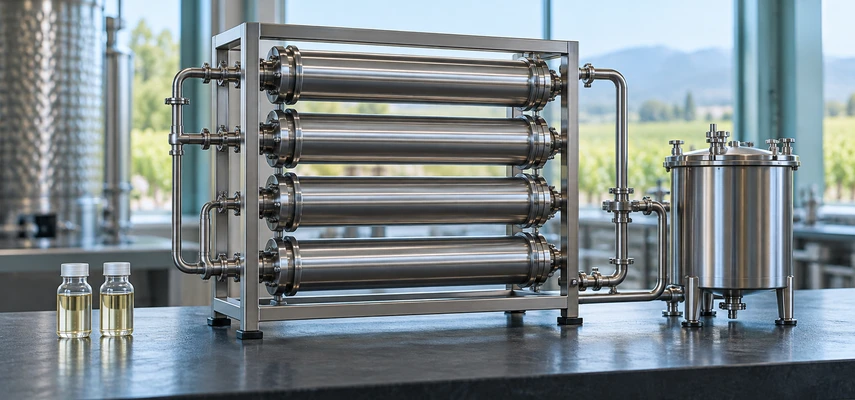

Removing alcohol does not leave an otherwise identical wine behind. Ethanol affects warmth, flavour release, texture and the environment in which microorganisms live. Modern winemaking can reduce its concentration precisely, but the resulting product needs to be assessed as a changed system rather than the original wine with one number erased.
A modest correction and a near-zero product also present different problems. Moving a full-strength wine slightly towards a preferred balance may preserve much of its familiar character. Removing almost all the ethanol can demand a broader plan for flavour, structure and stability. The intended product should guide the process from the vineyard onwards.
The official D1 specification includes alcohol, acid and colour adjustments. They are useful examples of production tradeoffs: changing one component can make others more prominent, create a new processing need or alter what the product may be called.
Modern winemaking starts by defining the adjustment
Specify the desired alcohol concentration and sensory objective. Reducing perceived heat in a red wine is a different brief from making a wine-like beverage with very little alcohol. A process capable of reaching either analytical target may still produce different recovery, cost and sensory consequences.
Ethanol contributes to warmth and affects the way flavour and texture are perceived. Its removal can expose acidity, sweetness or astringency differently. The direction and size of a sensory change depend on the wine, so the balance should be tested rather than predicted from the alcohol figure alone.
The AWRI ethanol-reduction fact sheet reviews vineyard, fermentation and engineering approaches. It provides a useful principle: the amount of alcohol and the overall sensory profile are related, but consumer preference is not a simple scale running from low to high alcohol.
Define success through composition, sensory assessment, stability and commercial fit. A sample that reaches the target but loses desirable aroma has solved only one part of the problem. Conversely, a successful small trial still needs to work at production scale and through packaging and distribution.
Earlier decisions affect potential alcohol
Grape sugar supplies the principal substrate for alcoholic fermentation. Earlier harvest can reduce potential alcohol, but may also change acidity, flavour and phenolic maturity. The correct comparison is between wines made from the different fruit, rather than between sugar readings alone.
Vineyard management can influence the relationship between sugar accumulation and other development. Such changes must still support healthy vines and suitable grapes. Deliberately weakening the canopy is not a universal solution, especially where the site already struggles to ripen its crop.
Fermentation biology offers another route to investigate. Yeast strains and mixed or sequential cultures can produce different yields of ethanol and other metabolites. AWRI’s yeast-choice resource explains the broader importance of culture performance. A modest biological difference should not be presented as a guaranteed route from ordinary must to a near-zero dry product.
Stopping fermentation early limits ethanol production but leaves fermentable sugar. It can suit a deliberately sweet style, provided stability is managed, but does not automatically supply the desired dry low-alcohol wine. Retaining sugar and removing alcohol after complete fermentation are different production strategies.
Post-fermentation reduction separates constituents
Reducing alcohol after fermentation begins with a fermented wine and removes some ethanol through a separation process. Removing alcohol almost entirely pushes that operation much further. Both can change other constituents and the relationship among the components that remain.
The OIV dealcoholisation entry identifies membrane methods, partial vacuum evaporation and distillation as technical routes. It is an international technical framework, not a substitute for the law applying to a particular producer, wine category or destination market.
Assess the starting wine before choosing equipment. Sound raw material remains important: a separation process should not be assumed to repair every unwanted sensory character. Retain a representative untreated sample and define the comparison, including how the final product will be brought to its intended volume and composition.
Membrane processes require a complete flow description
Membrane separation uses differences in how constituents pass through a membrane under specified conditions. A process such as reverse osmosis can divide wine into streams, with ethanol-containing material then treated and appropriate fractions recombined. The entire system determines the result; the membrane does not simply recognise and remove only ethanol molecules.
The AWRI NOLO project account discusses membrane and other technologies used for reduced-alcohol production. Different targets can favour different processes. Suitability includes the achievable reduction, sensory preservation, recovery and how the streams can legally and practically be handled.
Membranes and associated equipment require cleaning, energy, maintenance and skilled operation. Fouling and throughput affect costs. A service provider can offer access without ownership, but introduces transport, scheduling and minimum-volume considerations. Compare the treatment as delivered, rather than only the purchase price of a unit.
Trial the final recombined product. An attractive retained fraction alone does not establish the sensory quality or analytical composition of the finished blend. Document the amounts and identities of streams so that a promising pilot can be reproduced and its claims verified.
Vacuum distillation changes the thermal conditions
Reducing pressure allows volatile material to be separated at lower temperatures than would be required under ordinary atmospheric conditions. Vacuum processing can therefore reduce some heat exposure, but it does not guarantee that every aroma is retained or that the wine experiences no processing change.
A spinning cone column is a form of vacuum steam-distillation equipment used in this field. AWRI’s trial-scale facility description identifies its role in NOLO research. Appropriate systems can manage volatile fractions as part of the process, while the permitted handling and final recombination still need to be established.
Compare time, temperature, oxygen exposure and recovery alongside the ethanol removed. Aroma-related substances can travel with volatile streams, while others remain in different proportions. A low operating temperature is one useful characteristic, not a complete sensory evaluation.
The practical decision also includes plant availability and batch size. A technically effective process may be difficult to justify for a small lot unless contract treatment is available. Costs need to be related to useful packaged volume and a credible market rather than a theoretical flow rate.
Near-zero products need a flavour and texture plan
As ethanol falls substantially, a wine’s familiar balance can change. Aroma losses may occur during separation, and the remaining acid, sugar and phenolics can be perceived differently. Simply adding sweetness to fill a perceived gap can create a product that feels less like the intended dry wine.
Wine Australia’s completed NOLO research summary reports sensory and compositional challenges in evaluated products. Its findings identify problems to address, not a permanent verdict on every product or a universal recipe for future production.
Consider the style separately for white, rosé and red starting wines. Their aroma and structural resources differ, so the same degree of removal need not produce an equivalent result. A heavily tannic wine may need a different strategy from an aromatic white. Test the intended final product with the people expected to drink it.
Body also depends on more than viscosity. Warmth, flavour intensity and interactions among components contribute to the experience. A texture ingredient that thickens a sample does not necessarily reproduce ethanol’s complete sensory role. Any proposed ingredient must also be permitted for the resulting product category.
Acid and colour adjustments require the changed matrix
Acid adjustment can become relevant when the post-treatment balance differs from the original. Assess both pH and titratable acidity, then use appropriate trials. A target number may support stability or consistency, but it does not replace tasting or prove that the wine has enough flavour to carry the acidity.
AWRI’s acidity and pH resource explains the distinction and the importance of chemical context. The amount required and the response depend on the actual material. Do not export a rate from the untreated wine into a substantially altered product without verification.
Colour adjustment can involve appropriate blending or permitted treatments where there is an identified problem. Colour perception and pigment behaviour interact with composition and handling. A deeper red or paler rosé is not automatically a better-balanced product. Assess appearance within the full sensory and stability specification.
These are interconnected decisions. A blend intended to improve texture may change acidity or colour; an acid correction can change microbial conditions. Check the final composition after the complete sequence rather than treating separately successful bench operations as proof of a successful combined product.
Reduced alcohol changes the stability problem
Ethanol is one of several factors influencing microbial survival. Lowering it can weaken part of the protective environment, while retained or added sugar supplies potential substrate. AWRI’s microbiological-stabilisation resource provides context for choosing controls suited to the actual wine and organisms.
A stable full-strength starting wine should therefore be reassessed after processing. Suitable filtration or other approved treatments, clean packaging and verification may be needed. Storage conditions and the intended shelf life belong in development trials, not merely in the shipping instructions after the product is launched.
Confirm both the analytical target and the method’s suitability at low concentrations. A report below a laboratory’s quantification limit is different from a precisely measured zero. Claims should reflect the method and applicable rules rather than rounding a small amount away because a simpler label is attractive.
Product names and market rules need separate verification
Terms such as low alcohol, reduced alcohol, dealcoholised and alcohol free do not have one universal definition. The process, final composition, permitted additions and market can affect the available wording. A product sold under one descriptor in one country may need another description elsewhere.
Wine Australia’s labelling guidance illustrates the distinction between domestic claims, comparative claims and export requirements. Its Australian provisions should not be presented as world-wide thresholds. Establish the destination and product category before designing a claim or assuming the name wine can be used without qualification.
The same care applies to certification and geographical indications. Technical feasibility does not establish permission for a protected category or an organic processing standard. Keep the production trial and the compliance review connected so that a promising formulation is actually saleable under the proposed description.
Evaluate a complete product and business case
Compare treatment cost, recovery, transport, energy, blending materials, packaging controls and testing. Additional development work can be substantial even when the separation itself is efficient. A premium price or growing interest in a category does not guarantee demand for a particular product.
Define a sensory target and test alternatives against it. A partial reduction may best suit one wine, while a purpose-designed near-zero product justifies a different starting material and process. Modern equipment is valuable when it enables that intended result reliably. The strongest argument explains what is changed, what is preserved and which tradeoffs remain acceptable.
Connect this explanation with maturation, stabilisation and packaging and sweet wine production as linked parts of the same explanation. Trace the relevant growing or cellar decision through to its consequences, and identify the condition that could change the result rather than treating the relationship as automatic.
Original Diploma practice
These original exercises are not official WSET questions and have no official mark allocations.
Question 1: compare two alcohol targets
Compare a modest reduction in a full-strength red with producing a near-zero product from the same wine.
Indicative answer points: degree of matrix change; warmth and structure; aroma losses; technology and recovery; tannin balance; microbial protection; testing and market.
Outline answer: The modest correction may adjust perceived heat while retaining much of the existing balance, but still requires a final-product trial. Near-total removal changes ethanol’s sensory and microbial contributions much more substantially and may expose an unsuitable tannin-acid balance or require a different starting wine. Compare treatment routes, recovery and the complete finishing strategy. Reaching both numerical targets does not establish that either product meets its sensory or commercial objective.
Question 2: evaluate early harvest as a substitute
A manager proposes earlier harvest instead of post-fermentation alcohol reduction. What should a comparative trial establish?
Indicative answer points: sugar versus other maturity; acid and flavour; phenolic suitability; full fermentation; processing costs; sensory comparison; stable finished product.
Outline answer: Earlier picking can reduce potential alcohol but changes the grapes as well as the future ethanol level. Compare representative fruit and finished wines, including acidity, flavour and texture, rather than matching sugar alone. Post-fermentation reduction begins with a different maturity profile and introduces its own losses and costs. Judge both complete routes at the intended endpoint. One may suit the site and product better without being a universal solution for all varieties or seasons.
Question 3: assess a label and stability claim
A product meets the desired low alcohol concentration immediately after treatment. The producer wants to copy an overseas alcohol-free label and rely on the starting wine’s stability result. Evaluate the plan.
Indicative answer points: market-specific descriptors; analytical limit and accuracy; changed microbial environment; added components; final packaging controls; shelf-life evidence.
Outline answer: Verify the destination’s definitions and the actual product category before using the overseas wording. Check the alcohol result with an appropriate validated method and interpret any quantification limit correctly. Processing changes the matrix, so the original wine’s stability evidence is insufficient. Assess the finished formulation after all additions, choose suitable controls and verify the packaged product across its intended life. A successful immediate alcohol measurement resolves only one part of the launch decision.












