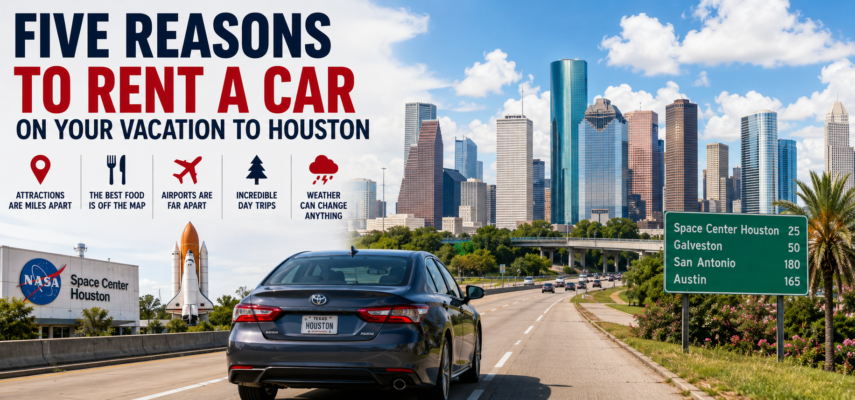
Houston does not hide what it is. The fourth-largest city in the United States sprawls across a metropolitan area roughly the size of New Jersey, was built almost entirely around the car, and makes no particular apology for either of those facts. Visitors who arrive hoping to navigate it on foot or by public transit quickly discover that the city has a different relationship with pedestrians than most places they have traveled.
1. The city’s best attractions are miles apart from each other
Renting a car on holiday to Houston is not just convenient – it is the difference between seeing the city properly and missing most of it. Houston’s major draws do not cluster the way they do in older American cities. Space Center Houston, the official visitor center for NASA’s Johnson Space Center, sits about 25 miles southeast of Downtown on NASA Road 1. The Museum District is 4 miles south of Downtown. The Houston Heights is 2 miles northwest. Buffalo Bayou Park runs west from Downtown along a corridor that dead-ends without a car. Galveston Island – one of the most rewarding day trips from the city, with its Victorian Strand District and Gulf beaches – is 50 miles south on I-45. Without a car, each of these requires a ride-share, and the costs accumulate over a multi-day trip far faster than a rental does. With a car, you cover all of them in a logical sequence and on your own schedule.
2. The food that makes Houston worth visiting is not on the tourist map
Houston has one of the most diverse restaurant ecosystems in the United States, built on decades of Vietnamese, Mexican, Nigerian, Indian, and Chinese immigration. The restaurants that represent this best are in neighborhoods and strip malls that sit well off any walkable circuit. The Vietnamese restaurant corridor along Bellaire Boulevard in the area locals call Chinatown runs west of Beltway 8, a significant distance from Downtown hotels. The taquerias along Navigation Boulevard in the East End are similarly car-dependent. The best dim sum in the city requires a drive. A visitor restricted to the walkable core around Downtown and Midtown will eat well enough, but will miss the food culture that distinguishes Houston from every other major American city. The car unlocks the real version of the city’s eating.
3. Houston’s two airports are far from the city center and from each other
George Bush Intercontinental Airport sits roughly 25 miles north of Downtown – a 45-minute drive in light traffic, considerably longer during morning and evening rush hour. William P. Hobby Airport is about 10 miles southeast of Downtown and handles primarily domestic routes. Neither is convenient by public transit for most hotel locations. The METRORail does not serve either airport with a direct line comparable to city center rail connections common in European cities. Visitors without a car are dependent on ride-shares from arrival to departure, including any time they need to travel between the airport corridor and their hotel or attractions. Picking up a rental at the airport on arrival and dropping it off on departure eliminates that dependency entirely and is almost always cheaper than the equivalent number of ride-share journeys across a three or four-day trip.
4. The surrounding region is worth exploring, and it is all within driving distance
Texas is a state that rewards road travel, and Houston’s position in the southeast of the state puts it within reach of destinations that significantly extend the value of a visit. Galveston and the Gulf Coast are under an hour south. The Sam Houston National Forest is about 70 miles north. San Antonio is three hours west along I-10, with the River Walk and the Alamo. Austin is two and a half hours northwest. Big Bend National Park is a full day’s drive, but it represents one of the most dramatic landscapes in the lower 48 states. The Texas Parks and Wildlife Department covers state parks and natural areas throughout the region, many of which are easily incorporated into a Houston-based trip with a rental car and a day to spare.
5. Houston’s weather makes spontaneous logistics essential
From June through September, Houston’s heat and humidity regularly push the heat index above 100°F, and sudden severe thunderstorms can make outdoor plans unworkable at short notice. Having a car means you can adapt on the fly – move an outdoor visit to the morning before the heat builds, shift to an air-conditioned museum when a storm develops, or extend a morning at Buffalo Bayou Park into an afternoon at the Galleria without waiting for a ride-share in the rain. Houston is not a city that rewards rigid itineraries, and a rental car is the tool that gives you the flexibility to respond to whatever the day delivers. Book it before you travel, check availability around the Houston Livestock Show and Rodeo window in late February and March when demand spikes, and you will wonder why you ever considered arriving without one.
Houston is a city that repays the visitor who arrives prepared
The friction that puts people off Houston – the scale, the heat, the absence of a walkable core – dissolves almost entirely once you have a car and a rough plan for how to use it. The food neighborhoods, the space history, the Gulf Coast an hour south, the bayou trails, the museum district: none of it is difficult to reach, and none of it disappoints once you get there. The rental car is not an add-on to a Houston trip. It is the trip. Book it before you land, keep the Rodeo window in mind when you choose your dates, and the city will look after the rest.