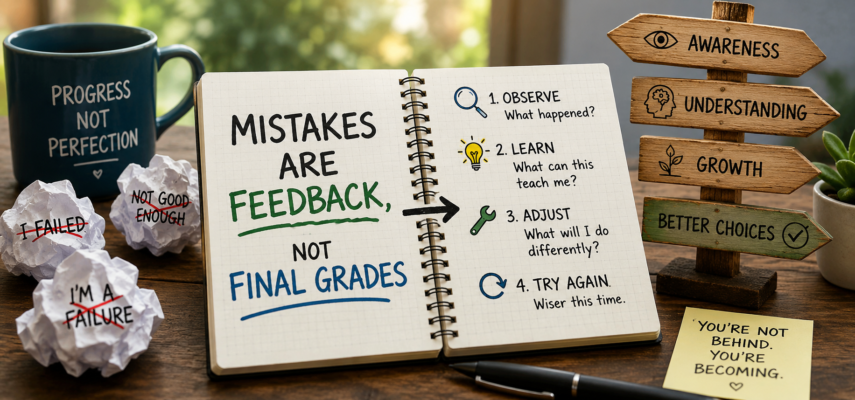
Most people say they want to grow, but many of us still react to mistakes as if they are courtroom decisions. One wrong move, one awkward conversation, one missed payment, one failed attempt, and suddenly the inner voice starts handing down a sentence. You blew it. You should have known better. This says something about who you are.
That is exactly why the phrase “mistakes are feedback, not final grades” matters so much. It is not just a motivational line. It is a more useful way to interpret reality. In daily life, mistakes usually are not clean moral verdicts. They are information. They tell us where a system broke down, where a skill needs practice, or where our expectations were unrealistic. That is true whether you are learning algebra, rebuilding trust, or figuring out budgeting for couples.
The Cost of Treating Mistakes Like Verdicts
The problem is that many adults still live like they are waiting for permanent scores. We carry school logic into relationships, careers, parenting, and money. We imagine every mistake gets stamped into our record forever. But real life is less like a report card and more like navigation. If you miss a turn, the map does not insult you. It reroutes. That is the energy we need more of.
Why Shame Makes People Repeat the Same Mistakes
A lot of people assume harsh self criticism is what keeps standards high. If you are tough on yourself, you will improve faster. It sounds logical. In practice, it often does the opposite.
When a mistake triggers shame, your attention shifts away from learning and toward self protection. Instead of asking, “What happened here?” you start asking, “What does this say about me?” That question is much heavier, and much less useful. It makes people defensive, avoidant, and weirdly attached to perfection. You do not become more honest under that pressure. You become more fragile.
Research and classroom practice alike point to something important: people learn better when errors are followed by timely feedback and a chance to correct them, not when errors are treated as proof that they cannot improve. The learning benefit comes from making a reasonable attempt, getting information back, and adjusting from there, which is one reason mistakes can actually strengthen memory and understanding when feedback follows them. Edutopia’s overview of learning from mistakes explains this dynamic in a way that applies far beyond school.
The same pattern shows up emotionally. Being cruel to yourself may feel responsible, but it can trap you in rumination. Self compassion is not the same as making excuses. It is a way of staying steady enough to take responsibility without collapsing into self attack. Kristin Neff’s work at the Center for Mindful Self Compassion has long emphasized that self compassion supports accountability because it lowers the panic that makes people hide from their own behavior.
A Better Question After You Mess Up
If mistakes are feedback, then the first goal is not punishment. It is interpretation.
That means the most productive question after a mistake is rarely, “How bad is this?” A better question is, “What is this trying to teach me?” Sometimes the answer is obvious. You were tired and rushed. You did not ask enough questions. You assumed agreement when there was only silence. You spent based on optimism instead of actual numbers. You tried to solve a problem with a skill you have not built yet.
This shift sounds small, but it changes everything. It keeps the focus on process. Feedback is specific. Final grades are global. Feedback says, “Your approach needs work.” Final grades say, “You are the problem.” One message builds capacity. The other attacks identity.
That difference matters because identity based failure can make people stop too early. They do not quit because the task is impossible. They quit because they decide the mistake has revealed some fixed truth about them. Bad with money. Bad at love. Bad under pressure. Bad at follow through. Once a person tells that story enough times, they stop experimenting, and growth stalls.
Life Is Built Through Revisions, Not Clean First Drafts
One of the least helpful myths in adult life is that competent people get things right quickly. They do not. They revise. Quietly, constantly, and often imperfectly.
Healthy relationships are revised through better conversations after bad ones. Careers are revised through failed interviews, awkward presentations, and jobs that taught the wrong lesson before the right one. Financial stability is often revised through overspending, underestimating, forgetting, restarting, and learning how habits work in real conditions instead of ideal ones.
Seen this way, mistakes are not interruptions to growth. They are the material growth uses. If you remove all error, you usually remove the need to adapt, reflect, and strengthen judgment. That is why people who seem wise are not always the ones with spotless histories. Often they are the ones who learned how to study their missteps without turning them into an identity.
How to Use Mistakes as Data Instead of Drama
The trick is not to become emotionally flat. Mistakes can still sting. The trick is to shorten the distance between the sting and the lesson.
Start with naming the mistake plainly. Not theatrically. Just accurately. “I avoided the conversation.” “I guessed instead of checking.” “I spent for relief, not for necessity.” Clean language helps keep the brain out of performance mode.
Next, separate the event from the self. You made a poor choice. That does not mean you are a poor quality person. It means something in your strategy, habits, environment, or awareness needs attention.
Then ask for the next useful adjustment. Not the perfect life overhaul. Just the next correction. Put the bill on autopay. Add a calendar reminder. Practice the script before the conversation. Build in a pause before emotional spending. Apologize specifically, not dramatically. Feedback becomes valuable when it changes behavior.
Finally, repeat without demanding instant mastery. A lot of growth is just tolerated repetition with better noticing.
What This Mindset Changes in Relationships
This perspective becomes especially powerful around other people. If you believe mistakes are final grades, you will treat conflict like a ranking system. Someone has to be right, someone has to be wrong, and the wrong person has to feel it. But if mistakes are feedback, then conflict can become information about needs, assumptions, and patterns.
That does not mean lowering standards or tolerating harm. It means choosing repair over labeling whenever repair is possible. It means leaving room for the sentence, “That did not go well. Let’s understand why.” In families, friendships, and partnerships, that kind of response creates more honesty because people are less afraid that every misstep will be turned into a permanent character summary.
The same is true internally. When you stop treating your own mistakes as final grades, you become easier to live with. You waste less energy proving you are redeemable and spend more energy actually improving.
Growth Is Messy, and That Is a Good Sign
A smooth path can look impressive, but it often means you are staying inside what you already know. Growth usually feels clumsy in the middle. It includes wrong guesses, mismatched expectations, false starts, and uncomfortable feedback. That is not evidence that you are failing. It is often evidence that you are in motion.
So the next time you mess something up, resist the urge to act like the semester is over and the grade is posted. It probably is not. Most of life is still in progress.
Mistakes are not always pleasant, and sometimes they are costly. But they do not have to be final. If you are willing to read them correctly, they can become directions. Not a verdict. Not a label. Just a signal that says, “Try again, but wiser this time.”