










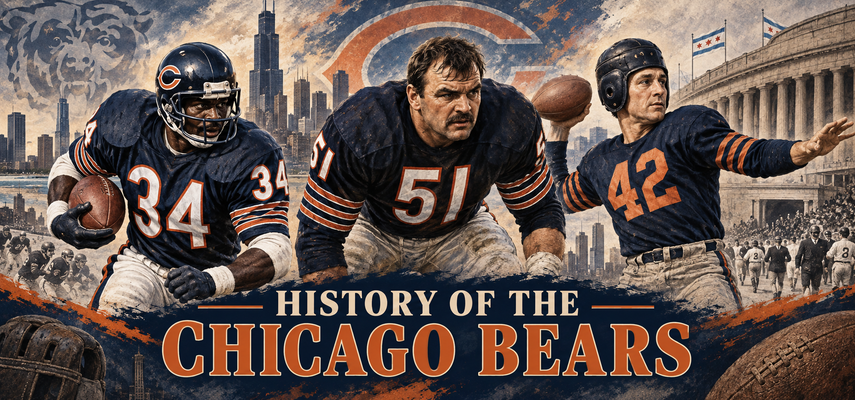

The Chicago Bears helped shape professional football before the sport became a national institution. George Halas connected the franchise’s industrial-team origins to decades of innovation and championship contention, while players from Red Grange to Walter Payton gave successive eras their own character. The Monsters of the Midway identity reflects a strong defensive tradition, but Chicago’s greatest teams also changed how offense was played. Eight early NFL titles and one Super Bowl victory anchor a longer, uneven record. This history follows that record through the completed 2025 season, separating its achievements from subsequent developments and the ongoing 2026 campaign.
Franchise at a glance
| Field | Details |
|---|---|
| Founded | 1920 APFA charter franchise; company team origins in 1919 |
| First season | 1920, American Professional Football Association; renamed NFL in 1922 |
| Original city and name | Decatur, Illinois — Decatur Staleys |
| Current city and name | Chicago Bears; Chicago, Illinois |
| Previous cities and names | Decatur Staleys, 1920; Chicago Staleys, 1921; Bears name from 1922 |
| League and conference/division | NFL — National Football Conference North |
| Home venue | Soldier Field; Bears’ regular home from 1971, except 2002 renovation season |
| League championships | 9 NFL championship seasons: 8 pre-Super Bowl titles and the 1985 Super Bowl title |
| Other recognized championships | 2 NFC championships: 1985, 2006; conference honors are separate |
| Historical coverage | 2025 NFL season, including postseason completed in February 2026; later developments through October 16, 2026 |
Origins and early years
The A.E. Staley company sponsored a football team in Decatur before its entry into the American Professional Football Association in 1920. George Halas helped organize and play for the team, then moved the operation to Chicago the following year. The company supported the transition on the condition that the Staleys name remain for one season. The Chicago Staleys won the 1921 league championship.
The team became the Bears in 1922, adopting an identity linked to the baseball Cubs whose home it shared. The football club’s record remained continuous across the changes of city and name. Halas and partner Dutch Sternaman worked to make the professional game commercially viable while the league itself was still developing stable rules and membership. Chicago’s significance therefore began before its later national fame. Its early championships, prominent player signings and involvement in the league’s structure helped turn a fragile professional competition into a more durable institution. Halas’s unusual combination of playing, coaching and ownership roles made the franchise especially influential in that process.
Defining eras
1920–1933: Establishing the professional game
Chicago’s first championship came through the standings in 1921, during the period before a scheduled league title game. Halas also sought players whose reputations could attract larger crowds. Red Grange’s arrival in 1925 and the subsequent barnstorming tour helped expand public attention around professional football. The relationship between star attraction and a stable team became an important part of the Bears’ development.
The 1932 team defeated the Portsmouth Spartans 9–0 in an indoor playoff arranged to settle the championship. The game counted in the standings under that season’s system and helped prompt changes to the league’s structure. The following year introduced divisions and a scheduled championship game, which Chicago won 23–21 against the New York Giants. Bronko Nagurski’s power and versatility gave those teams a distinctive identity. The Bears had become both a successful club and an important participant in the evolution of the competition, with their record spanning the transition from standings-based titles to a formal championship series.
1934–1946: Luckman and the T formation
The Bears remained contenders after their early titles, but the most influential breakthrough came with quarterback Sid Luckman and the modernized T formation. Chicago’s 73–0 championship victory over Washington in 1940 made the offense’s possibilities impossible to ignore. The result was extraordinary, yet its larger importance came from coordinated movement, deception and passing within an organized system.
More championships followed in 1941, 1943 and 1946. Wartime service interrupted personnel continuity and took Halas away from the team, with Hunk Anderson and Luke Johnsos sharing coaching responsibility for the 1943 champions. Luckman remained central to the strongest teams. The era established Chicago as a dominant professional football institution and left a tactical influence that extended well beyond its own wins. Later descriptions of the Bears as a purely defensive franchise miss this part of the record. Their strongest early teams advanced offensive organization as well as relying on physical strength and exceptional individual players.
1947–1967: A final Halas championship
After the 1946 title, the Bears experienced a long gap without another championship. They remained capable of strong seasons, including a title-game appearance in 1956, but could not sustain their earlier dominance. The NFL’s growing popularity and competitive depth changed the environment around a franchise that had helped build the league. Chicago’s own identity increasingly emphasized defensive toughness.
The 1963 team finally won another championship, defeating the New York Giants 14–10 behind a formidable defense. Halas was still the head coach, linking the achievement directly to the organization’s earliest era. Two years later the draft brought Dick Butkus and Gale Sayers, exceptional players whose careers became central to Bears history without producing another team title. Their arrival demonstrated the distance between individual greatness and a complete championship roster. Halas retired from coaching after 1967. The next generation inherited an imposing tradition, but the football operation would have to recover from a difficult period before another major breakthrough.
1968–1985: Payton, Ditka and the championship defense
The Bears struggled through much of the period after Halas’s coaching retirement. Moving from Wrigley Field to Soldier Field in 1971 changed their home setting, while the organization searched for another durable contender. Walter Payton arrived in 1975 and gave the offense a foundational player whose rushing, blocking and receiving could shape almost every possession. Playoff appearances later in the decade supplied progress without a championship.
Mike Ditka became head coach in 1982, working alongside defensive coordinator Buddy Ryan. The 1985 team combined Payton and an improving offense with an exceptional defense featuring Mike Singletary, Richard Dent, Dan Hampton and other major contributors. Chicago finished 15–1, shut out both NFC playoff opponents and defeated New England 46–10 in Super Bowl XX. Dent earned MVP honors. The team’s personalities, public confidence and distinctive defensive approach made it a cultural phenomenon as well as a champion. Its achievement became the strongest modern expression of the Monsters of the Midway identity.
1986–2012: Strong defenses and another Super Bowl
The teams after the championship remained successful in the regular season but did not reproduce the same postseason finish. Injuries and changing personnel complicated the effort to repeat. Ditka’s tenure ended after 1992, and later coaching changes brought uneven results. Chicago continued searching for dependable quarterback continuity while its strongest public identity remained tied to defense and the running game.
Lovie Smith’s arrival in 2004 restored a clearer direction. Brian Urlacher and Lance Briggs anchored the defense, while Devin Hester transformed the return game. The 2006 team won the NFC and reached Super Bowl XLI, where Indianapolis won 29–17 despite Hester’s opening kickoff touchdown. Another conference-final appearance followed after the 2010 season, ending against Green Bay. Those teams did not match the 1985 championship, but they created a significant era of their own. Their success showed how another generation could work within the franchise’s defensive tradition while facing the continuing challenge of developing a more dependable offense.
2013–2025: Offensive rebuilding and a new opportunity
The following years brought repeated attempts to establish a different offensive standard. Marc Trestman, John Fox, Matt Nagy and Matt Eberflus coached teams with varying approaches and limited sustained success. The 2018 defense helped Chicago win its division, but a narrow playoff loss to Philadelphia ended that opportunity. Quarterback changes remained central to the rebuilding process, with talented individual players unable to resolve the wider institutional inconsistency.
The Bears selected Caleb Williams first overall in 2024 and appointed Ben Johnson as head coach for the following season. Johnson’s first team finished 11–6, won the NFC North and defeated Green Bay 31–27 in the wild-card round after a large comeback. The Rams then won their divisional meeting 20–17 in overtime. The run did not add another conference championship, but it supplied the franchise’s first playoff victory since the 2010 season. Chicago had a renewed offensive direction whose long-term outcome remained open rather than an already established championship era.
Recent history
The latest completed season is 2025, when Chicago finished 11–6 and won the NFC North in Ben Johnson’s first year. The Bears rallied to beat Green Bay 31–27 in the wild-card round before losing 20–17 in overtime to the Rams. Those games were played in January 2026 but belong to the 2025 season.
As of October 16, 2026, Johnson remained head coach and the following campaign was underway. Its final result and postseason outcome were still undecided. Soldier Field remained the team’s home, while discussion of a future stadium had not become a completed move. The historical record therefore remained nine league championship seasons, comprising eight earlier NFL titles and the 1985 Super Bowl victory. The recent playoff advance marked meaningful progress without adding a third NFC championship or another Super Bowl to those completed totals.
Greatest players and influential figures
Red Grange
Grange’s arrival brought an exceptional collegiate reputation and helped draw national attention to professional football. His early Bears service and later return connected commercial growth with important championship teams. His time with a separate New York team remains part of his wider career rather than an addition to Chicago’s record.
Bronko Nagurski
Nagurski supplied exceptional power and versatility as a runner, blocker and defender. His contribution helped define the Bears’ early championship identity, including the pivotal 1932 playoff. His later return during the wartime period added another chapter to a playing career that remained associated with Chicago’s strongest foundational teams.
Sid Luckman
Luckman became the quarterback through whom Chicago’s T formation demonstrated its full possibilities. His passing and decision-making helped produce four NFL championships during the 1940s. His entire professional playing career belonged to the Bears, giving the franchise an offensive legacy as important as its later reputation for defense.
Dick Butkus
Butkus gave the Bears a defining linebacker presence through range, intensity and exceptional instinct. His individual excellence developed during years when Chicago did not build a comparable championship team. That contrast is central to his legacy: his importance rests on the defensive standard he established rather than a postseason title.
Gale Sayers
Sayers supplied an extraordinary combination of open-field running and return ability after arriving in the 1965 draft. Knee injuries shortened his career, but the concentration of exceptional performances made him foundational to Bears history. His contribution belongs alongside the era’s team struggles rather than being mistaken for a championship run.
Walter Payton
Payton carried Chicago’s offense across difficult seasons before helping it reach the Super Bowl XX championship. His running, receiving, blocking and durability made his contribution unusually complete. The long pursuit before the title remains essential to understanding a career spent entirely with the Bears and recognized by their retired No. 34.
George Halas
Halas shaped the Bears as a player, coach, owner and league organizer. His involvement connected the Decatur beginning to the 1963 champions and decades of institutional development afterward. The franchise’s early success and professional football’s wider growth are inseparable from the unusually broad responsibilities he carried.
Mike Ditka
Ditka first contributed as a Bears player on the 1963 champions, then returned as head coach to lead the 1985 Super Bowl team. His forceful public personality became part of that era’s identity. The championship and later disappointments both belong to a coaching tenure that restored Chicago’s national prominence.
Championships and postseason milestones
Chicago’s nine league championship seasons comprise eight earlier NFL titles and one Super Bowl victory. The 1921 championship was determined through standings; the 1932 indoor playoff helped settle that season’s standings. The later scheduled NFL championship games and Super Bowl are listed by their actual competitions. The 2006 NFC title ended in a Super Bowl defeat.
On smaller screens, scroll horizontally to see all columns.
| Season/year | Competition | Opponent | Result | Defining figure(s) |
|---|---|---|---|---|
| 1921 | APFA Championship — standings | Not applicable | League title — standings | George Halas; Dutch Sternaman |
| 1932 | NFL Championship-deciding playoff | Portsmouth Spartans | Won 9–0 | Bronko Nagurski; Red Grange; Ralph Jones |
| 1933 | NFL Championship | New York Giants | Won 23–21 | Bronko Nagurski; Jack Manders; George Halas |
| 1940 | NFL Championship | Washington Redskins | Won 73–0 | Sid Luckman; George Halas |
| 1941 | NFL Championship | New York Giants | Won 37–9 | Sid Luckman; George Halas |
| 1943 | NFL Championship | Washington Redskins | Won 41–21 | Sid Luckman; Hunk Anderson; Luke Johnsos |
| 1946 | NFL Championship | New York Giants | Won 24–14 | Sid Luckman; George Halas |
| 1963 | NFL Championship | New York Giants | Won 14–10 | Bill Wade; Larry Morris; George Halas |
| 1985 | Super Bowl XX | New England Patriots | Won 46–10 | Richard Dent; Walter Payton; Mike Ditka |
Rivalries, venues and team identity
Rivalries
Green Bay supplies the defining rivalry through a relationship that spans nearly the full history of the league. Detroit provides another long-running regional opponent, while Minnesota became a recurring divisional test after joining the NFL. The Bears’ playoff meetings with Green Bay give the rivalry a different weight from routine schedule repetition, most recently in the completed 2025 postseason.
Home venues and traditions
The move from Wrigley Field to Soldier Field in 1971 shifted the Bears from a shared baseball setting to their enduring lakefront home. The 2002 renovation season was played in Champaign before the return to Soldier Field. Navy and orange, the wishbone C and the Monsters of the Midway name connect supporters across very different rosters. Those traditions also carry memories of early offensive innovation and later defensive strength.
Retired numbers and team honors
Chicago formally retired numbers including Payton’s 34, Butkus’s 51, Sayers’s 40 and Luckman’s 42. Halas’s 7 recognizes his playing and institutional connection to the club. These team honors are separate from election to the Pro Football Hall of Fame. The franchise’s extensive historical recognition should not be reduced to championship participation, since several foundational figures played during difficult competitive periods.
Legacy
The Bears matter because their history joins the creation of professional football’s institutions to some of its most recognizable teams and players. Halas’s early organization, Luckman’s offense and the 1985 defense represent different kinds of influence. The long gaps between championships show how difficult it has been to turn tradition into repeated success. That tension gives later rebuilding efforts their context. Chicago’s full legacy includes innovation, exceptional individual careers and an enduring public identity, with nine league championship seasons anchoring a record much broader than one famous modern team.
Where to eat in Chicago
Planning a visit? Explore our best restaurants in Chicago guide.












