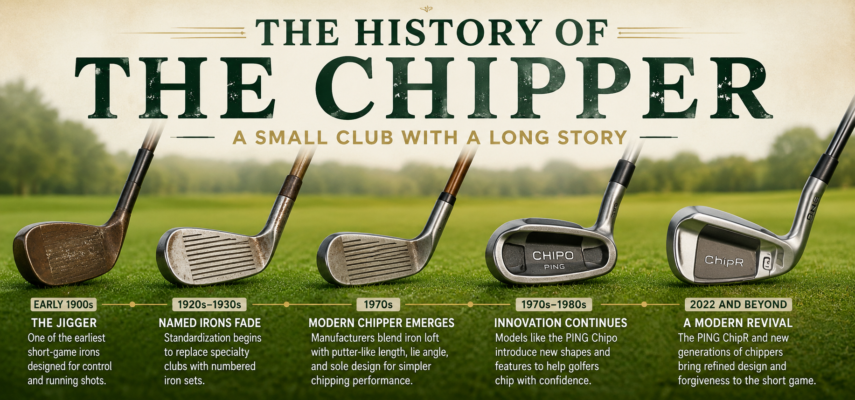
The golf chipper occupies an unusual place in the game’s equipment hierarchy. It looks partly like a putter and partly like an iron. It is swung with a putting-style motion but launches the ball into the air. It is perfectly legal when properly designed, yet many golfers mistakenly believe it has been banned. And although manufacturers have produced chippers for decades, the club remains far less common than the wedges, hybrids, and high-lofted woods that have transformed the modern golf bag.
The chipper was not created to hit dramatic bunker shots, towering pitches, or spinning approaches. It was designed for one narrow but important purpose: helping golfers play simple, repeatable shots from just off the green.
That specialization has been both the chipper’s greatest strength and the reason it has never become a standard club.
What Is a Golf Chipper?
A chipper is a short-game club intended primarily for low-running shots around the green. Its head usually carries approximately the loft of a 7-, 8-, or 9-iron, while its shaft length, upright lie angle, and address position often resemble those of a putter.
The result is a club that allows the golfer to stand relatively close to the ball and make a compact, pendulum-like stroke. The ball rises briefly over the fringe or rough, lands on the putting surface, and then rolls toward the hole.
Although its appearance can be misleading, the governing bodies classify a chipper as an iron rather than a putter. Consequently, a conforming chipper must meet the equipment requirements applying to irons, including restrictions involving its grip, clubface, grooves, and general construction.
Conceptually, the chipper addresses one of recreational golf’s most persistent problems. A golfer may be only a few yards from the green but still face several possible techniques: a conventional wedge shot, a bump-and-run with an iron, a hybrid chip, or even a putt through the fringe. Each choice introduces questions about setup, loft, wrist action, turf interaction, and carry distance.
The chipper attempts to remove most of those variables.
Before the Chipper: The Age of Named Irons
The chipper does not have a single, universally recognized inventor. Instead, it emerged from a much older tradition of specialized short-game clubs.
During the late 19th and early 20th centuries, golf clubs were commonly identified by names rather than numbers. Players carried clubs such as cleeks, mashies, mashie-niblicks, jiggers, niblicks, spoons, and brassies. Their dimensions were not standardized, and two clubs carrying the same name could differ considerably in loft, length, head shape, and intended use.
Among these old clubs, the jigger is frequently described as a conceptual ancestor of the modern chipper. It was typically a relatively short, narrow-bladed iron used for controlled approaches and running shots. It could be played from farther away than most contemporary chippers, so it was not an exact equivalent. Nevertheless, it reflected the same basic philosophy: use a compact iron to produce a low, accurate shot that lands and runs.
By the 1920s, the jigger was already becoming obsolete. Contemporary accounts described it as an old-fashioned, difficult-to-handle club that was being displaced by more standardized irons. One 1927 commentary noted that professionals increasingly preferred numbered or standardized alternatives for the distances once associated with the jigger. A 1929 survey of changing equipment similarly observed that uniquely named clubs were disappearing as manufacturers reorganized iron sets around numbers.
This transition was critical to the chipper’s later development. Standardization made golf equipment easier to understand and manufacture, but it also eliminated many highly specialized clubs from the ordinary set.
The Numbered-Iron Revolution
As matched iron sets became common during the first half of the 20th century, golfers increasingly received a predictable sequence of clubs covering progressively shorter distances. The 2-iron, 3-iron, 4-iron, and their companions replaced many older club categories whose functions had overlapped.
For shots around the green, golfers were generally expected to use one of the irons already in the set. A player might select a 5-iron for a long-running chip, a 7-iron for a medium trajectory, or a more lofted club when additional carry was required.
This system made a dedicated chipper appear unnecessary. The basic shot could already be produced with a conventional iron.
At the same time, however, the numbered-iron system did not make that shot easy. Traditional irons had longer shafts and flatter lie angles than putters. Golfers still needed to manage the club’s leading edge and make clean contact with a comparatively small margin for error.
The opportunity for a purpose-built chipping club therefore remained.
The Rise of the Modern Chipper
The recognizable modern chipper began to appear as manufacturers experimented with clubs that blended the characteristics of irons and putters.
Designers shortened the shaft, made the lie angle more upright, widened the sole, added perimeter weighting, and placed visible alignment aids on the head. The loft allowed the ball to clear the fringe, while the putter-like dimensions encouraged a simpler stroke.
These clubs were often marketed under names such as “chipping iron,” “chipper,” “putting wedge,” or “chipping putter.” Some looked almost like mallet putters with loft. Others resembled unusually upright cavity-back irons.
PING was among the prominent companies to experiment with the category. Its Chipo, introduced during the 1970s, became one of the better-known historical examples. Decades later, the company would explicitly draw upon that heritage when developing a new generation of the concept.
The chipper’s appeal was straightforward. Instead of teaching a golfer to control a delicate wedge swing, manufacturers offered a club that could be moved back and through with limited wrist action. Its broad sole was less likely to dig sharply into the turf, while its relatively heavy head helped stabilize the stroke.
For recreational golfers who frequently hit chips thin or heavy, the promise was compelling.
Why the Chipper Never Became Standard Equipment
Despite its practical advantages, the chipper never secured a permanent position in the conventional 14-club set.
The first obstacle was versatility. A sand wedge can be used for bunker shots, pitches, partial approaches, chips, and a variety of specialty shots. A chipper is designed mainly for low-running shots from close to the green. It performs that task efficiently, but it cannot easily replace a full-service wedge.
The second obstacle was the 14-club limit. Every specialty club occupies a space that might otherwise be used for another wedge, a long iron, a hybrid, or a fairway wood. Skilled golfers generally preferred to create chipper-like shots with clubs already in the bag rather than sacrifice a position to a dedicated tool.
The third obstacle was cultural.
Golf has traditionally celebrated creativity and touch around the greens. Players are admired for opening the face of a wedge, changing trajectory, controlling spin, or selecting the perfect landing point. Because the chipper simplifies these decisions, it developed an unfair reputation as a club for golfers who lacked technique.
That reputation resembles the early resistance once faced by other game-improvement equipment. Cavity-back irons, oversized drivers, hybrids, and high-lofted fairway woods were all criticized before becoming widely accepted. The chipper, however, remained sufficiently specialized that it never completed the same transition into the mainstream.
The Two-Way Chipper and the Rules Controversy
Much of the confusion surrounding chippers comes from older two-faced designs.
A two-way chipper has striking surfaces on both sides of the head, allowing it to be used either right-handed or left-handed. That feature could help a golfer play a ball lying next to a tree, fence, bunker face, or other obstruction.
However, clubs are generally required to have only one striking face. Putters are permitted a limited exception, but chippers are classified as irons. A two-faced chipper therefore does not receive the special treatment afforded to certain putter designs.
This distinction created the widespread misconception that all chippers were illegal. In reality, a conventional one-faced chipper can conform fully to the Rules of Golf. The club must simply satisfy the requirements applying to irons.
Because a chipper is not legally treated as a putter, it also cannot automatically use every feature permitted on a putter. For example, the USGA specifically states that chippers may not have putter grips and must conform to the construction rules governing woods and irons.
The legality of a chipper therefore depends on its design, not on the fact that it is called a chipper.
How the Chipper Works
The typical chipper occupies the design space between an iron and a putter.
Its loft is usually sufficient to lift the ball over several feet of fringe or uneven turf. Once the ball lands, it behaves more like a putt than a high wedge shot.
Its shaft is commonly shorter than that of a comparable iron, helping the player stand closer to the ball. Its lie angle tends to be relatively upright, encouraging a putting-style setup. Many models also use a broad or cambered sole intended to move through short grass without digging.
The technique is deliberately uncomplicated:
The golfer addresses the ball with a narrow stance, keeps the hands relatively quiet, and rocks the shoulders in a motion resembling a putting stroke. The club supplies the loft, reducing the need to scoop the ball or hinge the wrists aggressively.
A chipper is therefore not designed to manufacture a shot that is physically impossible with another club. A golfer could produce a similar result with a 7-, 8-, or 9-iron.
Its purpose is to make that result easier to repeat.
Competition From Wedges and Hybrids
The chipper’s history cannot be separated from the evolution of the clubs competing against it.
As wedges became more sophisticated, golfers gained access to specialized sole grinds, varying bounce angles, improved grooves, perimeter weighting, and more forgiving head shapes. These developments made conventional wedges more capable around the green.
The arrival of hybrids created another alternative. Because a hybrid has a broad sole and relatively low loft, it can be used with a putting stroke from closely mown areas. The shot often produces the same basic flight-and-roll pattern as a chipper.
Manufacturers also began producing game-improvement wedges with wide soles and deep cavities. These clubs reduced digging and improved stability while retaining enough versatility for pitches, bunker shots, and partial approaches.
Each of these developments made it harder for the single-purpose chipper to justify its place in the bag.
Yet none eliminated the underlying problem the chipper was designed to solve. Many recreational golfers continued to struggle with short chips, particularly from tight lies where a wedge’s leading edge could strike the ground or the middle of the ball.
As long as that problem existed, the chipper retained a market.
The Modern Revival
The chipper category received renewed attention during the early 21st century as equipment companies reconsidered the needs of ordinary golfers.
Cleveland produced its Smart Sole Chipper as part of a broader family of simplified short-game clubs. Wilson, Odyssey, and several specialty brands offered their own versions. Some emphasized wide soles, while others adopted alignment systems and head shapes more commonly associated with putters.
The most visible modern revival came in 2022, when PING introduced the ChipR. The club combined a 35-inch length and highly upright lie angle with 38.5 degrees of loft—approximately the loft of a traditional 9-iron. PING described it as a blend of wedge and putter characteristics intended to reduce the fear of chunking or blading shots around the green.
The ChipR was significant because it came from one of golf’s largest and most respected equipment manufacturers. Rather than treating the chipper as a novelty, PING engineered and presented it as a legitimate scoring club.
The design also reflected how much the category had matured. Modern chippers could incorporate cavity-back construction, precision grooves, advanced sole shaping, improved weighting, and contemporary fitting options. They were no longer merely crude irons bent upright and cut to putter length.
Why Professionals Rarely Carry Chippers
Chippers are almost never seen in elite professional golf, but their absence does not necessarily indicate that the design is ineffective.
Professional golfers possess exceptional control with conventional wedges and irons. They can change the loft presented at impact, vary the landing point, generate spin, alter trajectory, and adapt to different grass conditions. For them, a specialty club capable of playing primarily one type of shot offers little strategic value.
Tour courses also demand a wide range of short-game shots. Thick rough, elevated greens, closely mown collection areas, deep bunkers, and firm putting surfaces frequently require more height or spin than a chipper is designed to produce.
For the average golfer, the calculation can be entirely different. A predictable low-running shot may be more valuable than theoretical versatility. The chipper is designed not for the player who can execute ten different shots, but for the player who needs one dependable option.
The Chipper’s Place in Golf History
The chipper represents a recurring theme in golf equipment: the tension between versatility and specialization.
Traditionalists tend to favor clubs that reward technique and can produce a broad range of shots. Equipment designers often pursue a different objective—reducing the consequences of imperfect technique.
The chipper sits firmly in the second category.
Its historical roots can be traced to an era when golfers carried individually named irons for specific purposes. Its modern form emerged from attempts to combine an iron’s loft with a putter’s simplicity. It survived the standardization of iron sets, the expansion of the wedge family, and the rise of hybrid clubs.
It has also endured decades of jokes, misconceptions, and questions about its legality.
Yet the chipper continues to reappear because the problem it addresses has never disappeared. Golfers still miss greens. They still face awkward shots from the fringe. And they still lose strokes by striking short chips fat or thin.
The club’s persistence suggests that golf equipment does not evolve only through the pursuit of distance, speed, or technological complexity. Sometimes innovation means making one of the game’s simplest-looking shots genuinely simple.
A Specialty Club That Refuses to Disappear
The chipper will probably never become as universal as the pitching wedge, sand wedge, or putter. Its function is too narrow, and many golfers can reproduce its basic shot with other clubs.
But universality is not the only measure of an equipment idea’s success.
For more than a century, golfers and clubmakers have searched for an easier way to play controlled running shots around the green. The names, materials, and head shapes have changed, from the old jigger to the Chipo and the modern ChipR, but the underlying objective has remained remarkably consistent.
Get the ball safely into the air. Land it on the green. Let it roll toward the hole.
Few clubs have been designed around a simpler proposition. Few have been more misunderstood. And few have demonstrated the chipper’s stubborn ability to survive on the edges of the golf bag.