









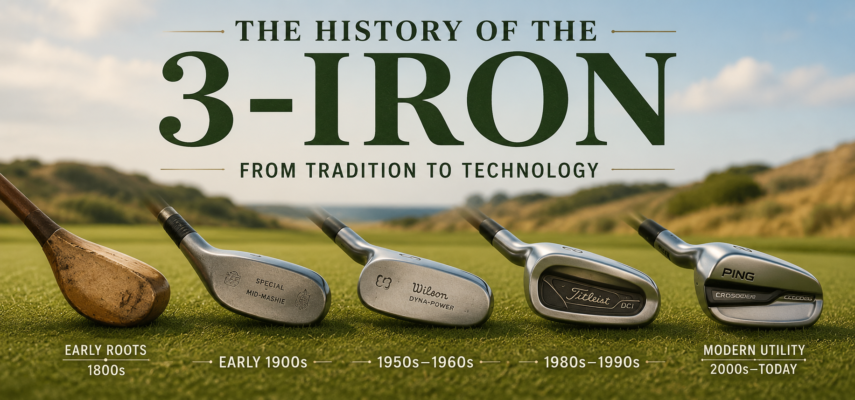
For much of golf’s modern history, the 3-iron occupied an important place in the golf bag. It was the club players reached for when a driver was too risky, a fairway wood flew too high, or a long approach demanded both distance and precision.
It was also one of the most intimidating clubs to hit.
With its long shaft, low loft, compact head, and relatively small margin for error, the traditional 3-iron demanded considerable speed and technical consistency. A well-struck shot produced a penetrating flight that seemed to cut through the wind. A poorly struck one often traveled low, short, and painfully into the golfer’s hands.
Today, the 3-iron is disappearing from recreational golf. Hybrids, high-lofted fairway woods, utility irons, and increasingly strong-lofted iron sets have taken over much of its former role.
Yet the 3-iron remains one of the most revealing clubs in golf history. Its rise reflects the standardization of equipment during the early 20th century. Its golden age coincided with the dominance of forged blades and shot-making professionals. Its decline illustrates how technology has changed not only golf clubs, but also what golfers expect a club to do for them.
Before There Was a 3-Iron
Golf clubs were not originally organized by number.
Early golfers carried clubs with individual names such as the cleek, mashie, niblick, jigger, spoon, and baffy. These names referred loosely to the club’s design and intended purpose, but specifications varied considerably among clubmakers.
The closest historical predecessor to the 3-iron is generally considered the mid-mashie. Antique-club references commonly place the mid-mashie near the modern 3-iron, although such comparisons are approximate rather than exact. Old clubs were handmade, and two clubs carrying the same name could have different lofts, lengths, weights, and playing characteristics.
Other long-bladed clubs contributed to the 3-iron’s development as well. The cleek and driving iron were used for long, low shots, particularly from firm ground or into the wind. Some resembled what would later become the 1- or 2-iron, while more lofted versions filled the distance range eventually associated with the 3-iron.
These clubs emerged during an era when golf was played largely on firm, exposed links. A low-running shot was often more useful than the high, soft-landing trajectory expected on many modern courses.
The early ancestor of the 3-iron was therefore not designed merely to carry the ball through the air. It was a club for controlling trajectory, using the ground, and negotiating wind.
The Numbered Iron Set Emerges
The transition from named clubs to numbered irons accelerated during the opening decades of the 20th century.
Golf was expanding rapidly beyond Scotland, and equipment manufacturing was becoming more organized. Mass production made it increasingly practical to sell matched sets rather than collections of individually selected clubs.
Numbering gave both manufacturers and golfers a simple system. Instead of learning the distinctions among a mashie, mid-mashie, mashie-niblick, and lofting iron, a golfer could purchase a progressively lofted set arranged from the longest iron to the shortest.
By the late 1920s, contemporary writing was already describing the disappearance of many traditional club names as equipment became standardized and golfers adopted numbered sets.
The arrival of steel shafts helped reinforce this transformation.
Hickory shafts had defined golf equipment for centuries, but no two pieces of wood behaved exactly alike. They could vary in flex, weight, torque, and durability. Steel offered manufacturers greater consistency and made it easier to build a coordinated set with predictable distance intervals.
Steel-shafted clubs appeared during the 1920s and gradually received approval from golf’s governing bodies. By the early 1930s, steel had begun to establish itself at the highest levels of the game.
The 3-iron became part of this new system: a long iron positioned between the very low-lofted driving clubs and the more manageable middle irons.
What Made the Traditional 3-Iron Different
For most of the 20th century, the 3-iron was a demanding but versatile club.
Traditional models typically featured:
- A relatively long shaft
- Low loft
- A narrow sole
- A compact forged head
- A small effective hitting area
- A center of gravity located close to the face
These characteristics gave skilled golfers exceptional control. They could hit the ball high or low, curve it in either direction, flight it beneath the wind, or allow it to land short and run toward the target.
But that control came at a price.
The clubhead offered little assistance when impact occurred away from the center. Shots struck thin could produce harsh vibration. Shots hit toward the heel or toe lost substantial distance. Golfers without sufficient speed often struggled to launch the ball high enough for the club to perform as intended.
The traditional 3-iron was therefore not simply a longer version of an easy-to-hit iron. It was a test of whether the golfer could produce enough speed, strike the center of the face, and deliver the club with the correct loft.
The 3-Iron’s Golden Age
The 3-iron became a standard part of the serious golfer’s equipment during the middle decades of the 20th century.
Professional and accomplished amateur golfers commonly carried iron sets beginning with a 2-iron or 3-iron and continuing through the pitching wedge. Some even carried a 1-iron.
Courses were becoming longer, but the equipment alternatives available to cover long approach distances remained limited. Fairway woods could provide distance, but their larger heads and longer shafts did not always offer the same trajectory control or accuracy.
The 3-iron filled the gap.
It could be used from the tee on tight par fours, from the fairway on long approaches, beneath tree branches, into strong winds, or on firm ground where a running shot was desirable. On links courses, it could function almost like a precision driving club.
The club also became associated with one of golf’s most admired skills: the ability to strike a long iron cleanly.
A towering long iron that landed softly on a distant green represented complete command of the golf swing. A low, controlled 3-iron into the wind demonstrated imagination and discipline. Before launch monitors and detailed performance statistics, long-iron play was one of the clearest visual distinctions between ordinary golfers and elite players.
The Blade Era
The classic 3-iron reached its purest form during the age of forged blades.
For decades, iron heads were relatively small, thin, and minimally forgiving. Even the finest professionals played equipment that required precise contact.
Players such as Ben Hogan, Jack Nicklaus, Lee Trevino, Tom Watson, and other leading golfers of the blade era became known for their ability to control long irons. Their equipment did little to disguise imperfect impact, but it gave them the feedback and workability they valued.
The 3-iron suited the strategic golf of the period. Players were expected to manufacture shots rather than simply produce one preferred trajectory. They altered ball position, swing length, face angle, and finish to create different flights.
A skilled golfer might use the same 3-iron to hit a high approach, a low runner, a shaped recovery, or a conservative tee shot.
That versatility explains why the club retained its place even though it was difficult. Golfers accepted the challenge because the 3-iron could produce shots that no other club in the bag replicated exactly.
Cavity-Back Irons Make the 3-Iron Friendlier
Iron design changed significantly during the second half of the 20th century.
Manufacturers began redistributing weight from the center of the clubhead toward its perimeter. This cavity-back construction increased stability on off-center strikes and made irons more forgiving.
The 3-iron benefited substantially.
A cavity-back head could help preserve ball speed when contact drifted toward the heel or toe. Wider soles improved interaction with the turf. Lower centers of gravity helped golfers launch the ball more easily.
The 3-iron did not become easy, but it became more playable.
Investment casting also allowed manufacturers to create head shapes and internal weighting structures that would have been difficult to produce through traditional forging. By the 1980s and 1990s, recreational golfers could purchase iron sets offering substantially more forgiveness than the blades used by previous generations.
For a time, these changes appeared likely to preserve the 3-iron’s place in the standard set.
Instead, they prepared the way for the technologies that would eventually replace it.
The Hybrid Changes Everything
The most serious threat to the 3-iron emerged with the rise of the hybrid.
Hybrids combined features of irons and fairway woods. Their heads were larger than those of traditional irons, but smaller and more compact than typical woods. Weight could be positioned low and deep, helping the ball launch higher with less effort.
For many golfers, a hybrid offered several advantages over a 3-iron:
- Higher launch
- Greater forgiveness
- Better performance from rough
- More ball speed on off-center contact
- A steeper landing angle
- More confidence at address
The hybrid did not require the same degree of precision or clubhead speed. A golfer who struggled to elevate a 3-iron could often hit a similarly lofted hybrid higher and farther.
By the early 21st century, manufacturers increasingly offered iron sets beginning with the 4- or 5-iron. The 3-iron became an optional purchase rather than an automatic component.
This was a major change in golf equipment philosophy.
For most of the 20th century, golfers were expected to learn how to hit long irons. In the hybrid era, manufacturers increasingly designed clubs that removed the need.
Loft Strengthening Further Redefines the Club
The decline of the 3-iron cannot be explained by hybrids alone.
Modern iron lofts have also become considerably stronger, particularly in game-improvement sets. A contemporary 4-iron may have a loft similar to that of an older 3-iron, while some modern 5-irons approach lofts once associated with traditional long irons.
Modern designers can use low centers of gravity, flexible faces, tungsten weighting, and hollow-body construction to produce acceptable launch despite these stronger lofts.
As a result, the number stamped on the sole no longer provides a reliable historical comparison.
A modern golfer may not carry a club marked “3,” yet still carry an iron with the loft and distance once associated with a 3-iron. Conversely, a modern utility iron labeled as a 3-iron may contain technology that makes it behave very differently from a traditional forged blade.
The identity of the 3-iron has therefore become less about its number and more about the role it performs.
The Rise of the Utility Iron
Although the traditional 3-iron has declined, it has not disappeared.
Instead, it has evolved into the utility iron or driving iron.
These clubs generally retain the compact appearance and penetrating trajectory associated with long irons, but incorporate modern construction methods. Many feature hollow heads, thin flexible faces, internal weighting, and materials designed to increase launch and preserve ball speed.
Utility irons are particularly attractive to players who:
- Prefer an iron-like appearance
- Generate sufficient swing speed
- Play frequently in windy conditions
- Want a controlled option from the tee
- Dislike the appearance or leftward tendency of some hybrids
- Value a flatter, more penetrating trajectory
In this form, the 3-iron has returned to one of its oldest purposes.
Like the cleeks and driving irons of earlier centuries, the modern utility 3-iron is often used as a precision club from the tee or for low shots through the wind. It is less frequently treated as an automatic fairway club for every golfer.
Why Professionals Still Carry 3-Irons
Professional golfers have not abandoned the 3-iron completely, but they use it selectively.
Tour players often choose the top of their bags according to course conditions. A golfer may carry a 3-iron or utility iron on a firm, windy links course, then replace it with a hybrid or higher-lofted fairway wood on a soft course requiring high approaches.
This flexibility reflects the specialization of modern equipment.
A traditional iron set was once expected to cover nearly every distance in orderly progression. Today, elite golfers can assemble a combination of irons, hybrids, utility clubs, and fairway woods according to the type of shots they expect to face.
The modern 3-iron is therefore more likely to be a strategic tool than a permanent obligation.
Why Most Recreational Golfers No Longer Need One
For the average golfer, replacing the 3-iron is usually a practical decision.
Low-lofted irons require speed to generate sufficient height and spin. Without those ingredients, shots may fly too low to carry their intended distance or stop on the green. A hybrid or fairway wood can often produce a more useful trajectory with less precise contact.
The issue is not simply whether a golfer can hit one excellent 3-iron on the practice range. The question is whether the club produces reliable results from imperfect lies during an actual round.
For many players, the answer is no.
That does not make the 3-iron obsolete. It makes it specialized.
Golfers with sufficient speed, strong ball-striking, and a preference for lower trajectories may still find it valuable. Others are better served by equipment that creates more height and forgiveness.
The Legacy of the 3-Iron
The 3-iron’s history is the story of golf moving from craftsmanship toward standardization, from blades toward forgiveness, and from general-purpose sets toward individually optimized bags.
It began as a loose descendant of clubs such as the mid-mashie, cleek, and driving iron. It became a standard part of the numbered iron set as steel shafts and mass production transformed equipment. It reached its cultural peak when elite long-iron play represented one of golf’s most respected skills.
Then technology changed the standard.
Hybrids made long shots easier to launch. Fairway woods became more versatile. Iron lofts grew stronger. Hollow-body utility clubs preserved the 3-iron’s best characteristics while reducing some of its weaknesses.
The traditional 3-iron may be vanishing, but its function remains alive.
Every time a golfer uses a utility iron to find a narrow fairway, flights a low shot beneath the wind, or chooses control over raw distance, the spirit of the 3-iron survives.
It is no longer a club every golfer is expected to carry.
Perhaps that makes it more meaningful for those who still do.












