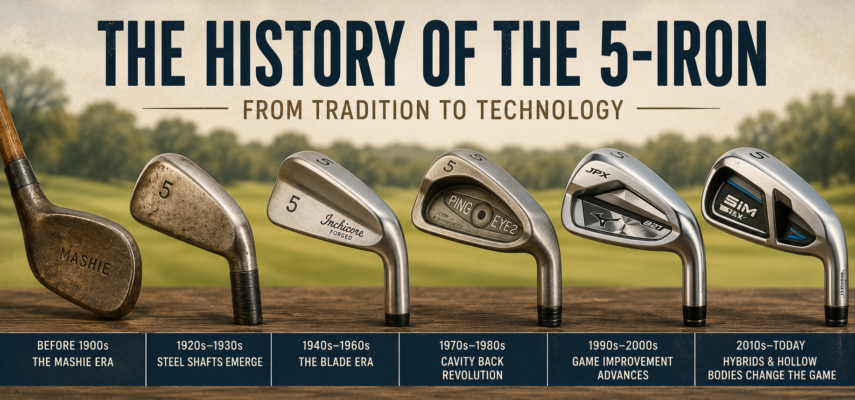
For much of modern golf history, the 5-iron occupied one of the most important positions in the bag.
It was long enough to attack distant greens, controlled enough to use from the fairway, and versatile enough to handle low punch shots, tee shots on short holes, and recoveries from difficult lies. It stood at the dividing line between the demanding long irons and the more manageable scoring clubs.
Today, however, the 5-iron is becoming something else: optional.
Hybrids, high-lofted fairway woods, and increasingly powerful game-improvement irons have transformed the middle of the golf bag. Some golfers still consider the 5-iron indispensable. Others have replaced it with a club designed to launch the ball higher and forgive imperfect contact.
That makes the history of the 5-iron especially revealing. Its evolution is not merely the story of one golf club. It reflects the broader development of iron design, from hand-forged blades and hickory shafts to cavity backs, hollow bodies, and clubs whose number no longer reliably indicates their loft.
Before There Was a 5-Iron
The earliest golfers did not carry numbered sets of irons.
Instead, clubs were known by descriptive names based on their appearance or intended purpose. A golfer might carry a cleek for long shots, a mid-iron for approaches, a mashie for shorter iron shots, and a niblick for escaping difficult lies.
The club most closely resembling a later 5-iron was probably the mashie or, depending on the manufacturer and period, a more strongly lofted mid-iron. Comparisons are imprecise because early clubs were individually forged and lacked standardized specifications. Two clubs bearing the same name could have noticeably different lofts, lengths, and head shapes.
The mashie nevertheless performed many of the duties associated with the traditional 5-iron. It was an approach club rather than an extreme-distance club, capable of producing a moderately high shot that would land with some control.
Early iron heads were generally forged by blacksmiths from iron or mild steel. They were attached to shafts made from woods such as ash and, eventually, hickory. Hickory became favored because it combined strength with enough flexibility to survive repeated swings.
These clubs demanded precision. Their faces were small, their sweet spots were unforgiving, and their shafts varied considerably from one example to another. Golfers had to adapt their swings to the individual behavior of each club rather than expecting every club in a set to feel identical.
The Rise of Numbered Irons
Numbered irons gradually replaced traditional club names during the early decades of the 20th century.
Mass production made it possible for manufacturers to build sets with more consistent spacing between clubs. Numbers also gave retailers and golfers a simpler way to identify a club’s position within a coordinated set.
The old names did not disappear overnight. For a time, manufacturers sometimes stamped both a traditional name and a number onto the same club. Eventually, however, the numbered system prevailed.
Under the emerging arrangement, the 1-, 2-, and 3-irons became the longest and least lofted irons. The higher-numbered clubs became progressively shorter and more lofted. The 5-iron settled near the middle of the set, roughly inheriting the role once performed by the mashie.
This position gave it unusual versatility. A 2-iron might be reserved for a powerful player striking a low, running shot, while an 8- or 9-iron was clearly intended for shorter approaches. The 5-iron could be used in a far wider range of circumstances.
Its exact specifications still varied, but its identity was becoming clear: it was the central approach club in the increasingly standardized iron set.
Steel Shafts Transform the Club
The adoption of steel shafts during the 1920s and 1930s was one of the most important changes in the 5-iron’s development.
Hickory shafts could perform beautifully, but they were affected by grain, moisture, age, and manufacturing differences. Finding a genuinely matched set was difficult. Steel made shafts more consistent in weight, stiffness, and performance.
For the 5-iron, steel offered several advantages.
The shaft was more durable, transmitted energy more predictably, and allowed manufacturers to create sets in which one club flowed more naturally into the next. Golfers could begin developing a repeatable swing without having to compensate as much for inconsistencies among individual shafts.
Steel also supported the emergence of the modern iron swing. Hickory generally encouraged smoother tempo because abrupt loading could cause the shaft to behave unpredictably or even break. Steel tolerated a more aggressive transition and gave stronger players greater confidence when swinging at full speed.
By the middle of the 20th century, the steel-shafted 5-iron had become a standard component of almost every conventional set.
The Classic Blade Era
From approximately the 1940s through the 1960s, the typical 5-iron was a compact forged blade.
These clubs were sometimes called muscle-backs because much of the head’s mass was concentrated directly behind the hitting area. A well-struck shot produced a solid, satisfying sensation, but contact away from the center could result in substantial losses of distance and accuracy.
The 5-iron exposed those weaknesses more clearly than the shorter irons.
Its relatively low loft required the golfer to generate sufficient speed and strike the ball cleanly. A thin shot might fly low and run unpredictably. A strike toward the heel or toe could twist the clubhead and leave the ball well short of its target.
Yet in the hands of a skilled player, the traditional blade 5-iron was extraordinarily versatile. It could produce a high approach, a penetrating shot into the wind, a controlled fade, a running draw, or a low recovery from beneath trees.
This was the era in which the 5-iron became associated with shotmaking. It was not merely a club used to cover a specific distance. It was a tool whose trajectory could be altered according to the demands of the situation.
The trade-off was unforgiving performance. The golfer supplied the height, speed, and consistency. The club offered relatively little assistance.
Perimeter Weighting Changes the Equation
The development of cavity-back irons fundamentally changed the 5-iron.
Instead of concentrating most of the head’s mass behind the center of the face, designers removed material from the back and redistributed weight around the perimeter. This increased the clubhead’s resistance to twisting when contact occurred away from the sweet spot.
Karsten Solheim and the Ping brand played a central role in popularizing this approach. Ping’s investment-cast irons demonstrated that forgiveness did not have to be limited to unusually large or unattractive clubs. Perimeter weighting could be incorporated into a functional matched set.
Cavity-back irons emerged during the second half of the 20th century and became increasingly common during the 1970s and 1980s. By the end of the century, they dominated the recreational market.
The benefits were particularly valuable in the 5-iron.
Because golfers naturally make less consistent contact with longer clubs, redistributing weight around the head helped preserve ball speed and direction on mishits. Wider soles made it easier to move through the turf, while lower centers of gravity helped launch the ball into the air.
The club still required more speed and precision than a short iron, but it no longer punished every small mistake as severely.
This was the beginning of the 5-iron’s transformation from a demanding shotmaker’s club into a more accessible distance club.
The Meaning of “5-Iron” Begins to Change
For much of the blade era, a 5-iron commonly carried a loft in the high 20s or low 30s, depending on the manufacturer and period.
Modern 5-irons can be dramatically stronger.
A traditional players’ model may still have approximately 27 to 30 degrees of loft. A modern game-improvement 5-iron may have only 21 to 24 degrees. In extreme cases, its loft can resemble that of an older 3-iron.
This trend is often described as loft jacking, but the full explanation is more complicated.
Manufacturers strengthened lofts partly because modern iron heads launch the ball more easily. Low centers of gravity, thin faces, and perimeter weighting can cause a traditionally lofted iron to fly excessively high. Reducing loft can create a more useful trajectory while also increasing distance.
Distance is also an obvious marketing advantage. A golfer comparing two iron sets may be impressed when one company’s 7-iron travels farther, even when the difference is partly attributable to loft rather than superior engineering.
As a result, the number stamped on an iron is no longer a dependable measurement. Modern iron lofts vary considerably among categories and manufacturers, and some contemporary sets are as much as one or two clubs stronger than older equivalents.
The modern 5-iron therefore has no single identity. In one set, it may remain a traditional mid-iron. In another, it effectively functions as a long iron.
The Arrival of the Hybrid
The greatest threat to the 5-iron did not come from another iron. It came from the hybrid.
Hybrids combined characteristics of irons and fairway woods. Their heads were larger than those of conventional irons, their centers of gravity were positioned farther back and lower, and their curved soles moved more easily through grass and uneven lies.
For many recreational golfers, a hybrid produced a higher launch with less effort. It also retained more ball speed when contact was imperfect.
The earliest hybrids appeared in various forms during the late 20th century, but the category expanded rapidly in the 2000s. Manufacturers began offering complete families of hybrids designed to replace the 2-, 3-, 4-, and sometimes 5-irons.
At first, the 5-iron appeared relatively safe. Most golfers replaced only their most difficult long irons. As hybrid technology improved, however, replacement moved farther down the set.
This created an important distinction between the 5-hybrid and the 5-iron.
The two clubs may be intended to occupy a similar distance slot, but they do not necessarily have identical lofts, shaft lengths, or trajectories. A hybrid usually launches higher, carries farther, and lands more steeply. A 5-iron generally produces a flatter flight and gives an accomplished player more control over trajectory.
Neither design is universally superior. They solve different problems.
Hollow-Body Irons Blur the Categories
The next stage in the 5-iron’s development borrowed technology from both irons and metalwoods.
Hollow-body irons look more like traditional irons at address, but their heads contain an internal cavity. Thin, flexible faces can increase ball speed, while internal weighting helps engineers adjust launch, spin, and forgiveness.
Some designs include tungsten weights, foam, or polymer materials intended to support the face and improve sound and feel. The result is a club that may preserve the appearance of an iron while producing performance closer to that of a hybrid or utility club.
This technology has been especially influential in long and middle irons. A hollow-body 5-iron can generate substantially more speed and forgiveness than a traditional forged blade without requiring the golfer to accept the visual appearance of a hybrid.
Modern manufacturers also create blended sets.
A set might use hollow, highly forgiving construction in the 4- and 5-irons, cavity backs in the middle irons, and compact forged heads in the scoring clubs. Instead of forcing every club to share exactly the same construction, designers optimize each part of the set for its primary purpose.
The 5-iron often sits at the point where that transition occurs.
Why the 5-Iron Is Disappearing
The 5-iron has not vanished, but it is no longer automatically included in every set.
Many manufacturers now sell recreational iron packages beginning with the 6- or even 7-iron. The longer positions are filled separately with hybrids, utility irons, or high-lofted fairway woods.
There are several reasons for this shift.
First, modern 5-irons have become stronger lofted. A club carrying 22 degrees of loft may be difficult for a moderate-speed golfer to launch, regardless of the number stamped on its sole.
Second, the average golfer tends to strike a shorter shaft more consistently. As iron length increases and loft decreases, the differences in carry distance between clubs can begin to shrink. A golfer may find that the 5- and 6-irons travel nearly the same distance because the 5-iron does not launch high enough.
Third, alternatives have improved. A 5-hybrid or 9-wood may fly higher, carry farther, and stop more quickly on the green.
Finally, golfers have become less attached to the idea of carrying a perfectly sequential set. A modern bag may contain a 7-wood, a 5-hybrid, a 6-iron, and several wedges without any concern for whether the numbers form an orderly progression.
Performance has become more important than tradition.
The 5-Iron as a Shotmaking Club
Despite its uncertain future, the 5-iron remains one of the most versatile clubs in golf.
It can be used for full approaches into long par-fours and par-fives, controlled tee shots on shorter holes, low punches from beneath trees, and running shots from firm ground.
Its lower trajectory can be particularly useful in windy conditions. Where a hybrid or fairway wood may launch the ball high into the air, a well-struck 5-iron can produce a penetrating flight that is easier to control.
The club also allows skilled golfers to shape shots in either direction. Its relatively compact head and shorter shaft can offer more precision than a fairway wood, while its lower loft provides more distance than a typical scoring iron.
That versatility explains why accomplished players often retain a 5-iron even when less experienced golfers replace it.
For those who can launch it consistently, the 5-iron remains a powerful combination of distance, control, and adaptability.
What a 5-Iron Represents Today
Today’s 5-iron can take several forms.
A tour-style blade remains a compact, demanding club built for control. A cavity-back model offers greater stability while preserving a conventional appearance. A hollow-body 5-iron emphasizes speed and launch. A utility iron may resemble an enlarged 5-iron but is designed primarily as a tee or long-approach club.
These clubs can carry the same number while producing very different results.
The modern golfer must therefore look beyond the label. Loft, shaft length, center of gravity, sole width, and head construction provide more useful information than the number alone.
The relevant question is no longer simply, “How far should a 5-iron go?”
It is whether the club launches high enough, carries a predictable distance, and creates a useful gap between the clubs on either side of it.
For some golfers, the answer leads to a conventional 5-iron. For others, it leads to a hybrid or fairway wood.
A Club Caught Between Eras
The 5-iron has survived every major transformation in golf equipment.
It evolved from the mashies and mid-irons of the hickory era. It gained consistency from steel shafts, became an instrument of precision during the forged-blade era, and grew more forgiving through cavity-back construction.
Its loft became stronger. Its face became faster. Its internal design became more complex.
Yet those improvements also created the conditions for its decline. As manufacturers pushed the 5-iron toward the performance territory once occupied by the 3- and 4-irons, many ordinary golfers found that they needed an easier-launching replacement.
The 5-iron now occupies an unusual position. It remains a symbol of traditional ball-striking, but it is also one of the clearest examples of how technology has changed the composition of the golf bag.
It may no longer be mandatory, but it remains historically significant.
For generations, the 5-iron was the club golfers reached for when a shot required both meaningful distance and precise control. Whether it survives in its traditional form or gradually gives way to hybrids and hollow-body alternatives, its influence can still be seen throughout the modern game.