Protein is not biologically useful in its intact form. It must first be broken down into smaller components before the body can absorb and utilize it. This breakdown process, known as protein fragmentation, is not just a digestive step—it is a defining factor in how effectively protein performs within biological systems.
Protein fragmentation affects two critical outcomes: absorption efficiency and functional activity. Absorption determines how much of the protein enters circulation, while functional activity determines how those fragments influence biological processes after uptake.
For wellness-oriented nutritional science, this distinction explains why different protein sources can produce very different physiological responses even when total protein content is the same.
What Protein Fragmentation Actually Means
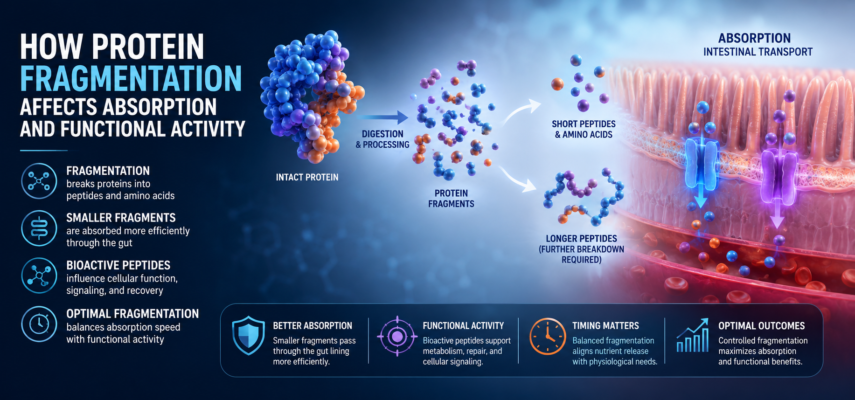
Protein fragmentation refers to the breakdown of large protein molecules into smaller peptides and amino acids through enzymatic, chemical, or processing-related mechanisms.
This process begins during digestion, where enzymes such as pepsin and proteases cleave peptide bonds. It can also occur during manufacturing through controlled hydrolysis or processing techniques designed to pre-digest protein structures.
The resulting fragments vary widely in size, structure, and biological function. Some are short peptides that are rapidly absorbed, while others are longer chains that require further breakdown before utilization.
The pattern of fragmentation plays a major role in determining how protein behaves in the body.
Fragment Size and Its Direct Impact on Absorption
One of the most important factors in protein absorption is fragment size. Smaller peptides and free amino acids generally pass through intestinal walls more easily than larger protein structures.
Dipeptides and tripeptides are particularly efficient for absorption because they can be transported directly via specialized peptide transport systems in the gut lining.
Larger fragments require additional enzymatic breakdown before they can be absorbed, which slows the overall availability of amino acids in circulation.
However, faster absorption does not always mean better utilization. Extremely rapid influx can lead to inefficient metabolic use if it exceeds cellular demand at a given time.
Enzymatic Fragmentation and Digestive Efficiency
Enzymatic digestion is the primary mechanism responsible for protein fragmentation in the body. Different enzymes target specific peptide bonds, producing a diverse range of fragments.
Gastric enzymes begin the process in the stomach, while pancreatic enzymes complete most of the breakdown in the small intestine. The efficiency of this system determines how quickly and completely protein is converted into usable forms.
Highly efficient fragmentation produces a balanced mixture of peptides and amino acids that align with absorption capacity. Inefficient fragmentation can leave partially digested proteins that reduce absorption efficiency and functional consistency.
Pre-Fragmented Proteins and Processing Effects
In addition to natural digestion, protein fragmentation can occur during manufacturing through controlled hydrolysis. This process intentionally breaks down proteins into smaller peptides before consumption or use.
Pre-fragmented proteins often show faster absorption because the digestive system has less work to do. However, the degree of fragmentation must be carefully controlled.
Over-fragmentation can reduce structural diversity and eliminate bioactive peptides that contribute to functional activity. Under-fragmentation may limit absorption efficiency.
The goal is to achieve a balanced fragmentation profile that supports both absorption and biological function.
Bioactive Peptides and Functional Activity
Not all protein fragments serve as simple nutrient sources. Some act as bioactive peptides that influence physiological processes beyond basic nutrition.
These peptides can interact with receptors, modulate enzyme activity, and influence signaling pathways related to metabolism, inflammation, and cellular repair.
Functional activity depends heavily on whether these peptides remain intact after fragmentation. Excessive breakdown can destroy biologically active sequences, reducing their functional potential.
This creates a trade-off between absorption efficiency and functional preservation.
Transport Mechanisms and Uptake Pathways
Once fragmented, peptides and amino acids must pass through intestinal transport systems to enter circulation. These systems include peptide transporters and amino acid carriers embedded in the intestinal lining.
Smaller fragments are generally transported more efficiently, but transport systems can become saturated or selective depending on physiological conditions.
Some peptides are absorbed intact and retain functional activity after entering circulation, while others are fully broken down before reaching systemic circulation.
The efficiency of these transport pathways directly influences how much fragmented protein is ultimately available for biological use.
Functional Loss vs Functional Gain During Fragmentation
Protein fragmentation is not purely beneficial or harmful—it depends on the balance of outcomes.
On one hand, fragmentation improves absorption by increasing molecular accessibility. On the other hand, excessive fragmentation can destroy functional peptides that contribute to signaling and metabolic regulation.
In some cases, partial fragmentation actually enhances function by exposing bioactive sequences that were previously hidden within the protein structure.
The key factor is controlled fragmentation that preserves beneficial activity while improving absorption efficiency.
Fragmentation and Metabolic Timing
The speed at which protein fragments become available in circulation affects metabolic timing. Rapid fragmentation leads to quick amino acid spikes, while slower breakdown produces sustained release.
This timing influences how effectively nutrients are used for repair, energy production, and maintenance processes.
If fragments are released too quickly, they may exceed immediate metabolic demand and be diverted into non-productive pathways. If released too slowly, they may not meet acute biological needs.
Optimal fragmentation creates a balanced release profile aligned with physiological demand.
Structural Integrity After Fragmentation
Even after fragmentation, some peptides retain structural features that influence their biological behavior. These structural remnants can determine receptor binding affinity, transport efficiency, and intracellular activity.
Maintaining partial structural integrity is important for preserving functional diversity. Completely random fragmentation may reduce biological specificity and limit functional outcomes.
Controlled fragmentation preserves key sequences while improving accessibility.
Industrial Processing and Fragmentation Control
In manufacturing environments, protein fragmentation is carefully controlled to achieve desired functional outcomes. Techniques such as enzymatic hydrolysis, filtration, and thermal processing are used to regulate fragment size distribution.
Precision in this process ensures consistent absorption profiles and functional activity across batches.
Companies like BioHack Labs operate within this framework by maintaining high-purity processing standards that control protein fragmentation patterns to preserve both absorption efficiency and functional peptide activity in research applications.
Analytical Tools for Fragmentation Assessment
Modern protein science uses advanced analytical techniques to evaluate fragmentation patterns. Methods such as mass spectrometry and chromatography help identify fragment size distribution and structural composition.
These tools allow researchers to determine whether fragmentation is optimal or excessive and how it affects biological performance.
By analyzing fragmentation profiles, manufacturers can fine-tune processing conditions to improve both absorption and functional outcomes.
Future Directions in Fragmentation Science
Protein fragmentation research is moving toward precision-controlled digestion modeling. Instead of relying on natural enzymatic breakdown alone, researchers are designing proteins with predictable fragmentation pathways.
Computational models are being used to simulate how proteins will break down under physiological conditions, allowing for optimized design of functional peptide release.
Artificial intelligence is also being applied to predict which fragments will retain bioactivity and which will primarily serve as nutrient sources.
As this field advances, protein design will increasingly focus on controlling fragmentation outcomes rather than treating it as an uncontrolled digestive process.
FAQ
What is protein fragmentation?
It is the process of breaking proteins into smaller peptides and amino acids during digestion or processing.
How does fragmentation affect absorption?
Smaller fragments are absorbed more easily and quickly through intestinal transport systems.
Does faster absorption mean better results?
Not always. Extremely rapid absorption can reduce metabolic efficiency if not aligned with biological demand.
Can fragmentation improve protein function?
Yes. Controlled fragmentation can expose bioactive peptides that enhance functional activity.
Why is controlled fragmentation important?
Because it balances absorption efficiency with preservation of functional biological activity.