History of Sprouts Farmers Market
Quick facts
- Founded: 2002 (Chandler, Arizona, by Stan and Shon Boney)
- IPO: 2013 (listed on NASDAQ as SFM)
- Notable industry events: 2017 — Amazon’s acquisition of Whole Foods; 2020 — COVID-19 pandemic
- Format: produce-first, farmers’-market-style grocery
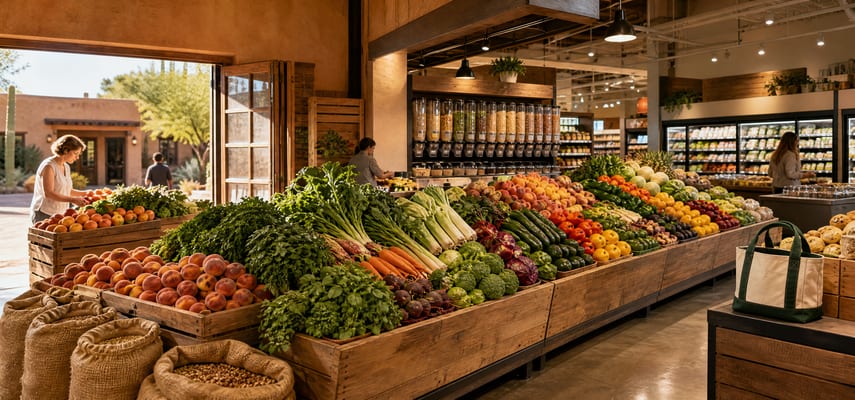
Founded in 2002 in Chandler, Arizona, Sprouts Farmers Market built its brand on translating the improvised, local feel of a farmer’s market—loose crates of peaches, handwritten price signs, and the smell of fresh herbs—into a scaled grocery format. From modest beginnings in Arizona to a national chain that reshaped how mainstream supermarkets sell fresh and natural foods, Sprouts’ story is equal parts regional retailing, timing, and retail experimentation.
Roots in the Southwest: a fresh-food concept
Sprouts was founded in 2002, when Stan and Shon Boney opened the first store under the Sprouts Farmers Market name in Chandler, Arizona. Its broader grocery lineage reaches back to Henry Boney’s 1943 Southern California fruit stand and the later Henry’s Farmers Market business. Headquartered in Phoenix, Sprouts built a produce-first format that combined natural and organic products with the pricing and convenience of a neighborhood supermarket.
That regional origin mattered. The Sun Belt’s year-round produce season and rapid population growth provided both the product flow and customer base to test a format focused on fruit, vegetables, bulk bins and a compact, market-style footprint. Sprouts’ stores emphasized visible produce departments up front, lower-margin staples and a strong selection of natural and organic items—positioning the chain between conventional supermarkets and higher-priced specialty grocers.
Building the farmer’s-market format
From the outset Sprouts concentrated on a few concrete retail choices that differentiated it from both big-box grocers and upscale natural-food stores. It emphasized:
- Large, high-profile produce displays at the front of the store;
- Extensive bulk-food sections and loose unpackaged items;
- A blend of natural, organic, and conventional items priced to be accessible;
- A private-label program and deli items that reinforced the market feel.
These choices were more than aesthetic. Placing produce at the center of an open, smaller-footprint store made the fresh-food proposition immediately visible. Sprouts paired that presentation with a broad mix of fresh, natural and organic foods at value-oriented prices, positioning itself between conventional supermarkets and higher-priced specialty grocers.
Regional expansion and the consolidation of a brand
Throughout the 2000s and into the 2010s, Sprouts expanded through both new-store development and major business combinations. In 2011, Sprouts combined with Henry’s Holdings, which operated 35 Henry’s Farmers Market stores in California and eight Sun Harvest Market stores in Texas. In May 2012, the company acquired 37 Sunflower Farmers Market stores, bringing its total to 143 and extending its footprint into New Mexico, Nevada, Oklahoma and Utah.
By December 29, 2013, Sprouts operated 167 stores in eight states: Arizona, California, Colorado, New Mexico, Nevada, Oklahoma, Texas and Utah. It had 253 stores in 13 states as of January 1, 2017, and 477 stores in 24 states as of December 28, 2025. By June 28, 2026, the company operated 490 stores in 25 states.
Sprouts also recorded several formal leadership transitions: on August 6, 2015 Doug Sanders became executive chairman while Amin Maredia succeeded him as CEO and Jim Nielsen became president and COO. After Maredia resigned on December 30, 2018, Jim Nielsen and Brad Lukow served as co‑interim CEOs until Jack Sinclair was appointed CEO on June 24, 2019.
The 2013 public offering and national ambitions
Sprouts’ shares began trading on the NASDAQ Global Select Market under the ticker SFM on August 1, 2013, and the IPO closed on August 6. The company received approximately $344.1 million in net proceeds and used $340 million to repay outstanding debt. Becoming a public company also brought quarterly reporting, investor scrutiny and a clearer articulation of growth metrics such as same-store sales and new-store productivity.
Going public also mattered because it occurred at a moment when the grocery landscape was changing dramatically. Increasing consumer interest in organic and natural foods, coupled with rising awareness of food origins and healthier eating, meant that Sprouts’ offering had a growing addressable market. The IPO gave the chain greater public visibility as it pushed into more competitive metropolitan areas.
Competition sharpens: Whole Foods, Trader Joe’s, and the Amazon effect
Sprouts’ strategic positioning—fresh-forward and value-conscious—made it a competitor to two very different incumbents. On one side stood Whole Foods Market, the upscale natural-food pioneer; on the other, Trader Joe’s, the cult-favorite with a quirky private-label strategy. Sprouts attempted to occupy a middle ground: more affordable than Whole Foods, fresher and more natural-focused than conventional grocers.
Amazon announced its agreement to acquire Whole Foods Market in June 2017, and the transaction closed on August 28, 2017. The deal joined a major online retailer with one of the specialty grocers Sprouts identified as a competitor. Sprouts was already developing digital coupons, online ordering and delivery partnerships before the acquisition, and its later filings continued to identify both physical and online retailers as competitors. Public disclosures do not establish that the Amazon-Whole Foods transaction directly caused particular Sprouts strategy changes.
Branding, private labels and supply-chain choices
From the mid-2010s onward, private-label merchandise and supply-chain control became central to Sprouts’ economics. Like other grocers, Sprouts developed store brands to capture higher margins and control product attributes—organic certification, non-GMO sourcing and ingredient transparency. Private-label goods also reinforced the brand promise: a consistent set of “Sprouts-approved” items that matched the chain’s value and freshness positioning.
On the supply side, Sprouts leaned on both national suppliers and a network of regional growers. That hybrid sourcing approach aimed to preserve the local, seasonal story that customers expect while maintaining the reliability required by a national retailer. For a fresh-first grocer, supply-chain efficiency is a direct determinant of profitability: tighter sourcing reduces spoilage and markdowns, and better forecasting lowers stockouts on high-turn items.
Investing in operations and technology
Retailers confronted the twin imperatives of store growth and digital modernization. Sprouts invested in logistics, store technology and category management tools to manage the complexity of a perishable-focused business. Inventory systems, cold-chain logistics and merchandising analytics became priorities because they directly affect shrink and the frequency of customer visits.
At the same time, digital tools—loyalty programs, mobile coupons, and online ordering—became necessary to maintain relevance. Consumers had begun to treat grocery as an omnichannel category: some purchases would be made in-store for immediate consumption, others ordered online for pickup or delivery. Sprouts’ operational focus in these years was thus twofold: keep the in-store experience unmistakably fresh and farmer-market-like, while building the digital plumbing to meet customers where they shopped.
COVID-19: an abrupt test of resilience
The COVID-19 pandemic in 2020 was a stress test for every grocery chain, particularly for retailers that emphasized fresh, perishable inventory and high store throughput. Panic buying in March 2020 pressured supply chains and forced rapid changes in store operations—sanitation protocols, social distancing, and limits on in-store traffic. At the same time, consumer buying patterns shifted heavily toward online ordering, curbside pickup, and larger basket sizes for pantry goods.
Sprouts, like other grocers, accelerated its roll-out of pickup and delivery options and adjusted merchandising to meet the surge in demand for staple items. The pandemic also highlighted structural strengths: chains with efficient produce sourcing and strong regional supply networks could better adapt to sudden spikes in consumer demand. The crisis underscored the strategic importance of omnichannel capabilities—a need that had been building for years but became urgent overnight.
Latest strategic moves and the drive to scale (post-2020)
Following the initial pandemic shock, Sprouts entered a phase that emphasized scale, efficiency and brand differentiation. The company continued to open new stores in markets where its format fit demographic trends—suburban areas with families and health-oriented shoppers—while also closing or remodeling underperforming locations to improve overall portfolio productivity.
Post-pandemic, the retail environment favored those who could combine in-store freshness with digital convenience. Chains that integrated inventory data, e-commerce platforms and localized assortment saw better margins and customer loyalty. For Sprouts, the strategic challenge was to maintain the authenticity of the farmer’s-market experience while adding the technology and operational resilience customers increasingly expected.
As of June 28, 2026, Sprouts operated 490 stores in 25 states and was pursuing a smaller-format expansion—having opened 125 stores since 2021—to drive unit growth while adding omnichannel capabilities such as nationwide loyalty and expanded pickup and delivery.
Why Sprouts changed grocerying
Sprouts’ rise matters because it helped normalize a fresh- and natural-centric shopping model within mainstream grocerying. Where natural and organic goods had once been a specialty niche, retailers like Sprouts demonstrated that a produce-first, value-oriented approach could win broad appeal. The chain’s format forced competitors to rethink produce space allocation, private-label strategies and pricing on natural items.
Moreover, Sprouts’ trajectory illustrated a broader retail lesson: differentiating on experience (the market feel, visible produce) while driving down costs in other areas (leaner store layouts, selective SKUs) can create a viable middle ground between mass-market discounters and premium specialty retailers. In a market increasingly defined by convenience, price sensitivity, and health-conscious choices, that middle ground proved commercially significant.
Continuing pressures and strategic trade-offs
Sprouts’ path forward has not been without strategic trade-offs. Expanding geographic reach requires dilution of a local, regional identity that initially served as a brand asset. Pursuing e-commerce and delivery can conflict with the in-store sensory experience that defines a farmer’s-market format. And competing on price with both discounters and Amazon-backed rivals forces constant margin management.
Additionally, as more consumers demanded transparency—on sustainability, labor practices and sourcing—retailers faced not only operational decisions but reputational ones. Maintaining credibility as a “fresh and natural” retailer meant consulting supply chains, certifications and marketing claims carefully; missteps could erode hard-won trust.
What to watch next
Analysts and shoppers alike will watch several indicators to assess Sprouts’ future trajectory:
- Same-store sales growth and the ability to sustain traffic gains after pandemic-driven spikes;
- Progress on omnichannel capabilities—especially the integration of digital ordering with in-store fulfillment;
- Private-label penetration and the role those brands play in margins and customer loyalty;
- Geographic targets for new stores and the company’s ability to adapt the format to different regional tastes;
- Supply-chain resilience and sourcing transparency, particularly for organics and seasonal produce.
These signals will indicate whether Sprouts can keep the balance it has sought for years: the palpable freshness of a farmers’ market married to the scale and convenience modern shoppers demand.
Conclusion
Sprouts Farmers Market did not invent the idea of fresh food; rather, it made a persuasive case that the farmer’s-market sensibility could be replicated at scale with disciplined operations and a clear brand promise. From its Southwest origins to its public-market ambitions and the contemporary pressures of e-commerce and consolidation, Sprouts’ history is a study in translating local retailing instincts into a national grocery proposition. Its future will depend on preserving that core sensibility while evolving the technology and logistics that define twenty-first-century grocerying.