










History of FedEx
Fred Smith founded Federal Express in 1971 with a core innovation: an integrated overnight air‑ground hub‑and‑spoke network that could guarantee next‑day delivery of small parcels.
The overnight idea that rewired commerce
That idea—an integrated overnight distribution system centered on a single nightly air hub—drove the creation of Federal Express, later shortened to FedEx.
The company transformed freight transport from a patchwork of local couriers and scheduled airline freight into a predictable, trackable service that large manufacturers and small businesses could rely on.
1970s: Origins and founding — Fred Smith and a new promise for delivery
Federal Express Corporation was founded by Fred Smith in 1971. Smith had developed the concept years earlier while a student and organized the company around the premise that a dense nightly air network could aggregate shipments and allow reliable next‑morning delivery.
Smith initially located the operation in Little Rock, Arkansas, but soon searched for a strategic airport site for an overnight hub because the hub’s location would determine routing efficiency, gate access and fuel costs.
The company raised capital from investors who were persuaded by the promise of a new kind of express service. From the outset the business model was capital intensive: aircraft, sorting facilities, dedicated personnel and a commitment to an overnight schedule required heavy up‑front investment before recurring revenue could flow.
That commitment to an integrated system—rather than relying primarily on scheduled airline freight or local contractors—set Federal Express apart from earlier couriers and laid the groundwork for its later growth.
1970s: Early development — nightly air hub and tracking
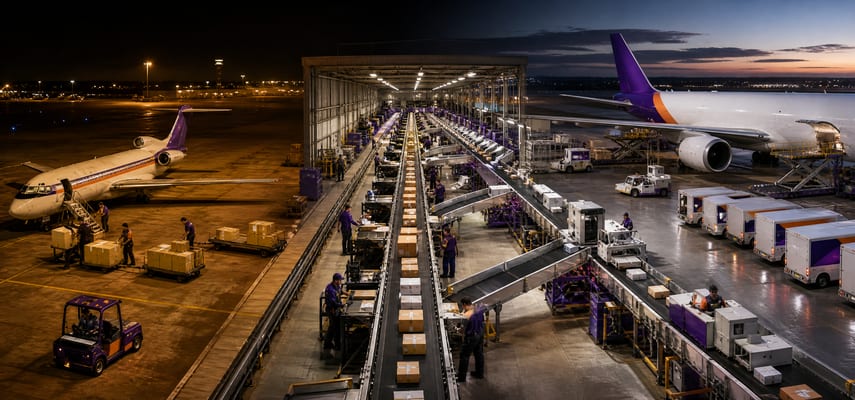
Federal Express began operations in the early 1970s with a concentrated overnight flying schedule designed to collect packages from local pickup points, bring them into a central sorting hub during the night, and redeploy them to local terminals for morning delivery.
Memphis, Tennessee, emerged as the principal hub because of its central location, reliable weather, available hangar space and airport support; FedEx established a heavy presence at Memphis International Airport that would remain central to operations for decades.
Two practical choices shaped the company’s early development. First, FedEx pursued a hub‑and‑spoke routing architecture: instead of many point‑to‑point flights, aircraft converged each night on a central facility for automated sorting. That system raised aircraft utilization and reduced the number of flight legs required to connect many origin‑destination pairs.
Second, the company invested in computerized operations and package tracking earlier than most rivals. FedEx developed internal systems to record package movement at critical touchpoints, turning proof‑of‑delivery and routing visibility into a brand promise.
Those choices were not risk‑free. Building and operating a dedicated air fleet and a new automated sortation plant cost tens of millions of dollars before the service reached scale. FedEx’s early years were marked by aggressive capital spending, operational learning, and the need to win customers—primarily businesses that valued speed and reliability enough to pay a premium.
The company’s ability to offer consistent overnight delivery, backed by visible tracking, helped it attract customers in sectors like electronics, manufacturing and legal services that needed documents and parts moved quickly.
1980s–2000s: Expansion and diversification — moving off the runway
As demand for time‑definite delivery grew, Federal Express expanded its network and service portfolio. The original overnight promise remained central, but the company broadened its footprint in several ways.
- U.S. network growth: FedEx extended pickup and delivery terminals nationwide, scaling local courier operations to feed the nightly airborne sort.
- International expansion: FedEx moved beyond domestic lanes with scheduled services to key markets, building a presence in Europe, Asia and elsewhere to serve global trade customers.
- Information systems: Investment in operations software and barcoding continued, enabling real‑time package tracking—a capability that became an expectation rather than a novelty.
These steps changed the company from a specialized overnight express carrier into a multi‑modal logistics provider. The technical backbone—electronic data capture, centralized processing and route optimization—became a durable advantage that competitors found costly to replicate.
Major milestones that reshaped the business
Certain events and choices in FedEx’s first three decades altered its trajectory.
- Building the Memphis SuperHub: Centralizing nightly sorting in Memphis allowed the company to reliably move thousands of shipments each night with fewer flights and more predictable delivery windows. The hub was the physical embodiment of FedEx’s promise.
- Early adoption of package tracking: FedEx’s internal tracking systems offered customers visibility and accountability; tracking became a competitive baseline for the logistics industry.
- Network diversification in the 1990s and 2000s: FedEx broadened services to include ground parcel delivery, freight, and business services such as retail printing and shipping stores. Those additions reduced dependence on the premium overnight product and opened lower‑cost volume tiers.
- Acquiring Kinko’s (2004): In one of its most visible moves, FedEx purchased Kinko’s to create a nationwide retail channel for packing, printing and drop‑off, later rebranded as FedEx Office. This acquisition put FedEx into the customer‑facing retail space and gave the company a channel for both consumer and small‑business shipments.
- Cross‑border consolidation (mid‑2010s): FedEx pursued acquisitions to add European road express capabilities, culminating in its purchase of TNT Express—bringing a significant European road network and local expertise into the FedEx family.
Some acquisitions were transformational because they gave FedEx capabilities that would have taken years to build organically. But integrating large regional carriers also presented familiar problems: labor contracts, regulatory approvals and IT harmonization. Those costs and frictions tempered the near‑term financial upside and demanded sustained managerial attention.
Each milestone changed how FedEx earned revenue. The Memphis hub and tracking system defended a premium overnight position; ground and retail services broadened the addressable market; European acquisitions reduced the need to stitch together partnerships overseas.
Leadership and organizational shifts: from founder to a modern parent company
Fred Smith remained the defining operational leader for decades, guiding FedEx through its capital‑intensive early years, the expansion into new service lines, and the reorganization that created a multi‑brand group. Under Smith the company kept a clear focus on on‑time delivery and operational discipline.
At the turn of the century FedEx reorganized its businesses under a corporate parent to reflect the multiplicity of services—express air, ground, freight, and retail—each with different economics and distribution models. That reorganization made it easier to manage diverse operations and to present distinct offerings to customers and investors.
In 2022 a major leadership transition completed when Raj Subramaniam succeeded Fred Smith as chief executive. Subramaniam had long tenure inside the company and moved from president and chief operating officer into the CEO role. The succession signaled a shift from founder‑led growth to executive stewardship aimed at managing scale in a more complex, competitive environment.
Challenges and controversies: competition, regulation and labor
FedEx has faced multiple strategic pressures and episodic controversies across its history.
Competition changed the game. UPS and DHL were established rivals with different strengths; each pressured pricing and network coverage. More recently, Amazon’s decision to build its own logistics capabilities introduced a powerful new competitor and a large customer that could bypass third parties.
Labor and regulatory issues also posed recurring challenges. FedEx’s ground and express units operate under different labor arrangements and regulatory regimes; managing those differences has led to disputes and public scrutiny at times. European acquisitions in particular required regulatory approvals and faced union negotiations that affected costs and integration timetables.
FedEx has also weathered operational crises tied to weather, airport capacity, and global supply‑chain shocks. The COVID‑19 pandemic demonstrated both the company’s strengths and vulnerabilities: demand surged for e‑commerce deliveries while international air cargo capacity tightened and labor supply fluctuated. Those disruptions tested FedEx’s network resilience and required large short‑term adjustments in staffing and routing.
2010s–2020s: Recent developments and the company’s position
The most consequential recent years for FedEx combined pandemic‑era demand shocks, competitive repositioning, and leadership change.
During the COVID‑19 pandemic (2020–2021) e‑commerce volumes rose sharply, boosting parcel demand but also straining capacity. FedEx added personnel and adjusted network capacity as demand increased, while constrained commercial air capacity and labor availability raised operating costs. The company responded with network adjustments and pricing initiatives.
Strategically, FedEx has continued to emphasize a portfolio approach: FedEx Express for time‑definite air shipments, FedEx Ground for cost‑efficient ground parcel service, FedEx Freight for less‑than‑truckload and full‑truckload freight, and FedEx Office for retail services. That multi‑brand structure reflects different margin profiles and operational rhythms.
Leadership succession in 2022—when Raj Subramaniam took the chief executive role—came at a moment when the company needed steady hands. The changeover preserved continuity because Subramaniam was a long‑time company executive; it also signaled management’s intent to focus on operational execution, cost discipline and further integration of acquired networks.
FedEx’s recent strategic priorities include modernizing facilities, investing in automation, and refining pricing strategies to reflect volatile fuel and labor costs. The company has emphasized network resilience and technology upgrades—continuing the historic pattern of pairing physical assets with information systems to create service differentiation.
Legacy and significance: what FedEx changed for business
Two durable contributions explain why FedEx matters. First, the airline‑plus‑hub model made overnight express delivery reliable and scalable. That operational architecture helped shorten supply chains and enabled just‑in‑time production practices that reshaped manufacturing and retail logistics.
Second, FedEx normalized package tracking and proof‑of‑delivery as standard expectations. By committing to visibility and accountability, FedEx forced competitors to make similar investments—so tracking moved from a premium feature to an industry norm.
Other elements of FedEx’s legacy are mixed. The company’s diversification into ground, freight and retail demonstrated that an air‑focused firm could build multiple revenue streams. At the same time, those moves complicated labor relations and integration. And the rise of new logistics models—most prominently Amazon’s vertically integrated delivery—shows the limits of third‑party delivery when a very large shipper pursues self‑sufficiency.
Conclusion: from a bold idea to a logistics staple
FedEx began as a bold operational bet: invest heavily in aircraft, a nightly central hub, and information systems to guarantee next‑morning delivery. Its early choices—centered on the Memphis hub and computerized tracking—created a durable service advantage that reshaped commerce.
Over decades the company diversified into ground, freight and retail, stitched European road networks into its global operations through acquisition, and restructured into a multi‑brand corporation. Recent years tested FedEx with pandemic shocks, shifting customer relationships and leadership transition.
The company’s modern form is less a single overnight carrier than a family of logistics businesses that combine air capacity, road networks and retail touchpoints—still anchored by the operational culture Fred Smith established but now managed for scale under a new generation of executives. FedEx’s central contribution endures: it made time‑definite, trackable parcel delivery an expectation of modern commerce, and that change continues to influence how goods move around the world.











