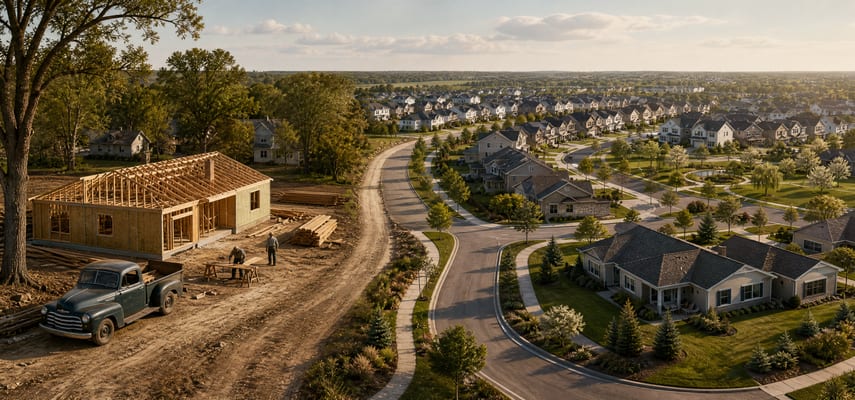
History of PulteGroup
When a young William “Bill” Pulte began building houses in 1950, he was not simply selling square footage; he was tapping into an enormous postwar appetite for new, affordable homes. What started as a small regional builder in Michigan grew, over seven decades, into PulteGroup—one of America’s largest publicly traded homebuilders—shaped by boom-and-bust housing cycles, bold rollups, and a persistent focus on product segmentation aimed at specific buyer types. This is the story of how a neighborhood homebuilder became a national platform and how it navigated crises, acquisitions, and changing consumer tastes.
Timeline — key milestones in PulteGroup history
- 1950 — Bill Pulte builds his first home in Detroit; PulteGroup dates its founding to this year
- 1960s–1970s — Expansion beyond Detroit into multiple U.S. markets
- 1990s–2000s — National expansion and multi-brand product strategy
- 2009 — Acquisition of Centex during the housing downturn
- 2010s — Post-crisis restructuring and clarified brand architecture
- 2020–2021 — Pandemic-driven demand surge and supply-chain challenges
- 2022–2024 — Rising rates, affordability headwinds, and strategic discipline
Origins: William J. Pulte and the postwar leap (1950s) — early history of PulteGroup
PulteGroup dates its founding to 1950, when 18-year-old William J. “Bill” Pulte built his first home in Detroit. The corporate predecessor was organized in 1956. Pulte launched the business at a time when returning veterans and a rising middle class created strong demand for single-family housing. Pulte’s early work was notable for speed and scale: small-lot communities of single-family homes built quickly to meet local demand.
That operational discipline—standardized plans, efficient land use, and an emphasis on volume—set the template for growth in the decades to come. Those early years established two durable features of Pulte’s corporate DNA: a builder’s mentality that controlled the cycle from land acquisition to sales, and product repeatability through a limited set of floorplans and design choices to drive efficiency and reduce cost.
Regional expansion and the move toward public markets (1960s–1980s)
During the 1960s and 1970s, Pulte expanded beyond metropolitan Detroit, entering Washington, D.C., Chicago and Atlanta in the 1960s and operating in 10 major markets by the 1970s. Like many builders of that era, Pulte benefited from broader demographic shifts—migration to the South and West, rising household formation, and an appetite for new subdivisions—while adopting operational practices that favored repetition and cost control.
Pulte’s expansion strategy rested on four simple moves: buy land in fast-growing regions, standardize home designs to lower costs, build at scale to achieve construction efficiencies, and align sales and financing to accelerate deliveries. Pulte went public as Pulte Home Corporation in 1969.
Leadership transitions and the PulteGroup name
Leadership gradually moved beyond the founder. Robert K. Burgess, who had become president and chief operating officer in 1985, became chairman and chief executive officer in 1993. After Burgess retired on December 30, 2001, Bill Pulte became board chairman and Mark J. O’Brien became chief executive officer the following day. Richard J. Dugas Jr. replaced O’Brien as president and chief executive officer on July 1, 2003, and became chairman when the Centex merger closed on August 18, 2009. Bill Pulte resigned from the board effective March 31, 2010.
Ryan Marshall became chief executive officer and joined the board on September 8, 2016. Dugas remained executive chairman until the 2017 annual meeting, when he retired and Bryce Blair became non-executive chairman on May 3, 2017, completing the separation of the chairman and CEO roles. Thomas J. Folliard succeeded Blair as non-executive chairman on January 1, 2023. As of 2026, Marshall remains president and chief executive officer, while Folliard serves as non-executive chairman.
The company’s corporate identity also changed during this period. Pulte told shareholders that the proposed PulteGroup name would better reflect a new branding strategy and that the change was not contingent on completion of the Centex merger. Pulte Homes, Inc. formally changed its corporate name to PulteGroup, Inc. on March 18, 2010.
Governance dispute and regulatory matters
The 2016 CEO transition came amid a public governance dispute. Founder Bill Pulte and allied shareholders called for Dugas to step down and sought changes to the board. In July 2016, PulteGroup entered into an agreement with Elliott Management under which three independent directors joined the board. In September, a separate agreement with the Pulte parties placed the founder’s grandson, William J. Pulte, on the board. That same day, Ryan Marshall became chief executive officer and Dugas moved into the executive-chairman role pending his retirement in 2017.
Pulte has also faced regulatory matters associated with its homebuilding and mortgage operations. In 1998, the company entered into an agreement with the U.S. Department of Justice resolving allegations that six multifamily developments did not fully meet the Fair Housing Act’s accessibility requirements. Pulte denied violating the act but agreed to corrective work, future compliance measures and industry education initiatives. In 2013, a Department of Housing and Urban Development inspector general audit found that Pulte Mortgage had not followed federal requirements for certain FHA-insured loans involving restrictive covenants and liens. HUD filed an administrative complaint seeking civil penalties in December 2015; the matter was dismissed on April 12, 2016, after the parties executed a settlement.
In its latest annual filing, PulteGroup described its current legal and governmental proceedings as incidental to continuing operations, with many involving alleged construction defects, and said it did not expect the ultimate liability—after considering insurance and reserves—to materially adversely affect its results, financial position or cash flows. Its quarterly filing for the period ended June 30, 2026 reported no material developments in those proceedings.
Becoming a national player: brands and product focus (1990s–2000s)
1990s: Scaling and segmentation
By the 1990s Pulte had become a national player, operating in multiple states and testing product segmentation as a commercial strategy. The company developed and marketed different brand names to reach distinct buyer segments: first-time buyers, move-up families, and older “active adult” purchasers who wanted single-level living and community amenities.
The logic was straightforward: product that matched a buyer’s life stage tends to sell faster and supports higher margins than a one-size-fits-all offering. This period also brought greater involvement in capital markets. Public status allowed Pulte to finance land purchases and plow returns into new markets while exposing the company to investor scrutiny and quarterly expectations.
The 2007–2009 housing collapse and the Centex transaction
2007–2009: The housing collapse
The housing crash that began in 2007 was the most consequential interruption in modern U.S. homebuilding history, and Pulte, like its peers, experienced a sharp reversal. New-home starts and sales collapsed, lots and inventory turned from assets into burdens, and many builders retrenched, took writedowns, and sought fresh capital or consolidation opportunities.
2009: Acquisition of Centex
On April 8, 2009, Pulte and Centex announced a definitive agreement to combine in a stock-for-stock transaction; the merger closed on August 18, 2009, making Centex a wholly owned subsidiary of Pulte. The deal was significant on two counts. First, it combined two national builders at a time when scale mattered for surviving the downturn—larger companies could spread fixed costs, negotiate better terms with suppliers, and leverage stronger balance sheets.
Second, the transaction reshaped the industry: consolidation reduced the number of national players and concentrated market share in fewer firms better positioned to buy land as the downturn ebbed. The merger expanded geographic reach and added product lines that addressed budget-conscious buyers as well as move-up customers, while creating a complex integration task—combining operations, aligning product lines, and unifying corporate cultures—at a time when the market was still fragile.
Post-crisis restructuring and brand architecture (2010s)
2010s: From survival to disciplined growth
After the immediate crisis years, Pulte—like other surviving builders—shifted focus from survival to disciplined growth. That meant rebuilding land portfolios selectively, returning to profitable communities rather than chasing volume at any cost, and sharpening brand distinctions so each division could target clearly defined buyers.
Product and community segmentation emerged as a strategic priority. Pulte’s model began to emphasize several distinct brands—each designed for a buyer cohort. Those brands were marketed with different price points, home plans and community amenities, and in many markets Pulte balanced a “value” brand for first-time buyers with a higher-end product for move-up families and an active-adult line targeting older buyers who wanted single-level living and community services.
Operationally, the company invested in supply-chain efficiencies and centralized back-office functions. That reduced overhead per home and made it easier to ramp up when demand returned. For an industry that moves in cycles, the lesson was clear: efficiency in downturns pays off in upturns.
Public markets and capital allocation
PulteGroup’s status as a publicly traded company (trading under the ticker PHM on the New York Stock Exchange) forced an explicit dialogue about capital allocation: how much to spend on land, how much to return to shareholders through dividends and buybacks, and how quickly to rebuild backlog when demand improved. Investors rewarded disciplined returns on invested capital and punished excessive leverage—lessons written large in the last recession.
Management’s approach during the recovery years favored flexibility. Rather than reloading aggressively on land in a single cycle, Pulte focused on scalable land positions that could be built out over several years. This hedged the company against a repeat collapse in pricing and enabled steadier earnings growth when demand revived.
Product innovation and community types
Over time, PulteGroup refined the product playbook. The company embraced design features reflecting shifting buyer priorities: open-plan living, energy-efficient systems, and flexible rooms that could serve as home offices—trends that accelerated with changing work patterns and buyer preferences. Pulte also continued to build age-restricted communities that appealed to retiring Baby Boomers who wanted amenity-rich, low-maintenance living.
The emphasis on product created differentiation in a crowded market. Buyers willing to pay a premium for design, energy performance or community amenities provided better margins. Conversely, when entry-level buyers tightened budgets, Pulte’s multi-brand setup allowed the company to offer more price-sensitive products without undermining higher-margin lines.
The pandemic, demand swings, and the housing tightness of 2020–2021
The COVID-19 pandemic produced an unusual shock to housing markets. Lockdowns and changes in work and lifestyle prompted many homeowners to reassess their housing needs; at the same time, historic monetary stimulus and low mortgage rates in 2020–2021 expanded buying power for many households. Across the industry, new-home demand surged in many suburban and Sun Belt markets.
PulteGroup benefited from those dynamics, as did most large builders, but the company also confronted supply-chain constraints: lumber price volatility, labor shortages and longer build times. The result was a mix of stronger pricing and tighter margins in some markets. For Pulte, the period validated an approach that combined product diversity with a national footprint—demand was uneven across regions, and scale allowed the firm to redeploy resources toward hotter markets.
Rising rates, affordability headwinds and strategic discipline (2022–2024)
As interest rates rose in 2022 and 2023 and mortgage costs climbed, the industry moved from a seller’s market toward one constrained by affordability. Buyers who had benefited from low rates found monthly payments substantially higher; entry-level demand cooled first, while move-up and active-adult segments showed greater resilience in some places.
For PulteGroup, the response emphasized two principles: protect balance-sheet flexibility and adjust product mix to preserve sales. That meant careful pricing, targeted incentives for qualifying buyers, and a continued emphasis on building homes and communities with features that justified higher prices—energy efficiency, better layouts, and amenity packages that appealed to households willing to stretch for value.
Even during these periods of weakness, land acquisition remained central to long-term strategy. Buyers of builders’ stocks closely watch metrics like owned and controlled lots, community count and velocity of sales; Pulte’s management stressed disciplined land buys rather than opportunistic overexpansion. The outcome was slower volume growth in constrained years but a lower risk of overhang if the market turned again.
Corporate footprint and brands
Today, PulteGroup operates a portfolio of brands that target distinct buyer segments and market positions. That brand architecture is purposeful: it aims to protect margins by avoiding product dilution and to capture buyers across income bands and life stages. In many markets the company fields multiple brands—value, move-up and active-adult—allowing it to serve different niches without blurring marketing or design focus.
The portfolio was assembled through acquisitions over time. Pulte acquired DiVosta in 1998 and completed its acquisition of Del Webb on July 31, 2001; Centex joined through the August 18, 2009 merger. After the housing crisis, PulteGroup acquired substantially all of the homebuilding assets of John Wieland Homes and Neighborhoods in January 2016 and certain assets of Las Vegas builder American West in April 2019. In January 2020, it also acquired Innovative Construction Group, an off-site framing business that continued as a stand-alone operation.
On the geographic side, the company’s national footprint—concentrated in growth-intensive Sun Belt metros but with presence across the country—exposes it to regional cycles. That balance is a practical hedge against localized downturns, though it also requires nuanced land and labor management when costs or regulations change at the state or municipal level.
Why PulteGroup’s history matters to the industry
PulteGroup’s trajectory tells a broader story about modern homebuilding in America. First, it demonstrates the power of scale and product segmentation: builders that survive cycles are typically those that can deploy capital across markets and match product to buyer demand. Second, the company’s post-crisis consolidation illustrates how industry structure changed after 2007–2009; fewer large public builders now capture a disproportionate share of national volume.
Finally, Pulte’s evolution shows the tension between growth and prudence. The firm’s strategic choices—when to buy land, how to price product, and how aggressively to expand—reflect lessons from the last major downturn. Those lessons still shape investor expectations and industry practices: resilient balance sheets, diversified products and measured land acquisition are prized over rapid, riskier expansion.
Recent challenges and the road ahead
Like its peers, PulteGroup faces several structural challenges going forward. Affordability remains a long-term concern: wages have not kept pace with house price gains in many markets, pushing first-time buyers to the margins. Regulatory and permitting delays in some jurisdictions raise development costs. Labor shortages in construction put upward pressure on margins and delivery schedules. At the same time, technology and product shifts—energy efficiency, smart-home features, modular construction experiments—offer paths to differentiation.
How Pulte responds to these pressures will determine its next chapter. Success will likely hinge on a combination of product innovation that reduces life-cycle costs for buyers, disciplined land deals, and operational improvements that shave time and cost from the build cycle. The company’s historical strengths—systematized construction, multi-brand segmentation, and national scale—remain useful tools for navigating the shifting landscape.
Conclusion
PulteGroup’s story is not a straight line from startup to corporate dominance. It is a narrative of adaptation: a founder-built company that scaled into a national platform, endured the industry’s deepest crisis, consolidated through acquisition, and emerged with a brand architecture designed to meet the needs of different buyer cohorts. The company’s history matters because it encapsulates the essential trade-offs of large-scale homebuilding—growth versus prudence, standardization versus customization, and the continual need to align product with what buyers will actually pay for. As housing markets pivot with interest rates, demographic shifts and technological change, PulteGroup’s past choices provide a lens for understanding how large builders weather cycles and how they might shape the future of American neighborhoods.