










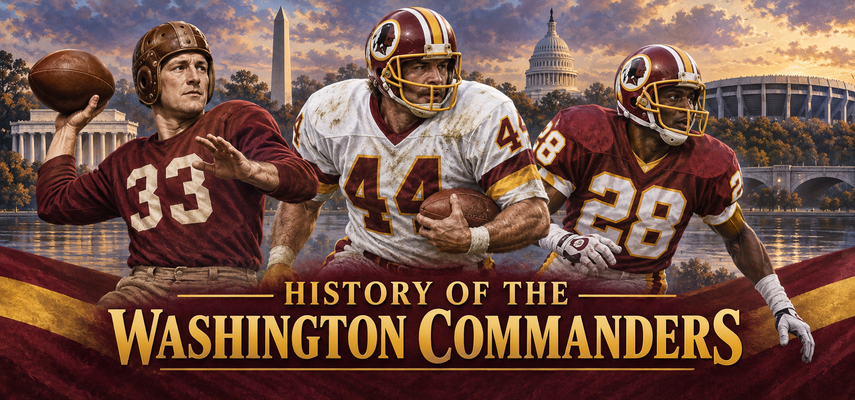

The Washington Commanders carry a franchise history that began in Boston and developed through several names, changing homes and sharply different competitive eras. Sammy Baugh’s early passing helped establish a champion, while Joe Gibbs later coached three Super Bowl-winning teams with different starting quarterbacks. Those achievements coexist with the organization’s exclusionary past, later ownership controversies and long periods of competitive frustration. The current name did not create a new franchise or reset its record. This history follows that continuity through the completed 2025 season, with later leadership, honors and stadium developments distinguished from events still awaiting completion.
Franchise at a glance
| Field | Details |
|---|---|
| Founded | 1932; NFL franchise established in Boston |
| First season | 1932, National Football League |
| Original city and name | Boston, Massachusetts — Boston Braves |
| Current city and name | Washington Commanders; home games in Landover, Maryland |
| Previous cities and names | Boston Braves (1932); Boston Redskins (1933–1936); Washington Redskins (1937–2019); Washington Football Team (2020–2021) |
| League and conference/division | NFL — National Football Conference East |
| Home venue | Northwest Stadium, Landover; opened in 1997 |
| League championships | 3 Super Bowl titles: 1982, 1987, 1991 |
| Other recognized championships | 2 pre-Super Bowl NFL titles: 1937, 1942; 5 NFC titles |
| Historical coverage | 2025 NFL season, including playoffs completed in February 2026; later developments through October 16, 2026 |
Origins and early years
George Preston Marshall headed the group that established an NFL franchise in Boston in 1932. The team initially played at Braves Field and used the Braves name, sharing its setting with a baseball organization without inheriting that club’s history. A move to Fenway Park in 1933 accompanied the adoption of the Redskins name. The franchise remained in Boston through the 1936 season, when it reached the NFL Championship Game but lost to Green Bay.
The NFL approved the move to Washington in 1937. Griffith Stadium became the new home, and rookie quarterback Sammy Baugh joined coach Ray Flaherty’s team. The relocation immediately produced a championship season, but it did not establish a replacement franchise. Boston’s earlier seasons remain part of the same record. The later Washington Football Team and Commanders names likewise represent changes within that continuing organization. Historical names appear here when needed to identify the teams and competitions of their own periods.
Defining eras
1932–1945: Baugh and the early champions
Baugh’s passing gave Washington a distinctive offensive strength at a time when professional football relied heavily on running. In the first season after the move, the team defeated Chicago 28–21 in the NFL Championship Game. Baugh threw three touchdown passes, with Wayne Millner an important receiving partner. The result established the franchise’s first overall title and gave its new city an immediate sporting success.
The Bears supplied both further opportunity and an extraordinary setback. Chicago won the 1940 championship game 73–0, exposing Washington’s defense to the T-formation offense. Two seasons later, Washington reversed the competitive outcome with a 14–6 championship victory over the Bears. Another final defeat to Chicago followed in 1943, and a one-point loss to the Cleveland Rams ended the 1945 title attempt. These were pre-Super Bowl NFL competitions. Baugh also played defense and punted.
1946–1970: Decline and an overdue integration
The postwar franchise struggled to reproduce its early championship position. Baugh’s eventual retirement removed its most important early player, while coaching and roster changes failed to produce sustained contention. Marshall also resisted racial integration after other NFL clubs had begun signing Black players. That exclusion is part of the franchise’s history, not a separate issue erased by its earlier victories.
Bobby Mitchell joined Washington in 1962 and became the organization’s first Black player to appear for the team. His receiving ability immediately improved the offense and helped change the institution he had entered. Sonny Jurgensen’s arrival in a 1964 trade with Philadelphia gave Washington another major passing figure, with Charley Taylor and other receivers providing important targets. Vince Lombardi coached the team to a winning record in 1969, but died before the following season. The improvement did not produce another championship.
1971–1980: Allen returns Washington to contention
George Allen became head coach in 1971 and emphasized experienced players, defense and immediate competitiveness. His teams quickly returned Washington to the postseason after a long absence. Billy Kilmer supplied quarterback leadership, Larry Brown became a major running threat, and defensive veterans helped establish a more demanding standard. Jurgensen remained an important part of the roster, though injury kept him out of the championship run after the 1972 season.
Washington defeated Dallas 26–3 in the NFC Championship Game and advanced to its first Super Bowl. Miami won Super Bowl VII, 14–7, completing its undefeated season. Washington’s achievement was therefore an NFC title, not an overall league championship. Allen’s later teams continued to contend without another Super Bowl appearance. After his departure, Jack Pardee’s tenure included a promising 1979 season that ended short of the playoffs. The next major reconstruction would build on the restored expectations while using a different coaching approach.
1981–1992: Gibbs builds three different champions
Joe Gibbs arrived as head coach in 1981 and gradually shaped a flexible offense around a strong offensive line. In the strike-shortened 1982 season, John Riggins’s running powered the postseason. His long fourth-down touchdown run helped defeat Miami 27–17 in Super Bowl XVII, with Joe Theismann directing the offense and Riggins earning the game’s MVP. Washington returned the following season but lost Super Bowl XVIII to the Los Angeles Raiders.
The 1987 season brought another strike and another title. Replacement players contributed regular-season wins before the established roster completed the campaign. Doug Williams then became the first Black starting quarterback to win a Super Bowl, throwing four touchdowns in the decisive second quarter of a 42–10 victory over Denver. Four seasons later, Mark Rypien led a 14–2 team to a 37–24 victory over Buffalo in Super Bowl XXVI. Gibbs’s three championships came with three different starting quarterbacks, supported by adaptable coaching, line play and roster depth.
1993–2019: Changing ownership and repeated resets
Gibbs’s first retirement after the 1992 season began a long search for comparable continuity. Washington moved from RFK Stadium to a new Landover venue in 1997. Daniel Snyder bought the franchise in 1999, beginning an ownership period marked by frequent coaching changes and limited postseason success. Gibbs returned from 2004 through 2007 and reached the playoffs twice, but did not add another championship.
Sean Taylor’s death in 2007 left a lasting impact on the organization and its supporters. Later quarterback changes brought brief improvements without a durable contender. Robert Griffin III’s outstanding rookie season helped win the division in 2012, before injury and subsequent difficulties changed that trajectory. Kirk Cousins led another division winner in 2015. The team did not reach an NFC Championship Game during this wider period. The gap between individual talent and institutional stability became a recurring part of how supporters experienced the franchise after its championship generation.
2020–2025: New names, new ownership and a breakthrough
The franchise retired the Redskins name in 2020, played two seasons as the Washington Football Team and adopted Commanders in 2022. These changes followed a long dispute over the former name and did not reset the franchise’s historical record. A group led by Josh Harris completed the ownership purchase in 2023, ending Snyder’s tenure. The transition also followed league investigations into workplace and financial misconduct.
General manager Adam Peters and coach Dan Quinn arrived in 2024, and rookie quarterback Jayden Daniels helped produce a 12–5 season. Road playoff victories over Tampa Bay and Detroit took Washington to the NFC Championship Game for the first time since the 1991 season. Philadelphia ended that run with a 55–23 victory. The breakthrough did not become a fourth Super Bowl title. The following team finished 5–12 in 2025 and missed the playoffs, making the completed record a sharp improvement followed by a significant reversal.
Recent history
The latest completed season is 2025, when Washington finished 5–12 and missed the postseason. Dan Quinn remained head coach as of October 16, 2026, with the following NFL season still underway. No final record or playoff outcome is assigned to that ongoing campaign. The franchise’s completed championships remained the NFL titles of 1937 and 1942 and Super Bowl victories in the 1982, 1987 and 1991 seasons.
The planned return to the RFK campus had advanced through stadium-development agreements, with the new venue targeted for 2030. That was a future project, not Washington’s current home: the team still played at Northwest Stadium in Landover. John Riggins’s No. 44 retirement had also been announced for a later 2026 game. At the research cutoff, it remained a scheduled honor rather than a completed ceremony, unlike Art Monk’s retirement in November 2025.
Greatest players and influential figures
Sammy Baugh
Baugh helped establish Washington’s early championship identity through passing, punting and defensive play. His rookie season ended with the 1937 NFL title, and he remained central to the 1942 champion. His entire NFL career belonged to the franchise, connecting its early Washington years with the development of a more varied professional offense.
Bobby Mitchell
Mitchell became Washington’s first Black player to appear for the team in 1962, entering an organization that had resisted integration. His receiving production made him an immediate offensive leader. His earlier Cleveland service and later Washington front-office work belong to a broader career whose significance extends beyond statistics.
Sonny Jurgensen
Jurgensen brought exceptional passing ability after his 1964 arrival from Philadelphia. He helped develop Washington’s productive 1960s offense and remained important during the later return to contention. His earlier Eagles championship belongs to that separate team, while injury kept him from directing Washington’s first Super Bowl appearance.
John Riggins
Riggins supplied the central running threat of Washington’s first Super Bowl-winning postseason. His decisive touchdown run and Super Bowl XVII MVP honor remain defining moments of that title. His wider career began with the Jets, while his announced Washington number-retirement ceremony was still a future event at the October 2026 cutoff.
Art Monk
Monk’s receiving consistency helped connect all three Gibbs championship teams. His work gave changing quarterbacks a dependable target and contributed to a broader offense built on more than one star. Most of his NFL career belonged to Washington, which formally retired his No. 81 in November 2025.
Darrell Green
Green supplied exceptional speed and long-term defensive continuity across twenty seasons with Washington. He contributed to the Super Bowl XXII and XXVI champions and remained important through later roster changes. His entire NFL playing career was spent with the franchise, which formally retired his No. 28 in 2024.
George Allen
Allen restored Washington’s competitive standing through veteran personnel, defense and an emphasis on winning immediately. His teams returned to the playoffs and earned the franchise’s first NFC championship after the 1972 season. That conference title remains distinct from a Super Bowl victory, which his Washington teams did not achieve.
Joe Gibbs
Gibbs coached three Washington Super Bowl champions with three different starting quarterbacks. His ability to adapt the offense around personnel made line play, preparation and roster depth central to the franchise’s strongest modern period. His later return produced two playoff appearances, but the championships belong to his first coaching tenure.
Championships and postseason milestones
Washington has five overall league championships through 2025: two pre-Super Bowl NFL titles and three Super Bowl victories. Its five NFC championships are separate conference honors, including the Super Bowl-losing seasons of 1972 and 1983. The 2024 conference-final appearance did not add another NFC title. Super Bowls use season years and were played in the next calendar year.
On smaller screens, scroll horizontally to see all columns.
| Season/year | Competition | Opponent | Result | Defining figure(s) |
|---|---|---|---|---|
| 1937 | NFL Championship Game | Chicago Bears | Won 28–21 | Sammy Baugh; Wayne Millner; Ray Flaherty |
| 1942 | NFL Championship Game | Chicago Bears | Won 14–6 | Sammy Baugh; Andy Farkas; Ray Flaherty |
| 1982 | Super Bowl XVII | Miami Dolphins | Won 27–17 | John Riggins; Joe Theismann; Joe Gibbs |
| 1987 | Super Bowl XXII | Denver Broncos | Won 42–10 | Doug Williams; Timmy Smith; Joe Gibbs |
| 1991 | Super Bowl XXVI | Buffalo Bills | Won 37–24 | Mark Rypien; Art Monk; Joe Gibbs |
Rivalries, venues and team identity
Rivalries
Dallas became Washington’s most prominent modern divisional rival through repeated meaningful games, including NFC Championship Game victories after the 1972 and 1982 seasons. Philadelphia supplies another competitive NFC East relationship, renewed on the conference-final stage after 2024. The Giants rivalry extends further back, linking the division’s modern games with the franchise’s earliest Washington years.
Home venues and traditions
The franchise moved from Boston grounds to Griffith Stadium, then to D.C. Stadium, later named RFK Stadium, in 1961. The Landover venue opened in 1997 and was called Northwest Stadium at the cutoff. Burgundy and gold, the marching-band tradition and memories of the Gibbs teams connect supporters across those settings. The planned RFK-campus return had not yet occurred.
Retired numbers and team honors
Washington’s formally retired numbers included Sammy Baugh’s 33, Bobby Mitchell’s 49, Sean Taylor’s 21, Sonny Jurgensen’s 9, Darrell Green’s 28 and Art Monk’s 81 at the cutoff. Riggins’s announced No. 44 ceremony was still upcoming. The Ring of Fame is a separate recognition and should not be treated as a list of retired jerseys.
Supporting record: Riggins announcement; Monk retirement.
Legacy
Washington’s history requires both continuity and candor. Its early champions helped expand professional football’s possibilities, while the Gibbs teams demonstrated that a successful system could adapt to different quarterbacks. Those achievements do not remove the exclusionary policies or institutional failures that also shaped the franchise. The more recent changes in name, ownership and competitive direction belong within the same record. Five championship seasons anchor that history, but the long gaps around them explain the importance of trust and organizational stability as well as talent in sustaining a successful team.
Where to eat in Washington DC
Planning a visit? Explore our best restaurants in Washington DC guide.












