










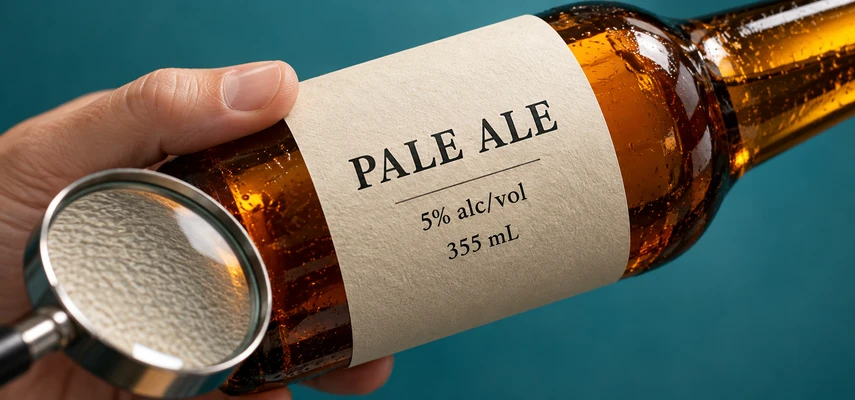
The loudest thing on a beer can is often the least useful thing for choosing it. A striking illustration or memorable name can catch your eye without revealing whether the beer is strong, bitter, sweet, or meant to be enjoyed fresh. The information you need may sit in smaller print around the side.
Learning to read a beer label is a way to turn that packaging into a practical buying tool. Identify the product and style, check strength and container size, then look for freshness guidance and ingredients that matter to the decision. That order works even when the front design is deliberately mysterious.
Treat the label as evidence, rather than a complete tasting note. Some details are measurable, some are descriptions, and some questions still require a retailer or brewer. Recognizing the difference prevents a promising illustration from doing all the thinking.
Start with the product identity
Separate the brewery name, the beer name, and the style. A brewery may make many different beers, while a dramatic product name may tell almost nothing about the liquid. The style usually offers a better starting expectation than either.
For example, a hypothetical can might carry a large name such as Orchard Signal and a smaller description identifying it as a pale ale. The name alone does not establish that it contains apples. Read the descriptive information before making that inference.
Look around the container as well as the front. Producer information, volume, and explanatory wording can occupy different places. The TTB overview of mandatory malt beverage label information identifies the principal information required for products within its jurisdiction in the United States. Imported labels and products regulated under different frameworks may look different.
The consumer’s job is simpler than a regulatory inspection: establish what the product is and who is responsible for it. An address is useful identification, but it does not tell the whole story of a brewery’s ownership or where every ingredient originated.
Read the style as a starting expectation
A style can suggest the kind of experience a brewer intends. Pilsner, stout, wheat beer, and IPA point in different directions, but each still allows variation. A producer’s additional description helps narrow the possibilities.
Notice modifiers. Words such as imperial, smoked, barrel-aged, fruited, or nonalcoholic change the questions worth asking. They do not replace the details elsewhere on the package. An emphatic adjective is not a numerical strength statement.
TFE Times’ existing beer styles guide provides a visual orientation. Use it to put an unfamiliar name in context, then return to the individual product’s information. A broad style description cannot guarantee a particular sweetness or intensity.
There is also a difference between a style and a sensory association. A label that mentions citrus may describe hop aroma, actual fruit, or both. Look for ingredient and product descriptions rather than treating every flavor word as a recipe disclosure.
Check strength before choosing a serving
Alcohol by volume is a concentration
Alcohol by volume expresses the share of the liquid’s volume represented by alcohol. In everyday beer conversation, this is shortened to ABV. On packaging, a statement may instead appear in a form such as percent alcohol by volume or alc/vol.
The TTB guidance on malt beverage alcohol content explains the applicable federal wording and the circumstances in which the statement is required. State rules may also affect labels. Do not assume every package must present the same information in the same place.
Container size changes the amount in the package
A useful comparison combines concentration and volume. A 12-fluid-ounce beer at 5 percent alcohol by volume contains about 0.6 fluid ounces of alcohol; a 16-fluid-ounce beer at the same strength contains about 0.8. These are arithmetic examples, not recommendations about consumption.
That difference matters when comparing a small bottle with a tall can or deciding whether a package is intended to share. Color, the word light, and a familiar brand name cannot substitute for the printed numbers. Check whether the package contains the amount expected before ordering or buying it.
Distinguish a package date from a best-before date
A packaged-on date points backward to production. A best-before date offers the producer’s guidance about a future quality window. They answer different questions, so first identify what the date describes.
Dates and codes do not follow one easy universal format. A short number sequence may be a lot code rather than a date you can interpret yourself. When the meaning is unclear, check the brewery’s own explanation or ask staff to identify it.
Avoid converting every date into an exact shelf-life guarantee. Storage conditions and the particular beer matter. The Brewers Association beer and food course discusses freshness and aging as style- and producer-dependent subjects, rather than a single countdown applying to all beer.
At the shelf, a useful question is whether the beer is within the producer’s intended window and has been handled appropriately. An unreadable date does not prove a bad beer, but uncertainty is a reasonable reason to choose a product with clearer information.
Look for storage and serving guidance
Refrigeration instructions deserve attention, particularly when the beer is bought for a later occasion. Follow the producer’s directions and make a plan for storage at home rather than assuming packaging removes every freshness concern.
The Cicerone guide to beer at home connects handling with flavor preservation. A good label can tell you what the brewer recommends, but it cannot reveal the package’s entire journey through distribution and retail.
Serving suggestions are another useful clue, though not a demand for specialist equipment. A recommended glass or pouring instruction may help explain how the beer is intended to present. If sediment is mentioned, read that guidance before automatically shaking or emptying the package into the glass.
When buying for guests, retain the packaging until the beer is served. It preserves the identity, strength, and any specific instructions, and makes it easier to answer questions without relying on memory.
Read ingredient descriptions with care
Beer names can create strong assumptions. A coffee-like or chocolate-like description may refer to flavors associated with the grain recipe, while another product may contain actual coffee or chocolate. Search for a clear ingredient statement or the brewer’s detailed description.
The TTB explanation of class and type designations shows why some products carry additional wording about ingredients or processes. However, the label should not be treated as a guaranteed complete ingredient inventory for every dietary question.
For an allergy or other strict requirement, obtain product-specific information from the producer. The absence of a familiar warning or a suggestive style name does not establish suitability. Likewise, vegan, gluten-free, gluten-reduced, and nonalcoholic describe different questions; they are not interchangeable assurances.
If the information is unresolved, choose something else rather than guessing. This is one area where a precise answer matters more than preserving the original purchase plan.
Know which numbers are optional buying clues
Some packages display bitterness units, color measurements, or brewing gravity. These may interest an experienced drinker, but they are not necessary for a useful first reading. Identify their purpose before trying to compare products with unlike data.
An IBU figure relates to measured bittering substances, rather than a complete prediction of perceived bitterness. A color number does not measure alcohol strength. Neither replaces the product description or your experience with a particular beer.
If a label supplies a number without explaining it, ask whether it helps answer the current question. Someone seeking a gentler finish may benefit more from a staff description than from selecting the lowest number on the shelf.
The same restraint applies to medals and awards. Check what was recognized and when if the claim matters. An award graphic may be interesting background, but it cannot establish that the beer matches the occasion or personal preference.
A useful label-reading example
Imagine two hypothetical packages with equally attractive artwork. One describes a citrus-forward pale ale, lists a modest container size, and gives a clear package date. The other describes a stronger barrel-aged beer in a larger bottle, with guidance to share it.
Neither is automatically better. For a straightforward drink with dinner, the first may fit the plan. For a small shared tasting, the second might make more sense. Reading the details reveals that these are different purchases, despite their similar position on the shelf.
If food is part of the decision, the existing beer and food pairing guide offers a companion reference. Let the specific beer’s description guide the pairing rather than assuming every product in a color or family behaves alike.
Finish with a decision, not a decoding exercise
A label has done its job when it helps establish the product, the intended flavor direction, the strength and quantity, and any handling or ingredient questions. There is no need to decode every production symbol before making a sensible choice.
Take a photograph of the package after finding a beer worth buying again. Keep the exact product name and variant visible, since a similar-looking can may contain a different recipe. That small record turns label reading into a repeatable buying skill rather than a one-time puzzle.












