










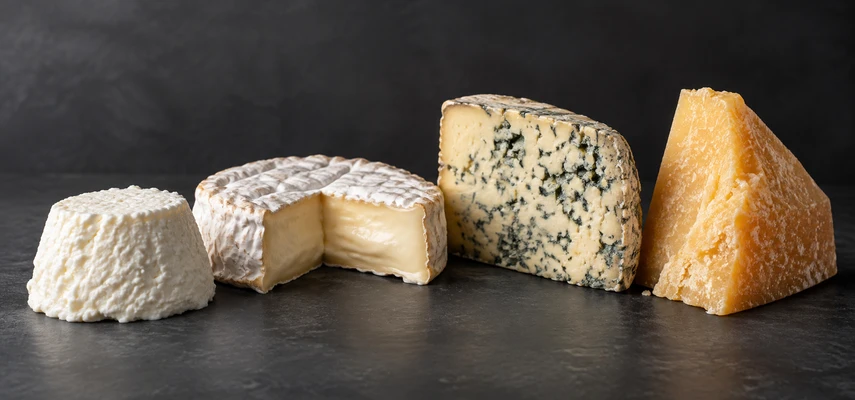
A spoonful of cottage cheese, a slice of Cheddar and a piece of blue cheese hardly seem like versions of the same food. One is moist and mild, another firm enough for a sandwich, and the third threaded with blue-green veins. Yet each begins with dairy ingredients that a cheesemaker transforms into something with its own texture, aroma and character.
What is cheese? In everyday terms, it is a food made by gathering milk proteins into curds and removing some of the surrounding liquid. That simple description opens onto a remarkably varied world. Understanding a few principles makes the cheese counter easier to navigate, whether you want something for toast, pasta or an unhurried tasting.
This opening installment of The TFE Guide to Cheese provides that starting point: what unites cheeses, what separates them and how to begin exploring without memorizing hundreds of names.
What makes a food cheese?
Most familiar cheeses concentrate milk’s casein proteins and retain varying amounts of fat, water and minerals. The liquid separated during production is whey. How much moisture remains helps determine whether the finished cheese can be spooned, sliced or grated.
Cheese need not be hard, old or enclosed in a rind. A fresh cheese belongs to the category just as surely as a mature wheel. The American Cheese Society’s definitions encompass fresh and matured products and explain why milk type, texture and place of origin offer different ways to describe them.
There are useful exceptions to a simple casein-based explanation. Traditional whey ricotta recovers proteins from whey, while some contemporary versions also use milk. Cream-rich specialties extend the range further. These differences matter when discussing how a particular product is made, but a beginner does not need a legal definition for every purchase.
Processed cheese is another distinct branch. It starts with cheese that is blended and heated with other permitted ingredients; emulsifying salts can help maintain a consistent mixture. It is different from an unprocessed wheel, rather than a separate milk-to-curd method. The University of Guelph’s processed-cheese overview explains that production approach.
How milk becomes cheese
Cheesemaking involves controlled changes to milk, followed by choices about draining, shaping and, often, maturation. The exact sequence varies. Some styles are ready quickly; others spend months developing before they reach a shop.
Gathering the proteins
One common route uses selected bacteria to turn lactose, milk’s sugar, into lactic acid. Increasing acidity helps change the behavior of milk proteins. Depending on the cheese, acid can be the main cause of coagulation or work alongside an enzyme.
Rennet is a preparation containing milk-clotting enzymes. It allows casein proteins to form a gel that holds fat and liquid. Coagulation does not simply mean boiling milk until it becomes solid, and rennet is not the same thing as a bacterial culture. Some cheeses instead use heat and acid together. Guelph’s cheese-family guide distinguishes these routes.
Separating curds and whey
Once a curd forms, the maker may cut it, stir it, warm it and drain it. Those decisions influence how much whey escapes. Curds can then be placed in molds, pressed or handled in other ways suited to the style. Salt contributes seasoning and affects the environment in which the cheese develops.
These are broad principles, not a home cheesemaking recipe. Temperature, timing, acidity and sanitation need much closer control in practice. Later installments will follow the production process and milk chemistry separately; here, the central idea is that a maker deliberately builds a texture from milk.
Milk sources: one ingredient, several starting points
Cow, goat, sheep and water buffalo milk all support important cheesemaking traditions. They differ in composition, but an animal’s species does not determine every characteristic of the finished cheese. Breed, diet, season and production choices also matter.
Cow’s milk supplies familiar examples such as Cheddar and many Alpine-style cheeses. Goat’s milk can become a soft fresh cheese or a firm aged one; the word “goat” does not automatically describe a spreadable texture. Sheep’s milk appears in cheeses such as Pecorino Romano and Manchego. Buffalo milk is associated with mozzarella, although plenty of mozzarella is made from cow’s milk.
The Food and Agriculture Organization’s milk-composition guide notes that sheep’s milk generally contains more fat and protein than cow’s or goat’s milk, while buffalo milk is particularly rich in fat. These are starting-material differences, rather than promises that every cheese from one animal tastes richer than every other cheese.
At a shop, try asking two separate questions: “What milk is it made from?” and “How was it made and matured?” Together, those answers tell you more than either alone.
The main cheese categories beginners should recognize
Cheese categories overlap. Moisture, rind, manufacturing technique and age describe different features, so no single list sorts every cheese perfectly. Use the following groups as practical landmarks rather than rigid compartments.
Fresh cheeses
Fresh cheeses are sold without an intended maturation period. Cottage cheese and fresh mozzarella are approachable examples. Their textures differ considerably, which is a useful reminder that “fresh” describes a stage of production rather than one consistency.
Soft-ripened cheeses
Brie and Camembert illustrate cheeses whose surfaces help guide ripening. A pale, bloomy exterior and a softer interior make them recognizable at the counter. Their development follows a different path from that of a firm cheese kept for extended aging.
Firm and hard cheeses
Young Gouda and Cheddar provide familiar entry points into sliceable cheeses. Harder examples can be shaved or grated. These texture descriptions are useful when choosing an ingredient, but age and recipe can shift a cheese along the spectrum.
Blue and washed-rind cheeses
Blue cheeses develop characteristic internal mold growth. Washed-rind cheeses receive surface treatments during maturation that encourage a different community of microorganisms. Neither label specifies the milk source, and both cover a range of textures. A strong aroma alone cannot tell you exactly how a cheese will taste.
The American Cheese Society emphasizes that cheeses can cross classification boundaries. Think of these terms as several useful descriptions of the same object, rather than competing answers to what it is.
Fresh versus aged: time changes more than firmness
Fresh cheese offers a direct way to explore moisture, acidity and the character of the starting dairy ingredients. Aged cheese adds another variable: changes that take place during maturation, also called ripening.
Enzymes break down proteins and fats, while microorganisms contribute to the developing flavor and aroma. Moisture movement and loss also affect structure. The result depends on the cheese: some become firmer, while certain surface-ripened cheeses soften. Guelph’s ripening reference describes these interacting changes.
Aging is therefore not a universal ladder from ordinary to superior. A fresh cheese is complete when it delivers its intended qualities. Keeping it longer does not turn it into an aged specialty.
For a clear contrast, compare fresh mozzarella with Parmigiano Reggiano. The latter has a minimum maturation of 12 months, according to its producer consortium. That difference reflects two foods designed for different results, rather than a competition over which one is more authentic.
Why cheese flavors and textures vary so much
A cheese’s character comes from a chain of decisions. Start with the milk, then consider the organisms selected, the way the curd is handled, the amount of salt and the conditions during maturation. Changing one stage can influence what happens at the next.
Milk itself contains several components that behave differently during production. Casein provides much of the structure in conventional cheese, fat contributes to its physical and sensory properties, and water remains an essential part of the finished food. Guelph’s milk-composition chapter explains these building blocks.
Cultures add another layer. Their roles include acid development and contributions to flavor; some organisms are selected for activities later in ripening. They are working ingredients, rather than merely an optional flavoring. The university’s cultures chapter separates those functions.
For a beginner, the practical lesson is to describe what you encounter. “Creamy,” “crumbly,” “tangy” and “nutty” can begin a useful conversation. You do not have to identify a microorganism to explain what you enjoyed.
An ancient food with no single documented inventor
Cheese predates the written accounts that might identify its first makers. A well-known story credits milk carried in an animal stomach, but it should be treated as an origin tale, rather than a documented event.
Archaeology offers firmer evidence. A study published in Nature identified dairy fats in perforated pottery from Neolithic sites in what is now Poland. The researchers interpreted the vessels as evidence of separating curds from whey in the sixth millennium BCE. That supports an ancient cheesemaking practice without proving precisely when or where cheese was first invented.
Today, choosing a cheese can also introduce a place, a farming tradition or a particular maker’s approach. You can begin with the food on your plate, then follow those connections as your curiosity grows.
How to start exploring cheese
Choose three small purchases with clear contrasts: a fresh cheese, a firm cheese and a soft-ripened cheese. Ask the seller for their names, milk sources and intended textures. Keep those details so you can find a favorite again.
Taste a small piece of each on its own before adding bread or condiments. Write a few plain observations: Does it crumble? Is the flavor salty or tangy? Does the aroma suggest something different from the taste? There is no need to force elaborate tasting language.
Keep purchases refrigerated as directed and follow product instructions. Pasteurization reduces hazards from raw milk, but contamination can occur afterward. FDA’s fresh-cheese guidance gives additional precautions, including specific advice for people at greater risk of listeriosis. Detailed safety decisions deserve their own guidance rather than a smell test.
Once you know what you enjoy, explore serving ideas through TFE’s Cheese Plate Essentials. If drinks interest you, the published beginner’s guide to pairing wine with food provides a broader introduction.
Cheese becomes easier to understand when you connect a few visible qualities with the choices behind them. Start with milk, moisture, method and maturation. Then let a few thoughtful comparisons turn an unfamiliar counter into a place where you know what to ask for next.










