










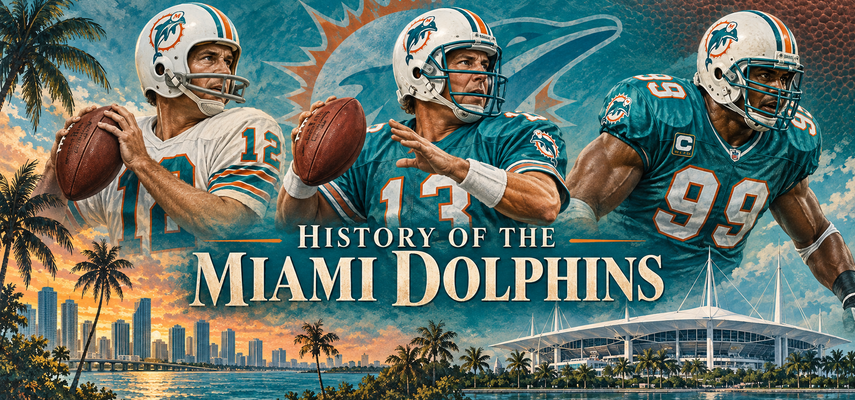

The Miami Dolphins reached football’s highest level with remarkable speed, progressing from an AFL expansion team to the unbeaten champions of the 1972 season. Don Shula’s teams then supplied a long competitive standard, first through defense and a powerful running game and later through Dan Marino’s passing. Two Super Bowl victories and five AFC championships belong to that completed history, alongside later periods of rebuilding and frustrated playoff hopes. The Orange Bowl and the stadium now called Hard Rock Stadium gave successive generations different homes. This account follows those changes while distinguishing league championships, conference honors and individual achievements.
Franchise at a glance
| Field | Details |
|---|---|
| Founded | 1965; AFL expansion franchise awarded to Joe Robbie and Danny Thomas |
| First season | 1966, American Football League |
| Original city and name | Miami, Florida — Miami Dolphins |
| Current city and name | Miami Dolphins; home games in Miami Gardens, Florida |
| Previous cities and names | None |
| League and conference/division | NFL — American Football Conference East; AFL through 1969 |
| Home venue | Hard Rock Stadium, opened in 1987 as Joe Robbie Stadium |
| League championships | 2 Super Bowl championships through the completed 2025 season: 1972, 1973 |
| Other recognized championships | 5 AFC championships: 1971, 1972, 1973, 1982, 1984; no AFL championship |
| Historical coverage | 2025 NFL season, including playoffs completed in February 2026; later developments through October 16, 2026 |
Origins and early years
The American Football League awarded Miami an expansion franchise in August 1965. Joe Robbie and entertainer Danny Thomas established the organization, and the Dolphins began play in 1966 under head coach George Wilson. A public naming process supplied a regional identity suited to south Florida, while the Orange Bowl provided an existing home in the city of Miami.
The inaugural season offered a memorable beginning when Joe Auer returned the opening kickoff for a touchdown, but the team soon encountered the practical difficulties of expansion. Miami needed to develop players, build depth and establish a coherent approach while competing against more experienced AFL opponents. Quarterback Bob Griese arrived through the 1967 draft, becoming an important early foundation. Robbie eventually became the controlling ownership figure, and a much larger competitive change came when Shula replaced Wilson in 1970. The Dolphins entered the merged NFL that same season. Their later championships belonged to that NFL period; the team had not won an AFL title during its four seasons in the older league.
Defining eras
1966–1971: Shula changes the competitive standard
Miami’s first four seasons produced no winning record, but the roster was developing several players who would become central to the championship years. Griese supplied a young quarterback, while Larry Csonka, Jim Kiick and other additions strengthened the backfield. Shula arrived from Baltimore with a different expectation of preparation, discipline and consistency. His influence was immediate: the 1970 Dolphins went 10–4 and earned the franchise’s first playoff berth.
The next season took Miami further. A double-overtime playoff victory at Kansas City became one of the defining games in club history, followed by a conference-final win over Baltimore. The Dolphins reached Super Bowl VI but lost 24–3 to Dallas.
1972–1974: Perfection and a second championship
The 1972 Dolphins won all fourteen regular-season games and three postseason games, finishing 17–0. Griese’s injury made Earl Morrall an essential part of the season, while the running game and the No-Name Defense supplied strength beyond the quarterback position. Miami defeated Washington 14–7 in Super Bowl VII, with safety Jake Scott receiving the game’s MVP. The season remains distinct because the team completed both an undefeated regular season and a championship postseason.
The following year showed that the success was not confined to one extraordinary record. Miami went 12–2 and won another Super Bowl, defeating Minnesota 24–7. Csonka’s rushing earned the Super Bowl VIII MVP, and the Dolphins’ combined strength again made them more than a collection of individual stars. Oakland ended their bid for a third consecutive title after the 1974 season in the playoff game remembered for the Sea of Hands touchdown. Csonka, Kiick and Paul Warfield then left for the rival World Football League. Their departures changed the roster substantially and helped close the franchise’s brief but exceptionally powerful championship peak.
1975–1982: Rebuilding the defense and returning to the Super Bowl
Shula rebuilt after the departures of the championship-era offensive core. The Dolphins remained capable of strong regular seasons, but playoff opportunities no longer automatically led to deep runs. Griese continued at quarterback before injuries and age brought another transition. Miami had to find a different balance between familiar veterans and younger contributors rather than simply preserve the perfect-season roster indefinitely.
The defense eventually became the defining strength of another conference champion. The Killer B’s nickname reflected a group featuring players such as Bob Baumhower, Doug Betters and the Blackwood brothers. In the strike-shortened 1982 season, the Dolphins advanced through an expanded playoff field, including a 14–0 AFC Championship Game victory over the Jets. Washington won Super Bowl XVII, leaving Miami with a fourth conference title but no third Super Bowl championship. The next transformation came through a new quarterback.
1983–1995: Marino transforms the offense
Miami selected Marino in the 1983 draft, and he quickly became the franchise’s central offensive figure. In 1984, he threw for 5,084 yards and 48 touchdowns, numbers that dramatically raised the contemporary passing standard. Mark Clayton and Mark Duper supplied leading receiving targets, while Shula adapted around the young quarterback’s quick release and command of the passing game. The Dolphins reached Super Bowl XIX, where San Francisco won 38–16.
That remained Marino’s only Super Bowl appearance. Later Miami teams were frequently competitive and sometimes advanced deep into the playoffs, but they did not return to the final game. The offense’s individual production could not consistently overcome weaknesses elsewhere or defeat every postseason opponent. In 1987, the club moved from the Orange Bowl to Robbie’s new stadium, which would carry several later names. Shula surpassed George Halas as the NFL’s all-time coaching wins leader in 1993 and finished his coaching career after the 1995 season. His departure ended twenty-six seasons in Miami, a tenure that connected the perfect-season champions with a very different, pass-centered generation.
1996–2008: Life after Shula and Marino
Jimmy Johnson succeeded Shula and emphasized rebuilding the defense and roster depth. Jason Taylor and Zach Thomas became leading figures in that effort, supplying the team with an exceptional defensive end and linebacker. Marino remained at quarterback through 1999, then retired after a heavy playoff defeat at Jacksonville. His departure forced Miami to replace a player who had defined its offense for seventeen seasons.
Dave Wannstedt’s early teams relied more heavily on defense and the running game. Miami won a playoff game after the 2000 season, but subsequent opportunities did not produce another postseason victory. Coaching and quarterback changes then became recurrent features. The 2007 Dolphins fell to 1–15, a low point far removed from the expectations established under Shula. Under Tony Sparano in 2008, Miami rebounded to 11–5 and won the AFC East. Chad Pennington’s quarterback play and the Wildcat package contributed to the turnaround, but Baltimore ended the season in the wild-card round. The striking improvement demonstrated the possibility of a quick revival without establishing another sustained championship team.
2009–2025: Repeated attempts to build a lasting contender
The years after the 2008 division title brought repeated attempts to stabilize the organization. Stephen Ross became the controlling owner, and successive coaching groups pursued different offensive and roster approaches. Ryan Tannehill’s development gave the club a longer-term quarterback option, while the 2016 team under Adam Gase reached the playoffs. Pittsburgh ended that run, with an injured Tannehill unavailable for the postseason game.
Tua Tagovailoa arrived through the 2020 draft. Mike McDaniel became head coach in 2022 and built a fast, motion-heavy offense around a different collection of playmakers. The Dolphins earned wild-card berths after the 2022 and 2023 seasons, losing at Buffalo and Kansas City respectively. Those appearances restored relevance but did not end the playoff-victory drought. Miami then missed the postseason in 2024 and finished 7–10 in 2025, again outside the field. The changing results showed the gap between an explosive offense at its best and a complete team capable of sustaining an October-to-February championship run. A further leadership transition followed the completed 2025 season.
Recent history
Miami finished the 2025 regular season 7–10 and missed the playoffs. The club subsequently hired Jon-Eric Sullivan as general manager and named Jeff Hafley head coach in January 2026, replacing the previous football leadership. Hafley had been Green Bay’s defensive coordinator, and his appointment was a completed change rather than a projected coaching search outcome. At the October 16, 2026 cutoff, the new staff’s first season was still underway. This history therefore does not assign a final 2026 record or infer that the Dolphins had ended their postseason-victory drought. Their latest playoff win remained in the 2000 season, and their most recent Super Bowl championship remained the 1973 season. The completed franchise record contained two Super Bowl victories and five AFC championships, with the conference honors kept separate from the overall titles.
Greatest players and influential figures
Dan Marino
Marino spent his entire NFL playing career with Miami and transformed the franchise’s offensive identity after the 1983 draft. His 1984 passing season earned the Associated Press NFL MVP and helped produce an AFC championship. The extraordinary individual career did not include a Super Bowl victory, an essential distinction in the team’s history.
Bob Griese
Griese supplied quarterback leadership across both Super Bowl championship teams, combining efficient passing with command of a balanced offense. Injury made Morrall’s contribution essential during the perfect season, without removing Griese’s importance to the wider era. His career-long Miami service connected the expansion years with the franchise’s greatest completed success.
Larry Csonka
Csonka’s powerful running became central to the championship offense and earned him the Super Bowl VIII MVP. His contribution complemented Kiick, Mercury Morris and a strong offensive line. He later left for the World Football League before returning to Miami, so his career extended beyond one uninterrupted Dolphins tenure.
Paul Warfield
Warfield gave Miami an exceptional deep receiver whose threat affected defenses even when the offense emphasized running. His five Dolphins seasons included three AFC championships and two Super Bowl wins. Earlier Cleveland success and later service elsewhere belong to his wider career, while the Miami years helped define a balanced champion.
Jason Taylor
Taylor became Miami’s leading pass-rushing figure during the period after the Marino–Shula partnership. His 2006 Associated Press Defensive Player of the Year recognized an exceptional individual season. Most of his NFL career was spent with the Dolphins, although separate Washington and Jets tenures must remain distinct from his Miami contributions.
Zach Thomas
Thomas supplied instinctive, productive middle-linebacker play across a long Miami tenure, becoming a central figure in the franchise’s strongest post-Shula defenses. His selection for the Pro Football Hall of Fame recognized that sustained contribution. A final Dallas season belongs to his broader career rather than an additional Dolphins team achievement.
Don Shula
Shula coached Miami to two Super Bowl victories and five AFC championships across twenty-six seasons. His adaptability connected a defense-and-running champion with Marino’s passing era. His record 347 NFL coaching wins include regular-season and postseason games with Baltimore as well as Miami, rather than representing Dolphins victories alone.
Joe Robbie
Robbie helped found the Dolphins and became the central ownership figure behind their early development. His hiring of Shula changed the club’s competitive direction, while his pursuit of a privately financed stadium reshaped its physical home. Those institutional decisions extended his contribution beyond the players and results of any single season.
Championships and postseason milestones
Miami’s two Super Bowl championships came in consecutive seasons, 1972 and 1973. The 17–0 record belongs to the first of those teams, while the second title came after a 12–2 regular season. The Dolphins’ five AFC championships also include 1971, 1982 and 1984, each followed by a Super Bowl defeat. These conference honors are not additional Super Bowl victories. The club won no AFL championship before joining the merged NFL.
On smaller screens, scroll horizontally to see all columns.
| Season/year | Competition | Opponent | Result | Defining figure(s) |
|---|---|---|---|---|
| 1972 | Super Bowl VII | Washington Redskins | Won 14–7 | Bob Griese; Earl Morrall; Jake Scott; Don Shula |
| 1973 | Super Bowl VIII | Minnesota Vikings | Won 24–7 | Larry Csonka; Bob Griese; Don Shula |
Rivalries, venues and team identity
Rivalries
Buffalo supplied repeated divisional confrontations, especially during the Kelly–Marino years. The Jets became another lasting opponent through the 1982 conference final and memorable regular-season games. New England later set the division’s competitive standard. These relationships developed through changing eras rather than being explained only by geographical proximity.
Home venues and traditions
The Orange Bowl housed the perfect-season team and Miami’s early growth. The club moved to Joe Robbie Stadium in 1987; the same venue, extensively renovated and renamed, is now Hard Rock Stadium in Miami Gardens. Aqua and orange, warm-weather football and the 1972 team’s legacy give the Dolphins a distinctive local identity.
Retired numbers and team honors
The Dolphins have retired Griese’s 12, Marino’s 13 and Csonka’s 39. Their Honor Roll recognizes a wider range of players and institutional contributors. Membership in that group is different from a retired jersey or election to the Pro Football Hall of Fame. The distinction preserves the particular meaning of each honor without turning every recognized figure into a championship participant.
Legacy
Miami’s perfect season remains its most distinctive achievement, but the franchise’s history extends beyond an undefeated record. Shula’s ability to build different kinds of contenders and Marino’s transformation of the passing offense supplied another long chapter of relevance. The later playoff frustrations show how difficult that standard has been to recover. The club’s identity connects those experiences through a shared place, colors and institutional memory. Its completed history therefore contains both an unmatched championship season and the more familiar challenge of replacing an exceptional generation without assuming that its success will automatically return.
Where to eat in Miami
Planning a visit? Explore our best restaurants in Miami guide.












