










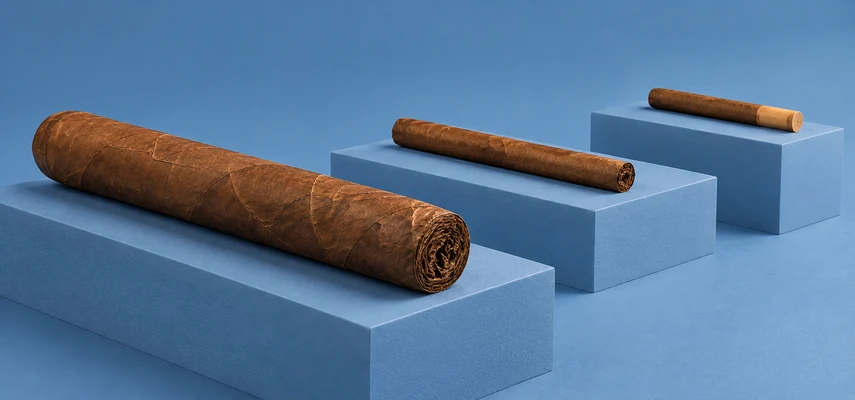

“What type of cigar is it?” sounds like a question with one answer. In practice, the answer may describe its size, its interior tobacco, its manufacturing method, its outer covering or its shape. A product called a handmade long-filler figurado is not being assigned three competing identities. Each word describes a different feature.
Understanding the types of cigars therefore requires a classification system rather than a shopping list. The goal is to recognize which question a label answers and which questions remain open. This guide explains the main categories used in educational and industry descriptions, while keeping health risks separate from claims about craft or appearance.
Start with the broad product family
The FDA defines a cigar as rolled tobacco enclosed in tobacco leaf or another substance containing tobacco. This includes a wider range than the traditional, large, natural-leaf product familiar from historical imagery. Some small filtered products resemble cigarettes closely.
That boundary matters because an exterior need not consist of one intact leaf for the product to belong to the cigar family. Equally, an object does not become a different broad family merely because it is short, inexpensive or machine-made. The covering and product specification deserve attention before visual assumptions.
The useful next step is to describe separate attributes. Think of a museum catalog entry with different fields for dimensions, materials and manufacture. Filling in one field does not automatically fill in the others.
Large cigars, cigarillos and little cigars
The CDC identifies three major U.S. cigar types: large cigars, cigarillos and little cigars. These broad groupings are useful for public-health description, although names and commercial boundaries do not function as perfectly consistent specifications worldwide.
Large cigars
Large cigars encompass both hand-rolled and machine-made products. The category describes a general product format rather than guaranteeing a particular assembly method or filler length. It should not be treated as another name for “premium.”
Cigarillos
Cigarillos occupy a smaller format and are generally larger than little cigars or cigarettes. The name does not, by itself, identify the interior blend, the presence of added flavor or the exact wrapper material. A specific product description is needed for those details.
Little cigars
Little cigars can approximate cigarette dimensions and commonly include filters. Their resemblance to cigarettes is one reason photographs alone can be misleading. A filter is a construction feature, not evidence that the product is harmless.
These broad categories establish an initial map. They should not be arranged into a safety ladder: smaller dimensions, different packaging and higher prices do not establish a safe tobacco product.
Long-filler and short-filler describe the interior
Traditional cigar construction assigns different jobs to filler, binder and wrapper. The filler occupies the center, the binder contains the bunch, and the wrapper forms the exterior. Habanos’ construction account provides a producer’s explanation of these roles in Cuban cigars.
Long-filler construction uses substantial lengths of leaf running along the cigar. Short-filler construction uses smaller pieces. These terms answer a material question about the interior; they do not establish a complete description of the finished object’s quality, dimensions or health effects.
“Filler” is not inherently a derogatory term. It is the name of a component. Likewise, “long” and “short” refer to the form of that material rather than the finished cigar’s length. A short-format cigar and a short-filler cigar are therefore not interchangeable descriptions.
When a source makes a quality claim based on filler, ask what else it documents. Material selection, assembly and inspection are additional matters. The classification should support an explanation, not substitute for evidence about the particular product.
Handmade and machine-made describe assembly
Handmade is often associated with long-filler construction, but the association is not an identity. Habanos describes a handmade short-filler method in which chopped tobacco is assembled inside full-length binder leaves and the wrapper is applied by hand. This supplies a concrete counterexample to the claim that every handmade cigar must be long-filler.
Machine-made, in turn, identifies mechanical participation in production. It does not tell a reader everything about the leaf source or the covering. Product manufacture can involve different combinations of equipment and manual work, so precise descriptions are preferable to an unexplained handmade-versus-industrial hierarchy.
An article or exhibit should state which operation a manufacturing claim concerns. Was the bunch formed manually? Was the wrapper applied manually? Was the claim supplied by the producer? Those questions make the description more informative without requiring a reader to rank products or consume them.
Natural-leaf and processed tobacco coverings
The outer layer supplies another classification axis. Traditional handmade examples often use natural leaf, while other cigar products can employ reconstituted tobacco materials. The National Cancer Institute’s 1998 chapter on cigar chemistry describes processed binders and wrappers alongside natural-leaf construction.
That historical technical account explains why a paper-like covering and a natural leaf should not be confused, even when both belong to the cigar category. “Reconstituted” describes a material made from processed tobacco constituents; it should not be inferred solely from a photograph’s smooth surface.
Here, too, classification must stay separate from health reassurance. A natural leaf contains tobacco. Identifying it does not eliminate nicotine or the harmful substances associated with smoke. Material specificity improves accuracy, but cannot transform a tobacco description into a safety certification.
Shapes and dimensions form a different system
Parejo and figurado
Parejo describes a straight-sided form; figurado describes a shaped form, such as one with a tapered end. These are broad geometry terms, not measures of tobacco quality. A photograph may make shape easier to assess than filler length, which is largely concealed.
Vitola and ring gauge
Vitola refers to a cigar format. Ring gauge measures diameter in sixty-fourths of an inch, while length is stated separately. Thus, a hypothetical 5-inch cigar with a ring gauge of 48 is five inches long and three-quarters of an inch wide. The figures describe size, not nicotine dose.
Habanos’ format guide explains that factory and market names can differ and that different brands may use the same market name for different sizes. Familiar terms such as robusto or Churchill should therefore be checked against the stated dimensions rather than assumed to form one universal standard.
Wrapper color is not a complete type
Color supplies a visible descriptor, but it cannot disclose the whole construction. A dark wrapper can surround different interior materials and occur on different shapes. It does not independently establish a brand, manufacturing country or nicotine exposure.
Habanos’ account of color sorting describes careful matching of finished wrappers by shade. That account concerns presentation and grading in a particular production tradition. It does not establish that a darker exterior reliably indicates a more hazardous or less hazardous product than a lighter one.
This is an important limit when interpreting illustrations. A drawing that groups cigars from pale to dark may be useful for describing surfaces. It cannot become a comprehensive chart of strength or health risk simply because the shades form an orderly progression.
Origin and brand do not replace a specification
Geography is another source of shorthand. A manufacturing location, the growing origin of a particular leaf and a brand’s historical association describe different relationships. An origin term should be attached to the correct component or operation whenever the evidence permits.
University of Kentucky guidance on Connecticut Broadleaf wrapper tobacco, for example, discusses a tobacco traditionally associated with Connecticut and Massachusetts that is also grown in Kentucky and Tennessee. The crop name does not restrict every instance of that tobacco to one modern growing location.
The same reading discipline applies to a box or catalog. A recognizable name may tell a historian where to begin investigating; it does not disclose every leaf or production step. Treat undocumented details as unknown rather than filling them in from a familiar association.
How to read a compound description
Imagine an educational catalog describing an unbranded specimen as a “handmade, long-filler, straight-sided cigar.” Handmade identifies assembly, long-filler identifies interior material form, and straight-sided identifies geometry. None of those terms supplies the exact dimensions or growing origins.
Now imagine a second entry describing a “small filtered cigar.” That entry supplies a general size and an exterior feature, but does not establish that its construction matches the first specimen. The two descriptions are uneven in detail, not necessarily contradictory.
To compare them fairly, ask the same questions of both: which broad family, what dimensions, which filler form, what covering, what assembly method and what evidence? This approach is especially helpful when commercial language mixes objective features with evaluative adjectives.
No classification removes the health risks
The National Cancer Institute’s cigar health information identifies nicotine dependence and serious disease risks, including cancers associated with cigar smoking. Not inhaling does not prevent exposure through the mouth or make smoking safe. Secondhand smoke also affects people nearby.
Long-filler, handmade, natural-leaf and premium are not exceptions to that evidence. They describe construction or positioning. A responsible classification guide explains what those terms can establish and stops them from implying what they cannot.
The different types of cigars make more sense when their attributes remain separate. Size, materials, manufacture and shape can all describe the same object at once. Read together, with clear sources and explicit limits, they produce a more accurate account than any single label.











