










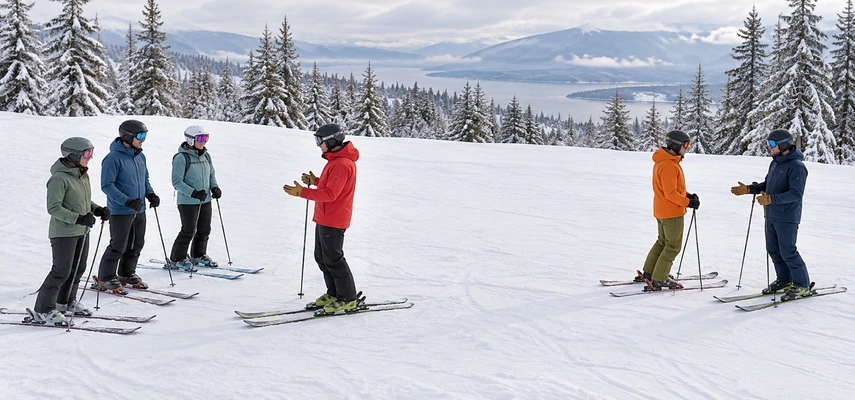

Two beginners can book a ski lesson for the same morning and have rather different experiences. One learns alongside a small collection of equally puzzled adults. The other spends the session working directly with an instructor, perhaps repeating one movement until it makes sense.
Neither format is automatically the right choice for everyone. What matters is how the lesson matches the learner, the pace, the terrain, and the goal. Price belongs in the decision, but it isn’t the only variable—and the most expensive option doesn’t remove the need to practice.
Think of the choice as deciding how you’d like attention and learning time organized. Group lessons share an instructor among suitably matched students. Private lessons let the session focus more closely on one person or a booked party. Understanding that distinction helps you ask useful questions before paying.
What a group lesson is trying to do
A group lesson brings students together around a broadly similar starting point and learning objective. The instructor chooses tasks and terrain, watches individuals, and manages a pace intended to work for the group.
For a first-time group, that may involve equipment familiarity, balance, gliding, and stopping. More experienced groups can focus on a particular skill level or task. The label group doesn’t mean the content is always introductory.
The value comes partly from shared structure. You see demonstrations, try the task, receive feedback, and observe other attempts. Someone else’s question may explain the thing you hadn’t yet found words for.
But attention is shared. The instructor cannot continuously watch every learner at once. Expect moments of individual feedback and moments when the group practices or waits for others. The balance varies with group size, student needs, terrain, and the school’s teaching approach.
Matching the group matters more than its name
A well-matched group gives everyone a more workable task. A first-timer who hasn’t stood on skis needs a different session from someone already linking controlled turns. Calling both people beginners doesn’t erase that difference.
Schools use their own level descriptions. Aspen Snowmass’s lesson guide, for example, separates never-skied students from those who can slide, stop, and later link turns. Read the description rather than selecting a level based on confidence alone.
Describe what you can do repeatedly and on what terrain. If you can make parallel turns only on a very gentle empty run, say that. If it has been years since you last skied, include that too.
The instructor may reassess the group at the start. Speak up if the task is clearly unsuitable. Moving to an appropriate group is a practical adjustment, not a public demotion.
The social advantage can be a real learning advantage
Learning with others can make unfamiliar equipment and awkward early movements feel less isolating. You discover that the person beside you also needed an explanation of the moving carpet. That is sometimes more comforting than another solemn reminder to relax.
Watching a demonstration together can create a shared reference point. You may notice how another learner responds to a cue, then recognize the same issue in your own attempt. The instructor can use those observations without making everyone learn identically.
Group learning can also suit someone who prefers a little space between direct corrections. Continuous individual attention is helpful for some people and tiring for others. A shared rhythm may feel more comfortable.
Still, camaraderie isn’t guaranteed, and group lessons aren’t a social obligation. If your needs require a different pace, language support, or an adapted setup, discuss that with the school rather than hoping the group will somehow sort it out.
What private instruction changes
A private lesson gives the instructor more freedom to tailor the session to the booked learner or party. That can mean adjusting pace, choosing a specific task, taking a break, or returning to a movement that needs more explanation.
For one learner, the benefit may be a calm introduction without comparison. For another, it may be precise feedback on a persistent turning problem. A private lesson can also help an experienced skier make useful use of limited time at an unfamiliar mountain.
Vail’s lesson overview distinguishes social group learning from individualized private instruction. The practical distinction is flexibility of attention, not a promise that every private student will progress faster.
Individual attention doesn’t mean continuous skiing. Explanations, observation, rest, terrain choices, and repetition remain part of learning. An instructor isn’t a machine for converting a higher hourly fee into a higher trail rating.
Private doesn’t always mean one student
Some schools allow a private booking to include a family or a small party. Check the permitted number, age rules, and ability requirements. A shared private can be enjoyable, but it introduces its own matching problem.
If one person has never skied and another wants help on advanced terrain, the instructor can’t provide two different mountains simultaneously. The lesson must use terrain appropriate to the participants and the school’s rules.
Similar ability doesn’t mean identical needs either. One person may want detailed verbal explanation while another learns better from a short demonstration. Discuss the group’s expectations before booking, especially if one person is paying and everyone else feels obliged to agree.
A cheaper cost per person isn’t necessarily better value if the learning objectives conflict. Sometimes separate matched groups or different sessions provide more useful attention than putting everyone into one private lesson for convenience.
Compare the full purchase, not just the lesson headline
Group lessons commonly cost less per participant than private instruction, but actual prices and inclusions vary widely. Don’t rely on a generic national price range to budget a particular date.
Check duration, start time, expected group size, and whether access products or rentals are included. A discounted lesson may still require separate lift access, while a first-time package may combine several essentials.
Ask what happens if weather or lift operations affect the session, if you arrive late, or if you need to cancel. Find out whether a shorter private option or a multi-session beginner program exists. Compare current written terms rather than assembling assumptions from several pages.
The useful budget question is what complete experience you can afford and use. An appropriate group lesson plus suitable practice may serve you better than a private session so financially stressful that you feel compelled to ignore fatigue and extract every possible minute.
Consider anxiety, communication, and specific needs
If you’re anxious about sliding, tell the school before choosing a format. A private setting may offer more control over pace and explanation. A supportive beginner group may instead reduce the feeling that all attention is on you.
Language matters too. Ask about instruction in a language you understand comfortably. A technical explanation delivered quickly in unfamiliar vocabulary isn’t improved merely by putting fewer people in the lesson.
For adaptive equipment, disability-related access, or other specialist needs, contact an appropriate program directly. Don’t assume any private lesson automatically provides the instructor training or equipment required.
Describe what helps you learn: seeing a movement, understanding its purpose, hearing one simple cue, or having time to repeat it. The instructor can use that information in either format. Paying for a lesson doesn’t require pretending you have no preferences or concerns.
What a good lesson should leave you with
Useful instruction connects a task to a purpose. You should understand what you’re practicing, why the chosen terrain is appropriate, and what a successful attempt feels or looks like.
Feedback should be specific enough to act on. “Be better balanced” may need a demonstration or a more concrete cue. Ask the instructor to explain what to change rather than accumulating several vague thoughts during each turn.
The PSIA-AASI beginner-experience resources reflect the importance of teaching the learner, not simply presenting movements. Your session should make room for questions, observation, and a manageable next step.
At the end, ask what to practice, where to practice it, and what to avoid for now. A clear plan for appropriate repetition can extend the value of the lesson well beyond the final demonstration.
Neither format should hurry you onto unsuitable terrain
A lesson isn’t successful because it reaches the highest lift or most difficult symbol. It is successful when the skier develops useful control and judgment on appropriate terrain.
Private attention can’t make a slope safe for someone who lacks the necessary skills. A group shouldn’t be pressured to keep up with its fastest member either. Terrain and pace should fit the learning task and current conditions.
The NSAA responsibility code still applies during and after instruction. You must remain able to stop or avoid people and objects, respect closures, and use lifts safely. An instructor supports that responsibility rather than suspending it.
If you’re exhausted, uncomfortable, or unable to repeat the task with control, say so. A productive adjustment may be easier terrain, a break, an equipment check, or a simpler movement. More difficulty isn’t the only available form of progress.
Choose for this lesson, not forever
Your best first format needn’t be your permanent one. You might enjoy a beginner group, then book individual help for a specific obstacle. Another skier may prefer a private introduction and later join a matched clinic for practice and company.
Before booking, write down your starting point, one useful goal, and any important needs. Ask the school which available format fits those details, then check the complete cost and conditions.
You don’t need to choose between being a group person and a private person. You’re choosing how to organize one learning opportunity. The worthwhile result is an explanation you understand, a movement you can practice, and a sensible next step on the snow.












