










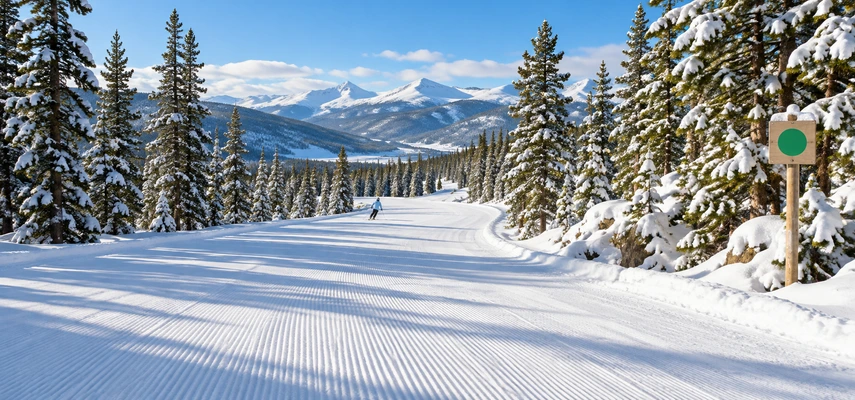

The first time a learning area gives way to a longer green run, the mountain can seem to have expanded its responsibilities. There is more distance, more traffic to notice, and perhaps a bend that hides what comes next.
Confidence grows when those demands become manageable through repeatable control. It doesn’t require convincing yourself that a green circle means nothing difficult can happen. The symbol is useful information, but your ability, the route, and today’s conditions still make the decision together.
Start with an instructor’s assessment of suitable terrain. You should be able to stop and make controlled direction changes in the setting you’re leaving. A first longer green is a progression, not a replacement for learning those skills.
Choose the right green, not simply any green
Green circles identify the easiest category within a resort’s system. They don’t make every green route identical, and they don’t translate into the same difficulty at another mountain.
A short open beginner run may differ greatly from a long route with intersections, flatter stretches, or narrower sections. Ask staff which open green fits your actual stopping and turning ability today.
The NSAA’s trail-signage guidance emphasizes the relative scale. Use that reminder to ask more useful questions: where does the route go, what is the surface like, and are there any sections a new skier should discuss with an instructor?
Know the whole route before boarding the lift. A gentle-looking entrance doesn’t describe everything below, and a lift’s easiest way down may still exceed your current skills. Local advice can prevent a navigation surprise from becoming a skiing problem.
Build a foundation you can repeat
Before adding distance, check that you can start deliberately, change direction both ways, regulate speed, and stop where intended on appropriate terrain. Those skills should work more than once by accident.
You don’t need to display polished parallel skiing to enjoy suitable green terrain. The relevant question is whether the movements you currently use provide dependable control and enough attention left for the environment.
Aspen Snowmass’s lesson-level descriptions distinguish initial sliding and stopping from later linked turns on green terrain. That separation is useful: the first successful glide isn’t the final stage of beginner learning.
Ask your instructor to identify one priority for the next run. A clear task, such as keeping speed manageable through a short sequence of turns, is easier to practice than a vague requirement to become confident everywhere at once.
Give yourself a route and a margin
From a suitable visible stopping place, look at the next section. Notice people ahead, junctions, changes in width, and the space available for your turns. Choose a path that doesn’t require perfect timing from strangers.
Keep enough margin to adjust. If you need an entirely empty slope or the full width of the run for every turn, the setting may be too demanding at that time. Wait, choose another suitable route, or ask the instructor for a different task.
Don’t follow the skier ahead so closely that their next decision becomes your emergency. They may slow, turn, or stop. Your responsibility is to leave space to avoid them rather than to predict their movement flawlessly.
The Canadian Ski Council’s slope guidance emphasizes limits, appropriate terrain, lessons, and distance. Those habits turn awareness into something practical instead of a general instruction to be careful.
Let rounded turns manage the descent
Use the turn shapes you’ve learned on suitable terrain to keep speed within your control. A turn that develops across the slope changes your path more usefully than a quick tip flick that leaves you traveling mostly downhill.
Don’t rush the transition because the straight-down portion feels alarming. An instructor can help you understand how to guide the skis through a manageable arc without bracing or making a sudden sideways movement.
Controlled skidding is a valid tool. You aren’t required to carve clean tracks or keep the skis perfectly parallel at every instant to be learning well. The snow interaction should serve the objective of controlled travel.
REI’s beginner-turn explanation connects direction and speed to turn shape. Practice that relationship in the corridor available to you, rather than turning the whole trail into a diagram only you have seen.
Look ahead without ignoring what is nearby
Raise your gaze enough to read the next section and notice other users. Staring continuously at the ski tips can leave you reacting late to a junction, a group, or a change in surface.
Looking ahead doesn’t mean fixing your eyes on one distant point and forgetting the space around you. Keep awareness moving with the task: where you’re going, what is ahead, and whether your route still makes sense.
If you need to read a map or consult a phone, stop first in a suitable visible place that doesn’t obstruct traffic. Don’t turn navigation into a second moving task before your basic skiing has attention to spare.
Small decisions made early usually leave more options than large corrections made late. Recognizing a narrower section while you still have room to slow is more useful than discovering it while trying to complete a turn inside it.
Use stops as planned pauses
A controlled stop can let you reset the task, check the route, or rest. Choose a place visible from above with room for others to pass. Avoid stopping below a crest or inside a narrow passage.
If you’re skiing with an instructor or friend, agree on appropriate meeting points. Don’t let a group slowly spread across a run while waiting for the final person. The stopping place needs to work for everyone using the trail.
Look uphill and avoid approaching users before setting off again. A successful pause doesn’t automatically create a safe gap to restart. Treat joining the flow as a fresh decision.
The NSAA responsibility code connects those habits: control, downhill priority, visible stops, and uphill checks. They are especially valuable when you are still learning how much space a movement will use.
Recognize changing snow and visibility
A green run can feel different as traffic scrapes the surface, soft snow becomes uneven, or temperature changes the snow. The trail sign may stay the same while the task becomes harder.
Begin each unfamiliar section conservatively. If a surface makes steering or stopping less reliable, reduce the demand rather than assuming the color guarantees success. Ask staff about another appropriate open option.
Poor visibility also reduces information. If you can’t read the next turn or surface change, skiing the same speed requires a different margin than it did in clear light. A break or a different setting may be the sensible response.
Big Sky’s safety guidance pairs speed with space and awareness. The point applies on gentle terrain too. Confidence should include noticing when the conditions no longer fit the plan.
Keep practice small enough to understand
Repeat a suitable run or section with one useful objective from your instructor. Notice what becomes more reliable rather than collecting an increasing number of trails.
If a turn repeatedly accelerates or one direction feels much harder, describe the pattern and ask for feedback. The cause may involve balance, steering, edge use, or terrain. A specific observation is a better starting point than deciding you need more courage.
Don’t add several new movements at once. A simpler task can reveal whether one change helped. Practice should leave enough attention to observe the result, not consume all of it in recovery.
When a run feels easier, that may be a good reason to consolidate the skill rather than immediately choose a harder category. Familiarity can create the space where a movement becomes dependable.
Let fatigue change the plan
A longer green adds sustained attention and physical effort. If your legs become rigid, your stopping feels less reliable, or you stop noticing traffic clearly, take a break or finish.
There is no obligation to complete one more run because the lift is still operating. The last run isn’t automatically special enough to deserve a reduced margin of control.
Equipment discomfort deserves attention too. If boot pressure or another problem changes how you move, ask a technician or instructor rather than quietly adjusting your stance around it. Persistent discomfort isn’t a useful training method.
Choose company that supports your pace. An experienced friend can meet you at an appropriate point without turning the afternoon into a race to their preferred terrain. Shared enjoyment doesn’t require identical routes.
Measure confidence by available choices
Useful confidence feels like having options. You can choose a turn, change the pace, stop appropriately, and recognize when you need advice. You don’t have to deny uncertainty to ski well.
Before changing terrain, ask an instructor to assess the skills you’ve made repeatable and the conditions of the proposed next route. A certain number of green runs doesn’t automatically unlock a blue.
For now, enjoy the difference between being carried down a slope and traveling along it deliberately. When the turns, pauses, and route choices begin to feel like your decisions, the green run has done something important. It has become a place to practice skiing, rather than simply a place to get through.












