









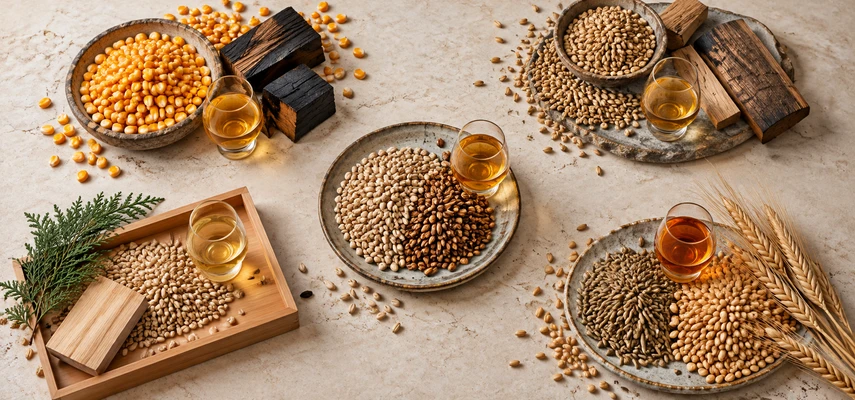

Walk along a whiskey shelf and the bottles seem to be answering different questions. One says bourbon, another says single malt, another says Irish, and a fourth announces that it’s a blend. It’s rather like finding apples sorted by country, color and pie-making potential all in the same aisle.
The apparent confusion has a sensible explanation. Whiskey names describe several things: where a spirit was made, which grains went into it, how it was produced and how different components were combined. Learn those layers and the shelf becomes much easier to read.
There’s no need to memorize every regulation before understanding the main types. You do need to resist one tempting shortcut: a category is a description of production, not a promise that every bottle will taste the same.
Start with the questions behind the names
All whiskey begins with fermented grain. Distillation concentrates alcohol and selected flavor compounds, and wood maturation usually changes the resulting spirit. Beyond that shared foundation, the rules split into national and regional traditions.
“Scotch” tells you about origin and a protected production framework. “Bourbon” brings requirements about grain and barrels as well as American origin. “Single malt” describes a particular relationship between ingredients and distillery identity. “Blended” describes a combination, though exactly what can be combined depends on the jurisdiction.
Those descriptions can overlap. A bottle can be Scotch, single malt and 12 years old at once. None of those terms tells you whether you’ll find it fruity, smoky or heavily oaky. They narrow the possibilities rather than finish the conversation.
Think of the label as the beginning of a useful set of questions: made where, from what, using which process, and combined how? Flavor comes next.
Bourbon: corn and new charred oak
Bourbon is an American whiskey whose fermented grain mixture contains at least 51 percent corn. Among its other requirements, it must be distilled at no more than 80 percent alcohol by volume and enter new charred oak barrels at no more than 62.5 percent. The U.S. standards of identity spell out the framework.
The new barrel matters. Fresh wood has material available for extraction, while charring changes its inner surface and underlying wood. That helps explain why vanilla, caramel-like and toasted impressions often appear in bourbon descriptions. It doesn’t mean producers add caramel syrup to ordinary bourbon.
Kentucky has a deep bourbon tradition, but bourbon doesn’t have to be made there. Nor does bourbon as a category carry a universal two-year minimum. The additional designation “straight bourbon” requires at least two years of qualifying maturation.
The remaining grain recipe can change the result substantially. Rye or wheat may play supporting roles alongside malted barley. Two bourbons can meet the same legal requirements and still feel very different in the glass.
Rye and other American grain whiskeys
American rye whiskey uses a grain mixture containing at least 51 percent rye, alongside other production requirements. A rye recipe often leads tasters toward spicy, herbal or grainy descriptions, although “spicy” is a sensory association, not a requirement that every rye must satisfy.
Wheat whiskey and malt whiskey are also defined American types. Their names identify the grain that supplies at least 51 percent of the mixture. Don’t confuse wheat whiskey with wheated bourbon: the latter still has the corn majority required for bourbon and uses wheat within its supporting grain recipe.
Tennessee whiskey belongs within the American landscape too. Many examples undergo charcoal mellowing before maturation. Its detailed requirements and exceptions deserve their own treatment; the useful beginner point is that geography and a particular production tradition are involved, rather than an entirely different agricultural starting material.
American single malt adds another important branch. The TTB standard effective January 19, 2025 specifies 100 percent malted barley, distillation at one U.S. distillery, American mashing and aging, and qualifying oak barrels. It also includes a transition for previously approved labels. This is a defined American category, rather than simply Scotch made somewhere else.
Scotch: one country, several categories
Scotch whisky is produced in Scotland and matured there in oak casks for at least three years. The name covers a family, not just one familiar smoky style.
Single malt and single grain
Single malt Scotch is made from malted barley at one distillery through batch distillation in copper pot stills. “Single” means one distillery, not one barrel. A producer can combine many qualifying casks from that distillery within a single malt release.
Single grain Scotch also comes from one distillery, but it follows a different category definition and may use other cereals. The word “grain” doesn’t mean that malted barley somehow stopped being a grain. These are established category names, not an attempt to improve botanical classification.
The three blended categories
Blended Scotch combines single malt and single grain Scotch. Blended malt Scotch combines single malts from more than one distillery, while blended grain Scotch combines single grain whiskies from more than one distillery. The Scotch Whisky Association’s category guide sets out those distinctions.
Blending is a production skill. It can build a flavor profile from components that contribute different strengths. The mere presence of the word “blend” doesn’t establish that a whiskey is worse than a single malt, any more than a recipe becomes inferior because it has several ingredients.
Smokiness is a separate question. Peat smoke used in drying malt can supply smoky compounds, but many Scotches are unpeated. A country name can’t substitute for a description of the actual bottle.
Irish whiskey: more than triple distillation
Irish whiskey is produced and matured on the island of Ireland, with at least three years of maturation. Its main traditions include malt, grain and pot still whiskey, plus blends.
Malt whiskey emphasizes malted barley. Irish pot still whiskey uses malted and unmalted barley within its technical specification, creating a different production starting point. Grain whiskey broadens the ingredient and equipment possibilities. Blends combine qualifying components.
Triple distillation is associated with many Irish producers, but it isn’t a universal requirement. The European Commission’s Irish Whiskey GI explanation describes both double and triple distillation. A distillation count alone also doesn’t prove a spirit is more refined or better.
Likewise, “smooth” is too imprecise to define an entire country. One reader may mean little alcohol burn; another may mean a light texture or no smoke. Actual information about strength, grain, casks and flavor is more useful than a soothing adjective.
Japanese and Canadian whisky
Japanese whisky grew through study of Scottish production and the development of local approaches. It can include malt, grain and blended expressions. Origin deserves attention because Japanese presentation and Japanese production haven’t always been the same thing.
The Japan Spirits & Liqueurs Makers Association standards specify production and maturation requirements for members using the Japanese whisky designation. They include domestic production steps, at least three years in qualifying wooden casks in Japan and bottling there. These are voluntary industry standards, not a universal statutory definition for every business. Check producer disclosures rather than treating a label’s artwork as evidence.
Canadian whisky has its own framework, including Canadian mashing, distillation and aging and at least three years in small wood. Its blending traditions can bring together whiskies made with different grains and production methods.
An especially useful distinction concerns rye. Under the Canadian compositional standard, Canadian whisky, Canadian rye whisky and rye whisky share a category definition. Don’t import the American 51-percent-rye rule onto a Canadian bottle. The same everyday word can carry different national meanings.
Country isn’t the whole map
Whisky is also made in places including India, Taiwan, Australia and several European countries outside Scotland and Ireland. Their climates, raw materials and local standards can create different production possibilities. A warm-climate warehouse isn’t simply a Scottish warehouse with the thermostat turned up: evaporation, wood interaction and operating choices can follow different paths.
For an unfamiliar origin, look for the same information you would want anywhere else. Identify the actual producer, where distillation and maturation happened, the grain basis and the strength. “World whisky” is a convenient umbrella in conversation, not a single worldwide production standard. The more specific the disclosure, the easier it is to understand the bottle.
Which type should a beginner choose?
Begin with a flavor question rather than a prestige ladder. Are you curious about fresh oak and vanilla-like aromas, cereal and fruit, pronounced smoke, or a lighter blended style? Those preferences create a useful conversation with a knowledgeable retailer.
Ask about the individual expression. A producer may make several bottlings with different cask histories and strengths. A familiar brand name doesn’t guarantee that two of its releases will behave alike. Neither does an older age statement guarantee that you’ll prefer the result.
You also don’t have to buy one bottle from every category. That turns a useful introduction into a costly inventory exercise. If you choose to taste, a small, thoughtfully selected comparison can answer more than an ambitious lineup sampled without attention. Stronger whiskey also contains more alcohol in the same volume; category labels aren’t a guide to dose.
The most useful discovery is the structure beneath the names. Bourbon describes a tightly specified American production route. Scotch and Irish whiskey connect production to protected places. Single malt and blend describe relationships among ingredients, distilleries and components. Once those layers separate, the whiskey shelf stops looking like a classification accident and starts looking like a map.











