










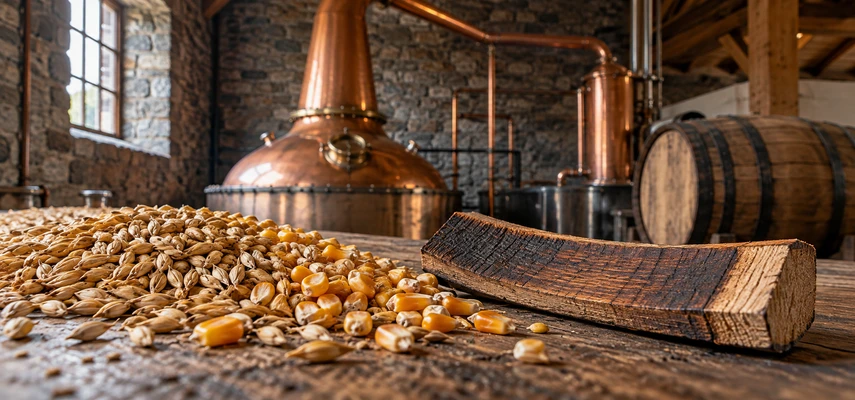

A handful of grain doesn’t smell like vanilla, dried fruit or a polished wooden cabinet. Yet a distiller can begin with grain, water and yeast and eventually produce a liquid that suggests all three. The vanilla may arrive without anyone adding a vanilla bean. The fruit may appear without an apple entering the building.
Whiskey is that kind of transformation: ordinary agricultural ingredients taking a long, carefully managed route through biology, heat and wood. Its variety makes more sense once you follow the route. Two distillers can start with similar grains and still end up somewhere remarkably different.
You don’t need a collection, a special vocabulary or an opinion about ice to understand it. Start with what happens to the grain.
What makes a spirit whiskey?
Whiskey is a distilled alcoholic drink made from fermented grain, usually matured in wooden barrels. Barley, corn, rye and wheat are common starting points. Fermentation creates the alcohol; distillation concentrates it; maturation changes the spirit over time.
That’s the useful introduction, rather than a universal legal definition. Countries set their own requirements. U.S. whiskey rules, for example, generally require oak storage but make an exception for corn whiskey. Scotch has a different framework, including at least three years in oak in Scotland.
The raw material helps distinguish whiskey from other spirits. Rum begins with sugarcane materials, while brandy starts with fruit. Vodka can also begin with grain, but its production aims for a much more neutral spirit. Whiskey deliberately keeps character from its ingredients and production, then usually develops more in wood.
And whiskey versus whisky? Both spellings name the same broad family. Ireland and the United States commonly use the extra “e”; Scotland, Japan and Canada commonly don’t. There are exceptions. Spelling is a useful cultural clue, not a flavor test.
First, persuade grain to become a drink
Grain contains starch, which is excellent stored energy for a growing plant but isn’t immediately useful to whiskey yeast. The distiller first needs to turn much of that starch into fermentable sugar.
Think of starch as a long chain and sugar as shorter pieces yeast can use. Enzymes act as molecular scissors. Malting, the controlled germination of grain, develops enzymes that help do this work. Distillers mill the grain and combine it with water; suitable temperatures let enzymes release sugars. Different grains and production systems require different preparation.
The resulting grain-and-water mixture is called a mash. A mash bill is simply the grain recipe: which grains, in what proportions. Those ordinary-sounding choices help establish the eventual spirit’s character.
Yeast supplies the alcohol
Add yeast to the prepared sugary liquid and fermentation begins. Yeast turns sugars into ethanol, the alcohol in beverages, and carbon dioxide. It also produces smaller quantities of other compounds that help shape aroma and flavor.
The distiller isn’t merely waiting for a sugar tank to empty. Yeast choice, temperature and fermentation time affect the mixture that reaches the still. Springbank’s account of its process shows how fermentation belongs within a much longer chain of decisions, from malting through bottling.
At this point the liquid is relatively low in alcohol. It’s closer to an unhopped brewing liquid than to the finished bottle on a shelf. Fermentation has done essential work, but it hasn’t made a concentrated spirit.
The still concentrates more than alcohol
Distillation separates components using differences in how readily they enter the vapor above a heated liquid. The vapor is collected and cooled back into liquid. Repeating or managing that separation raises the alcohol concentration.
It isn’t a case of boiling off pure alcohol while the water politely stays behind. Both enter the vapor, along with other volatile compounds. Equipment design and operating choices affect what travels through and what gets collected.
That matters because distillers want more than ethanol. They also want selected flavor compounds, sometimes called congeners: substances other than ethanol and water that contribute to the spirit’s character. Some are desirable in the right amounts; others aren’t.
Pot stills work in batches. Column stills use a different arrangement of repeated separation stages and can operate continuously. Neither shape automatically produces better whiskey. The question is what character the distiller is trying to preserve or create.
The Scotch Whisky Association’s production overview follows this progression from grain to spirit. The fresh distillate is generally clear. The familiar amber color mostly lies ahead.
A barrel is an ingredient with walls
Put clear spirit in a glass container and put a similar spirit in an oak cask. Wait. They won’t follow the same path.
Wood supplies compounds that change aroma, taste, texture and color. Oak-derived vanillin can contribute a vanilla-like aroma; other wood compounds can suggest coconut or add drying sensations. Heating the wood during barrel preparation changes the material available to the spirit.
There are several processes happening together. The liquid extracts substances from the wood. Compounds react over time, including reactions involving oxygen. Material also evaporates through the cask, the loss traditionally called the angel’s share. A barrel holds liquid, but it isn’t an airtight glass jar.
Annandale Distillery’s technical explanation of casks describes how wood, cask history and extraction influence maturation. A barrel previously used for another drink brings a different starting condition from fresh oak. Its size and the surrounding conditions also matter.
That helps explain why two whiskeys of equal age can taste different. One may have spent its time in new charred oak, another in a reused cask. A warmer warehouse and a cooler one create different conditions. Years count time; they don’t describe everything that happened during it.
Color is similarly incomplete evidence. Wood and cask history influence it, and some whiskey categories permit caramel coloring. A darker whiskey isn’t automatically older, stronger or better. The shade can start a question, but it can’t finish the investigation.
Five traditions to recognize
These names are useful signposts. They aren’t five fixed flavors, and they don’t cover the whole world of whiskey.
Bourbon and Scotch
Bourbon is American whiskey made from a grain mixture containing at least 51 percent corn and matured in new charred oak barrels, among other requirements. It doesn’t have to come from Kentucky. Bourbon itself has no fixed minimum maturation time under U.S. rules; “straight bourbon” must meet a two-year minimum. Corn and fresh charred oak help explain familiar associations with sweetness, vanilla and caramel, without making every bourbon taste alike.
Scotch whisky must be produced in Scotland and matured there in oak for at least three years. Single malt Scotch comes from one distillery and is made from malted barley in pot stills. Blended Scotch combines malt and grain whiskies.
Some Scotch is smoky because peat smoke was used in drying the malt. Plenty isn’t. Scotland has far more to offer than a universal aroma of bonfire.
Irish, Japanese and Canadian whiskey
Irish whiskey is produced and matured on the island of Ireland, with a minimum three-year maturation. Its traditions include malt, grain and pot still whiskey, as well as blends. Triple distillation is common, but it isn’t a rule covering every Irish whiskey.
Japanese whisky developed through engagement with Scottish methods and local production choices. The Japan Spirits & Liqueurs Makers Association’s labeling standards specify domestic production steps and at least three years’ maturation in wooden casks in Japan. These are industry standards for association members, rather than a universal statutory definition applying to every producer. A Japanese-looking label alone shouldn’t settle an origin question.
Canadian whisky standards require Canadian mashing, distillation and aging, with at least three years in small wood. Blending is an important part of the tradition. The familiar name “rye” doesn’t mean every Canadian whisky uses a rye-majority recipe; don’t apply the American rye definition to a Canadian label.
What an age statement actually tells you
A 12-year-old Scotch contains no Scotch younger than 12 years. The number refers to the youngest whisky in the bottle, not an average age. The Scotch Whisky Association’s guidance also explains that Scotch doesn’t continue maturing in the bottle.
Keep that bottle for another decade and you haven’t turned it into a 22-year-old Scotch. The years on the shelf aren’t additional cask maturation. Storage can affect a bottle’s condition, but that’s a different story.
Age-label rules vary by category and jurisdiction, so the Scotch example shouldn’t become a shortcut for every label worldwide. Nor is an age statement a score. More time can bring desirable development, but it can also leave a spirit overly dominated by wood.
Two other terms help here. A cask is a wooden vessel; in everyday whiskey discussion, it’s often used interchangeably with barrel. A blend combines spirit components according to the relevant category’s rules. Blending can be an exacting creative job, rather than evidence that something inferior happened.
How grain became culture
Whiskey’s history connects farms, fuel, trade, taxation and changing technology. Distillation turned fermented grain into a concentrated product, while transport and commerce helped spread regional practices. Later, warehouses, brands and export markets gave that agricultural transformation an international life.
The Scotch Whisky Association’s historical account traces developments including licensing, blending and overseas trade. Such documented changes tell us more than a tidy legend about one person inventing whiskey on one afternoon.
That history helps explain the attachment to place. A bottle may carry the story of a farming region, an industrial town or a family business. Those stories can be interesting without proving that a famous name, elaborate box or extraordinary price contains a better drink.
Strength matters more than the size of the glass
Alcohol by volume, or ABV, tells you what proportion of a drink’s volume is alcohol. In the U.S. proof system, double the ABV number: 40 percent ABV is 80 proof. A small-looking pour can still contain a substantial amount of alcohol.
According to NIAAA’s standard-drink guidance, 1.5 U.S. fluid ounces of 40 percent spirits contains about one U.S. standard drink, or 14 grams of pure alcohol. The same volume at 60 percent ABV contains one and a half standard drinks. A standard drink measures exposure; it isn’t a promise of safety.
Alcohol can impair judgment and coordination, cause dependence and increase health risks. The National Cancer Institute identifies alcohol as a cause of several cancers. Age, price and craftsmanship don’t remove those risks. Don’t drive after drinking; avoiding alcohol is appropriate during pregnancy and when medications or medical conditions make it unsafe. Learning about whiskey doesn’t require drinking it.
Once you understand its production, a whiskey label becomes less mysterious. Grain supplies a starting point, yeast makes alcohol and aroma compounds, the still selects and concentrates, and wood changes the result. The next time someone finds vanilla in a drink made from grain, you can explain how it got there. No vanilla bean required.










