











One letter has probably caused more unnecessary whiskey arguments than any other. A reader spots “whisky” on a bottle, adds an “e” in a message and is promptly corrected. Somewhere in the exchange, the drink itself disappears behind a spelling lesson.
Here’s the useful answer: whiskey and whisky name the same broad family of grain-based distilled spirits. The spellings reflect language, regional convention and producer identity. They don’t describe two universal recipes, two grades of quality or two different ways alcohol behaves.
That doesn’t make spelling meaningless. The right spelling can show respect for a producer’s name and a country’s protected terminology. It just needs to do the job of a spelling convention, rather than impersonate a laboratory report.
The pattern most people learn first
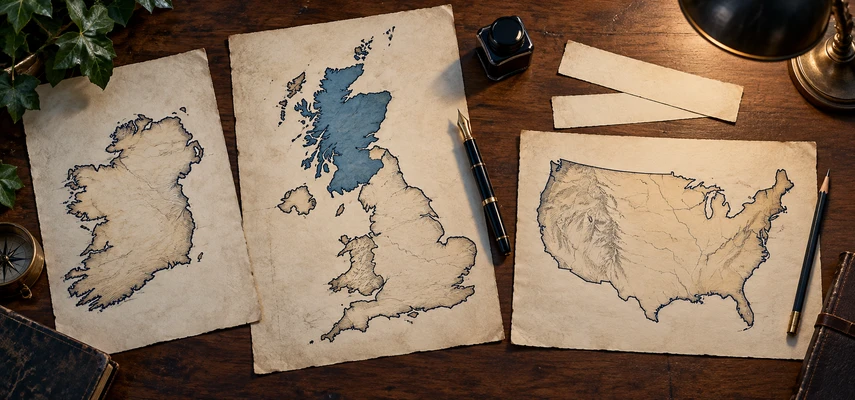
Scotland generally writes whisky. Ireland generally writes whiskey. The United States usually follows the Irish spelling, while Canada and Japan generally follow the Scottish one. The Scotch Whisky Association’s FAQ describes that broad pattern and stresses that production rules, rather than the extra letter, determine the spirit.
It’s a useful starting point because it lets you recognize common editorial conventions. A Scottish producer’s own description will normally say Scotch whisky; an Irish producer will normally say Irish whiskey. A publication discussing the entire category may choose either spelling as its house style.
The pattern isn’t a global sorting algorithm. Producers have their own histories, and countries outside that familiar group make grain spirits too. If you’re looking at an unfamiliar bottle, read its origin and category statements rather than guessing from the letter count.
Even the familiar American part of the pattern has conspicuous exceptions. That’s where a tidy rule becomes a convention with actual people and businesses behind it.
American whisky is a useful reminder
Maker’s Mark describes its bourbon as whisky. That spelling doesn’t move its Kentucky production to Scotland. It doesn’t mean the bottle is made according to Scotch rules. It’s an American bourbon using an established brand spelling.
American regulators accommodate both forms. The U.S. whiskey standard explicitly permits the word to be spelled whisky or whiskey. The legal substance lies in the production requirements and category designation.
This gives you a quick way to test an overconfident claim. If someone says all American whiskey must have an “e,” an American bottle without one is enough to reveal the problem. There’s no need to invent a special exception in the liquid itself.
It’s also a practical reason to preserve official names. If you are writing about a particular expression, use the spelling the producer actually uses. You can still use your publication’s preferred generic spelling elsewhere without rewriting the product’s identity.
The shared name goes back to water of life
The name belongs to a history of Gaelic expressions meaning water of life, connected to the Latin expression aqua vitae used for distilled spirits. The modern spellings developed through language and trade rather than through a committee assigning two separate beverages their own alphabets.
That long development invites a tempting kind of story: one precise moment when a whole nation decided to insert or remove a letter for one easily remembered reason. Such stories travel well. Proving them requires more than noticing modern labels.
The European Commission’s account of Irish whiskey connects the name with uisce beatha. The Scottish tradition has its related Gaelic wording. These connections explain the shared linguistic family; they don’t establish that every modern spelling choice has a single documented motive.
For a beginner, the important distinction is between an etymology and a production standard. The former explains a word’s development. The latter tells a distiller what a qualifying spirit must be. A good explanation can keep both without turning a linguistic family tree into a barrel specification.
What spelling can’t tell you about flavor
Imagine two bottles marked whisky. One is a smoky Scotch malt; the other is a Canadian blend with a much lighter profile. Their spelling agrees while their production histories and sensory characters may differ considerably.
Now imagine a whiskey and a whisky made from similar grain recipes and comparable casks. Their flavors might have more in common with each other than with other bottles sharing their spelling. The letter isn’t the variable that makes those aromas.
Grains, yeast, fermentation conditions, still design, spirit selection, wood, climate and maturation all contribute to the result. Bottling strength changes how that result is presented. Spelling doesn’t alter any of those processes.
The same applies to quality. Neither version means premium, traditional, smooth, natural or old. Nor does either spelling tell you whether a spirit is appropriate for mixing or intended for a particular serving style. Those judgments need evidence about the bottle and clarity about what the person wants from it.
Don’t use it as a smoke detector
A particularly common mental shortcut runs from whisky to Scotch to smoke. It takes two unreliable leaps in succession. Whisky is used far beyond Scotland, and many Scotches aren’t notably smoky.
Peat-related smoke aromas generally begin when smoke is used in drying malt. That’s a production choice, not a spelling effect. If smoke matters to you, seek a description of peat use and the individual expression. A label can be perfectly spelled and still tell you very little about that preference.
Country names carry the real obligations
Scotch whisky is protected through a legal framework tying it to production and maturation in Scotland. Irish whiskey has its own geographical indication and specification. Canadian whisky and American bourbon have different requirements again.
Those distinctions matter more than the generic choice between whisky and whiskey. You can’t turn a spirit made elsewhere into Scotch by dropping an “e.” Nor can adding an “e” turn a nonqualifying grain spirit into bourbon.
Canada offers a useful editorial example. The Government of Canada’s language guidance prefers whisky in Canadian usage while recognizing Irish whiskey. That is guidance about writing. The Canadian food standard, separately, sets requirements for the actual product.
Japan offers another. Its usual whisky spelling doesn’t prove that a given product was entirely produced in Japan. The relevant questions involve distillation, maturation, bottling and the standards governing the producer’s origin claims. Attractive typography and a familiar convention aren’t substitutes for those disclosures.
How to write about several traditions at once
For a general article, choose a consistent house style. An American publication might use whiskey as its umbrella term while preserving Scotch whisky, Canadian whisky and a producer’s official product names. Another publication may use whisky throughout generic discussion. Neither editorial choice changes what the spirits are.
Specificity usually solves the awkward cases. Write “the two bourbons,” “these Irish whiskeys” or “the Scottish and Japanese whiskies” when that is what you mean. Clear nouns help readers more than a running commentary on your spelling policy.
The normal plurals follow the spellings: whiskey becomes whiskeys, and whisky becomes whiskies. The apostrophe in a possessive, such as a whisky’s aroma, does a different job. None of this requires turning every casual message into a copyediting exercise.
What about whisk(e)y?
Whisk(e)y is a useful inclusive shorthand in specialist discussion. It signals that the writer is covering both conventions. It’s particularly convenient in a heading, an event description or an explanation of the word itself.
Repeated in ordinary prose, though, the parentheses can become visual clutter. A reader shouldn’t have to navigate punctuation every time the subject reappears. Establish the scope once, then write naturally. Courtesy to different traditions doesn’t require a small typographical obstacle course.
For search, either spelling may lead you to relevant information. When verifying a specific bottle, however, search its precise producer and expression name. That reduces confusion among similarly named releases much more effectively than arguing over the generic term.
Keep the category attached to the name
In a catalog or tasting notebook, record the full category along with the expression name. A note that says only “Japanese whisky” or “American whiskey” may be too broad to help you reconstruct what you tried months later. Producer, expression, strength and category give the record a useful identity. Keeping that information also helps distinguish a revised release from an earlier bottling with similar artwork. Careful naming is valuable because it preserves evidence, not because one spelling deserves to win.
Read the useful parts of the label
If you want to learn about a bottle rather than its orthography, start with the category and place of production. Then look at alcohol strength, any age statement and any disclosed cask information. Distinguish the company that bottled or marketed it from the distillery that made it when those roles differ.
Those details can answer actual questions. Is it bourbon or a flavored whiskey product? Is a Scotch a single malt or a blend? Does a high proof mean a small pour carries more alcohol than you expected? The spelling alone answers none of them.
There is a pleasantly modest conclusion to the great extra-letter dispute. Use the familiar regional convention when you know it, preserve official names and avoid judging other people’s tastes through their spelling. Whisky and whiskey have enough interesting differences inside their bottles. They don’t need an imaginary chemical border between their words.












