











https://www.pexels.com/photo/a-man-looking-at-a-computer-screen-with-data-6963944/
If you operate a business or work in tandem with an IT department on project management, you will have heard the phrase ‘penetration testing’ thrown around its fair share of times. But, more recently, people have been citing CTEM and its importance for keeping enterprises secure round-the-clock, against an ever growing list of cyber threats that every business now faces.
So, what’s the difference, and which one is better?
Traditional Penetration Testing in Practice
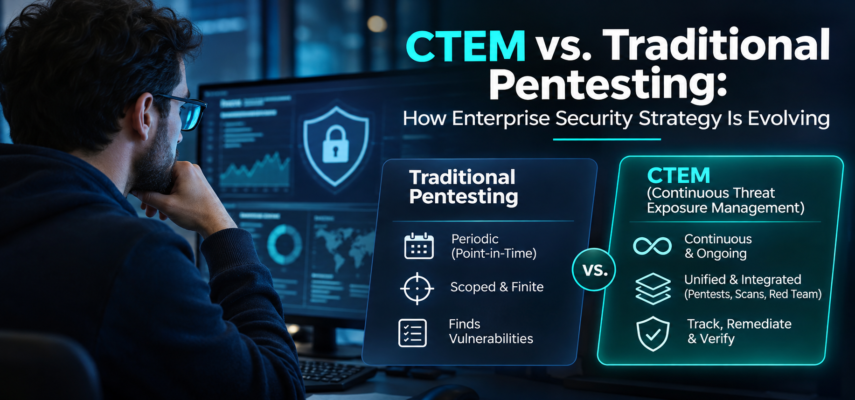
Textbook pentesting has a clear scope and definition. The pentesting team and the client will agree very specific parameters for the test, including how long it will run for, what the team will be working to gain access to, what they should do with their findings, and what – if anything – is prohibited. These tests generally run annually or bi-annually, and are designed to catch new vulnerabilities that could be exploited by real hackers in order to gain access to the company’s internal systems, should they be discovered.
It’s essentially a finite simulation of a real attack, whereby testers are trying to exploit vulnerabilities in order to find what needs to be fixed or changed – and how high the threat level is.
By that definition, it is inherently an exercise locked within a specific point in time. The environment at the precise moment of the test is all that the test can reflect. It says nothing about what the threat will be in a day’s, week’s, or year’s time.
That doesn’t mean it’s not useful. Penetration testing continues to represent the backbone of the cybersecurity industry, because it represents one of the best ways to ‘get into the shoes’ of hackers and view a business from the outside, rather than simply relying on the internal view of its defenses.
The Limitations of Point-in-Time Security Assessment
Environments change continuously, and that’s more true than ever – and will remain an increasingly significant challenge to cybersecurity forever. A test conducted in January may be totally irrelevant to the lay of the land by july. This has always been the case to some extent, but now with AI tooling making sophisticated cyber attacks far easier to execute – and at scale – it’s changing the entire face of the cybersecurity industry.
New vulnerabilities are discovered daily; a clean pentest report can become outdated within weeks. What’s more, remediation after a traditional pentest is often slow, informal, and difficult to verify. But the solution isn’t to stop pentesting. That would be a major mistake with potentially devastating consequences for the business, its customers, and its employees.
How CTEM and Penetration Testing Work Together
CTEM stands for Continuous Threat Management and, as the name suggests, refers to an ongoing process of identifying and remediating threats rather than conducting routine, isolated tests. It integrates findings from pentests, but also scanning and red team exercises, together in one place.
To be clear, CTEM isn’t a replacement for penetration testing. The most advanced pentest management platforms, such as Cyver’s CTEM platform, are designed around the CTEM model. They are engineered to provide security teams with something that takes the legwork out of centralising findings, workflows, and reporting.
It will never be a question of CTEM vs pentesting, but of how to streamline pentesting under the CTEM framework. That way, the value of pentesting can be realised without the inherent downsides holding it back.












