










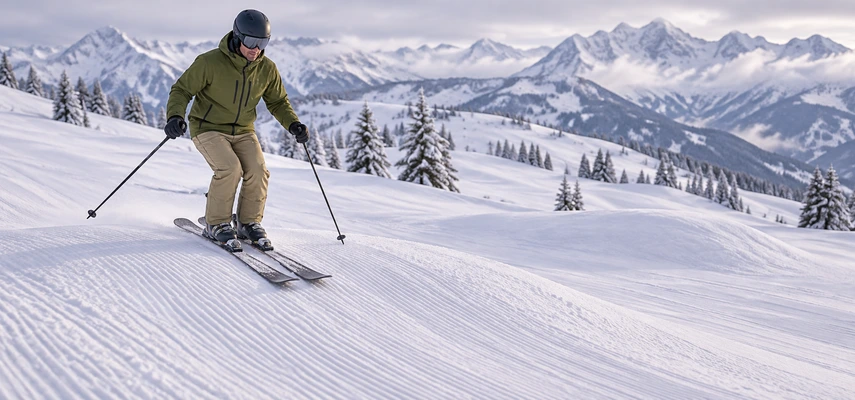

A skiing photograph can make balance look like a pose: bend here, lean there, keep the hands just so. Then the photograph starts moving, the snow changes, and the pose needs an update.
Useful balance on skis is an ongoing adjustment. You manage where your body is relative to the support coming through the skis, while the skis themselves travel over a changing surface. A position that works for one instant may need to change in the next.
That makes improvement more interesting than memorizing a silhouette. You want movements that leave you able to steer, release, grip, and respond, rather than a stance you can hold only while nothing unexpected happens. Think of body position as a place you can move through, not a chair you intend to occupy all afternoon.
Understand what is supporting you
On flat ground, standing comfortably usually means arranging yourself over your feet. Skiing adds sliding, turning, slope angle, and forces from the snow. The direction of useful support isn’t always the same as the vertical line you imagine when standing in a kitchen.
In Ron LeMaster’s explanation of balance and alignment, the relationship between the skier and the forces acting through the equipment helps explain why effective alignment changes during skiing. A skier leaning into a turn isn’t necessarily falling over; the situation includes more than a still person and gravity.
You don’t need to calculate those forces mid-run. The practical question is whether you can continue to influence the skis while the situation changes. If your position leaves you unable to steer or release without a large recovery movement, something useful is missing.
Imagine standing on a bus as it turns. Freezing upright may be less helpful than adjusting to the movement. The comparison isn’t a complete model of skiing, but it captures an important idea: balance responds to what is happening, rather than obeying a single picture of correct posture.
Begin with room to move
For many recreational skiers, a useful starting point includes comfortable spacing between the skis, some available bend through the lower joints, and hands carried where they don’t pull the body backward or distract from steering. The details depend on the person, equipment, task, and conditions.
The important word is available. Knees locked straight offer little room to absorb a change. A very deep crouch can also leave little useful movement in reserve. Flexing more isn’t automatically balancing better.
Likewise, bending sharply at the waist can make your chest look forward while the hips remain behind the feet. From inside the jacket, that can feel like an impressive effort to get forward. From the skis’ point of view, it may not solve the problem at all.
A qualified instructor can help identify whether ankles, knees, hips, or the relationship between them need attention. Ask for a functional result: what should become easier when you make the change? A cue should improve something you can observe, not merely make you resemble the instructor’s favorite photograph.
Notice fore-and-aft balance
Fore-and-aft balance concerns how you organize yourself along the length of the skis. Too far behind for the task, and directing the front of the ski may become difficult. Too far forward in an exaggerated way, and you can create a different limitation. “Forward” is not an unlimited resource to spend.
PSIA-AASI Rocky Mountain’s explanation of the skiing fundamentals includes managing the body relative to the base of support to direct pressure along the skis. That describes a relationship you regulate, rather than a permanent instruction to push into the boot tongues.
Light shin contact can be a useful cue for some skiers in some tasks. Crushing the cuffs continuously is a different proposition. Your boots support and transmit movement, but leaning against them isn’t a substitute for organizing the whole body.
Watch for situations in which you repeatedly fall behind the movement: entering a steeper section, crossing a small terrain change, or finishing a turn under stress. Tell your instructor where it happens. The timing of the problem may matter more than how far forward you try to stand afterward.
Let the legs do their share
When the snow rises toward the skis, the legs may need to shorten. When the surface falls away, they may need to lengthen to preserve useful contact. The appropriate amount and timing depend on terrain, speed, and the turn you are making.
This isn’t an instruction to pump up and down on every bump you can find. Large, late movements can make the response less predictable. Start with terrain and exercises chosen by an instructor who can see whether the movement is helping.
The Canadian Ski Instructors’ Alliance fundamentals describe balance as dynamic and explain its relationship to the support from the snow. The practical implication is that your legs need to remain adaptable while your body travels over the hill.
Think of carrying a nearly full mug across an uneven floor. The useful response isn’t to make every joint rigid, nor to bounce theatrically at each step. You make enough adjustment to keep the task organized. On skis, the task includes maintaining control, so the terrain must stay within what you can manage.
Balance from ski to ski without lurching
During a turn, the two skis don’t necessarily provide equal support. The outside ski commonly plays a major supporting role, but how support is distributed changes with the maneuver, snow, and moment in the turn.
That doesn’t mean lifting the inside ski is a universal requirement, or that standing on one leg is an appropriate independent exercise for every reader. Instructor demonstrations can isolate a skill in ways that aren’t sensible to copy on a crowded public run.
Instead, notice whether you can guide both skis and move into the next turn without an abrupt sideways heave. If you feel trapped on the old supporting ski, the issue might involve release or timing as well as balance.
Ask your instructor to connect the cue to the ski response. “More outside ski” becomes more useful when you understand where in the turn the change belongs and what it should allow the ski to do. A slogan repeated everywhere can turn into a habit that needs unlearning later.
Give your attention one job
Balance improves poorly when you try to monitor six body parts while also navigating traffic. Choose one small task on easy, suitable terrain, ideally after an instructor has identified the relevant adjustment.
For example, you might notice whether you retain enough movement through the legs to respond to a mild change in the snow. Or you might focus on finishing turns without settling backward. These are observation goals, not prescriptions to search out bumps or deliberately destabilize yourself.
After a short sequence, stop somewhere visible and out of the traffic flow. Describe the result: did the skis feel easier to guide, did one direction remain awkward, or did the change disappear when you looked farther downhill?
That last example is revealing. Sometimes a movement feels easy only while you concentrate on it completely. The next useful step may be making the task simpler so you can retain awareness, rather than increasing the difficulty to prove you’ve learned it.
Use feedback that explains the movement
An instructor watching from an appropriate location can often distinguish a cause from the recovery that follows it. A skier who swings their arms may be trying to recover from something that began earlier at the feet. Fixing the arms alone could remove the rescue without addressing the problem.
Video can help when it is recorded safely and with consent where required. Have another person film from a suitable stationary position; don’t handle a phone while skiing. A short clip with context is more useful than a dramatic angle that hides the skis.
Compare what you felt with what happened. Feeling far forward doesn’t prove that your hips moved forward; feeling calm doesn’t prove the skis remained controlled. Feedback gives you a way to check those impressions.
Equipment can complicate the picture too. Boots that fit poorly or an unsuitable setup may interfere with movement. Discuss persistent fit or alignment concerns with qualified professionals rather than changing binding settings or modifying equipment as an experiment.
Keep balance connected to decisions
Fatigue can reduce the movements and attention you have available. If you begin sitting back, bracing, or making repeated recoveries, a break or easier run may be the most useful adjustment. There is no special training credit for practicing until your legs stop cooperating.
The NSAA responsibility code still applies during drills: stay in control, avoid people ahead, look uphill before starting, and choose stops that others can see. A balance exercise must fit those responsibilities.
Judge progress by what the position lets you do. Can you guide the skis more predictably, adapt to modest changes, and begin the next turn without an emergency rearrangement? Those are better signs than maintaining an impressive crouch.
The best body position keeps becoming the next useful body position. Once that idea clicks, balance stops looking like a photograph you must copy and starts feeling like a conversation with the snow: notice the support, adjust, and keep enough movement available to answer what comes next.












