










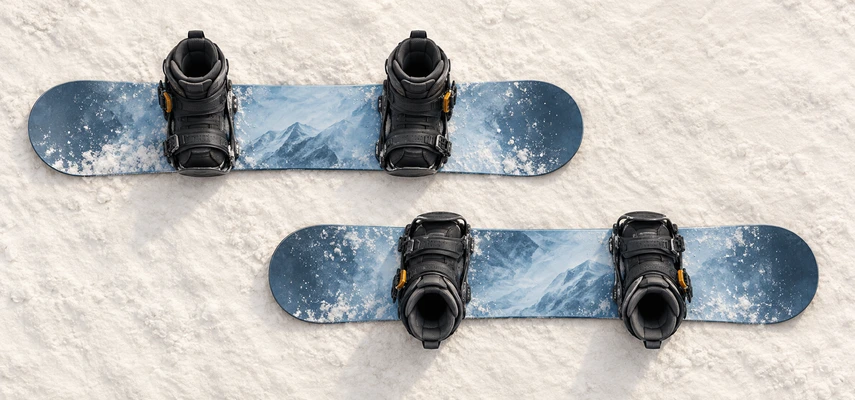

Regular and goofy sound like two options on a personality questionnaire. On a snowboard, they answer a much narrower question: which foot usually goes first?
Regular means left foot forward. Goofy means right foot forward. That’s the whole distinction at its simplest. It says nothing about skill, courage or whether you were paying attention when the rental technician asked.
The harder part is choosing when neither arrangement feels familiar. Beginners sometimes expect a quick test to reveal the correct answer with the certainty of a shoe-size measurement. Stance is more practical than that. Your history and preferences provide clues; careful experience on suitable terrain helps determine what works.
First, separate lead foot from the rest of the setup
Your lead foot is the one toward the front in your usual direction of travel. With a regular stance, the left boot leads and the right follows. With goofy, the right leads and the left follows. Both arrangements let riders use heel-side and toe-side edges.
This choice is one part of stance. Width describes the spacing between bindings; angles describe their rotation; setback describes their position relative to a board’s reference arrangement. Those choices can affect comfort and performance, but they’re different questions from which foot you prefer forward.
Burton’s stance guide makes the basic regular/goofy distinction and discusses the wider setup vocabulary. Treat the lead-foot question separately at first. Changing every variable while trying to compare two directions makes the result harder to interpret.
A rental technician can help establish a suitable initial setup and explain which binding is intended for which boot. Don’t put the wrong boot into a binding simply to reverse direction. If you want to explore the other stance, involve the instructor and fitter so the equipment arrangement makes sense.
Your hands don’t get the deciding vote
Being right-handed doesn’t require riding regular, and being left-handed doesn’t require riding goofy. The tasks are different. Writing, kicking and balancing with one foot leading don’t ask your body to organize itself in exactly the same way.
You may hear rules assigning the stronger foot to the back or the more stable foot to the front. They can sound convincing because each foot has important jobs. But both legs contribute to balance, pressure and steering. A single everyday preference isn’t a complete description of that coordinated relationship.
Even manufacturer advice about home tests isn’t perfectly uniform. That inconsistency is a reason to treat them as suggestions rather than diagnostic tools. You don’t need to resolve a debate about foot dominance before taking a beginner lesson.
The useful information is modest: have you naturally preferred one orientation in a related activity, and does that remain comfortable when you try appropriate snowboard tasks? That’s a better question than searching for proof that a handedness rule applies to you.
Start with experiences you already have
If you skateboard, surf or ride another sideways board, your usual leading foot is a sensible starting clue. The orientation may feel familiar, even though snowboarding adds different equipment and surface interactions. Familiarity can help without guaranteeing that every movement will transfer.
Think about actual experience rather than inventing a test you must pass. Which orientation have you comfortably used? Have you spent meaningful time in both? If the answer is that you’ve never done any of those activities, you simply have less prior information. That isn’t a problem requiring an elaborate substitute.
You can also stand on a stable, nonslip surface in a relaxed sideways position and notice each orientation. Keep the exercise stationary. It won’t establish your final snowboard stance, but it may help you describe an initial preference to the instructor without adding a slipping hazard at home.
Tell rental staff if you’re unsure. Saying I don’t know yet gives them useful information. Pretending certainty because the question sounds basic can make later discussion harder than it needs to be.
Be cautious with the famous quick tests
The sliding-in-socks test appears in plenty of advice. So do being pushed unexpectedly, stepping onto stairs and kicking a ball. Each tries to reveal a spontaneous foot preference. None should be treated as a universal prescription for snowboard stance.
There’s also no reason to create a fall risk to obtain a clue. Don’t ask someone to shove you or run across a slippery floor. Existing experience and controlled instruction are available without turning your kitchen into a small and poorly padded snow school.
If two casual tests suggest different answers, you haven’t failed a consistency exam. Different movements can favor different feet. Record the uncertainty, choose a reasonable starting point with qualified staff and let appropriate on-snow experience add information.
Nor does a preference test explain every first-day fall. Beginners fall for many reasons, including unfamiliar balance, timing, terrain and fatigue. Switching stance after each difficult attempt can prevent you from practicing either orientation long enough to understand what is happening.
Use the first lesson to explore, not to prove
Tell the instructor your initial choice and how you arrived at it. If you’ve ridden another board sport, mention that. If you’re guessing, say so. The instructor can observe your comfort during level-ground movement and other appropriate introductory tasks.
One-foot movement is particularly relevant because snowboarders commonly keep the lead foot attached while the rear foot pushes. REI’s beginner progression introduces skating and gliding before more complicated turning tasks. These are useful learning situations, though no single exercise should be treated as an infallible stance detector.
The comparison should happen in terrain and conditions the instructor considers suitable. Avoid deciding to experiment halfway down a trail that’s already challenging. A change in orientation can remove whatever familiarity you’ve just developed, so the setting needs to leave room for that.
If trying the other direction requires a setup change, have qualified staff make or check it. Mounting systems, left/right binding shapes and board design matter. Burton’s binding setup guide illustrates how lead-foot choice relates to binding arrangement, but its suggested settings aren’t universal instructions for your rental.
Notice useful differences, not just unfamiliarity
A meaningful observation might be that one orientation makes it easier to look along the board without twisting awkwardly, or that one-foot movement feels more manageable. Describe that to your instructor. Specific observations are more useful than saying an entire direction is wrong.
Discomfort can also come from boot fit, stance width, binding angles or a movement you’re trying to force. If something hurts, stop and get it checked rather than assuming the only explanation is regular versus goofy. Lead-foot choice shouldn’t become the catch-all diagnosis for every equipment issue.
Try to keep comparisons reasonably consistent. Different snow, terrain or levels of fatigue can change the experience. Testing one orientation on level ground and the other on a steeper slope doesn’t isolate the variable you’re interested in.
Your instructor may suggest keeping an initial choice while building the foundations, or exploring the alternative if the observations support it. There isn’t a universal number of attempts after which the answer becomes permanent. The goal is a workable learning setup, not a declaration that can never be revised.
Switch riding doesn’t require changing your identity
Switch means riding opposite your usual stance. A regular rider traveling right foot first is riding switch; a goofy rider traveling left foot first is doing the same relative to their own preference. The word describes the relationship to your usual direction.
That explains why an experienced snowboarder can look comfortable both ways without being undecided. They’ve practiced an additional skill. A beginner doesn’t need to become equally capable in both directions before choosing a first setup.
Board design affects how a reversed direction feels. A true twin is designed symmetrically in relevant features, while a directional board may prioritize one orientation. Riding the other way doesn’t necessarily mean remounting bindings, but equipment suitability and the exercise should be discussed with your instructor.
Rome’s stance overview also separates lead-foot preference from width and angles. That distinction helps keep the beginner decision manageable. Detailed setup tuning can wait until you have observations worth tuning around.
Keep a useful record of what you chose
After a rental or lesson, note your lead foot and ask staff to explain any setup details you want to remember. On a future visit, saying regular with a setup that felt comfortable is more helpful than trying to reconstruct a board graphic from memory.
If the experience was uncomfortable, record what happened rather than only the label. Was the pain in a boot? Did you struggle to push with the rear foot? Did one edge feel unfamiliar? These details give the next instructor something to investigate.
Ask what would justify revisiting the choice and what simply needs more practice. That keeps a useful possibility open without making every awkward attempt a referendum on your lead foot. You can change your mind thoughtfully while still giving a starting arrangement time to become familiar.
You don’t have to earn permission to ride goofy, and regular doesn’t come with a correctness certificate. Choose a sensible starting orientation, use appropriate instruction to explore it and leave room for what you learn. The board cares about coordinated movements and snow contact, not what you wrote in the stance box on your first booking form.












