










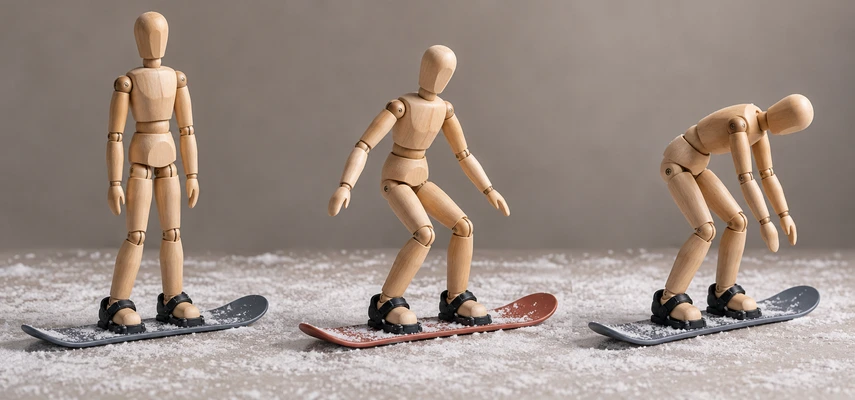

A beginner can work very hard at the wrong solution. The shoulders swing farther, the back leg pushes harder and the board still doesn’t produce the turn that seemed so obvious in the demonstration. More effort has entered the system without making the task clearer.
Many early snowboarding problems are understandable responses to unfamiliar movement. You lean away from a slope that feels intimidating, stare at equipment you don’t yet trust or brace when the snow changes. Calling these mistakes is useful only if the name helps you find a better next step.
Use this guide to recognize patterns worth discussing with an instructor. It isn’t a diagnosis of every fall or a checklist of poses to enforce on yourself. The useful correction depends on your equipment, skills, terrain and what actually happens during the movement.
Choosing terrain before you can control the movement
Following experienced friends onto their usual run can turn a manageable learning task into an exercise in getting down somehow. You may spend the descent bracing, stopping unpredictably or avoiding the less familiar edge. Completing the trail doesn’t prove that it was useful practice.
Choose terrain with your instructor and ask which route suits independent practice afterward. Ratings are relative within the resort, and snow, width, traffic and visibility affect difficulty. A green symbol doesn’t make every part of the experience suitable for every first-timer.
The NSAA Responsibility Code requires control and the ability to avoid others. That obligation supports a practical choice: learn the movement where the demands leave enough room to understand it.
Leaning away from the direction you need to manage
Moving the body toward the tail can feel like a way to resist acceleration. It may also make the front harder to guide and leave the rear leg bracing. The response is understandable, but it can reduce useful options.
The correction isn’t to launch yourself toward the nose. Ask the instructor to establish a more manageable task and a body position that allows appropriate pressure changes. A small observation about where you feel support is more useful than a large compensating lunge.
The AASI performance guide distinguishes pressure along the board from pressure across it. That helps explain why moving toward the front isn’t the same adjustment as changing the edge relationship. Diagnose the task before prescribing more of either.
Freezing the legs or folding only at the waist
Stiff legs leave little room to absorb terrain or adjust the board’s contact. A deep bend at the waist can lower the head while leaving the lower body surprisingly unresponsive. Looking crouched doesn’t necessarily mean you’re moving usefully.
Start from comfortable mobility through ankles, knees and hips, with guidance appropriate to your setup. You aren’t trying to maintain one perfect depth throughout the run. Different tasks need different movements, and an exhausted squat can restrict options as much as rigidity.
Ask the instructor to demonstrate the difference between flexing the legs and merely folding forward. Then use one clear cue on a small task. Trying to repair every joint at once can make an already unfamiliar movement feel even more complicated.
Swinging the upper body to rescue every turn
A dramatic shoulder swing may rotate the board, but it can also leave edge engagement and body position out of step. The visible arm movement may be a compensation for a problem that begins earlier or lower in the body.
Simply pinning the hands in place doesn’t necessarily solve it. Ask what happens before the swing: does the turn start too late, does the board remain locked on the old edge, or does pressure move toward the tail? Observation helps identify a useful adjustment.
REI’s beginner progression builds turning from simpler movements rather than treating upper-body effort as the whole solution. Return to a manageable component when the finished task becomes a repeated rescue.
Watching the board instead of the available space
Boots and bindings attract attention because they are new and important. Watching them continuously, however, leaves little information about the route, traffic or changing surface ahead. You may react late because the useful information arrived late.
Look where the exercise requires and scan appropriately for other users. Your instructor can help you coordinate head position with a comfortable body relationship to the board. Looking ahead supports decisions; it doesn’t turn the equipment automatically.
If you keep looking down because the equipment feels unreliable, address that concern directly. A binding you don’t understand or a boot that hurts is a real distraction. Asking for help is more effective than trying to ignore the reason your attention keeps returning there.
Using only the edge that feels familiar
One side often feels easier at first. You may prefer the view, understand its movement sooner or simply have had more successful attempts on it. The problem begins when that preference becomes the only response available on the slope.
Ordinary linked turns require control on both heel-side and toe-side. Being able to sideslip a route on your favorite edge isn’t equivalent to being able to manage every change in direction, traffic or terrain along it.
Ask the instructor for a smaller task on the less familiar side and one observable goal. The two edges don’t have to feel identical. They need to become useful options, developed through suitable practice rather than forced repetition on intimidating terrain.
Letting speed replace a clear plan
A little more momentum can make some movements feel different, but deliberately adding speed isn’t a general cure for a beginner problem. It can leave less time to coordinate a turn and increase the consequences of losing control.
If every sequence ends with an urgent skid, review the earlier route and timing with an instructor. Turns may be becoming too direct, finishes rushed or transitions poorly organized. Fixing the whole descent with one harder braking movement is an unreliable plan.
Use suitable turn shape and appropriate skidding to regulate movement within the chosen practice area. The goal is to stay able to choose the next action. A faster run that you survived isn’t necessarily a more controlled one.
Treating discomfort as part of the membership fee
Painful boots, excessive heel movement or an awkward stance can interfere with learning. You may adjust your body around the problem and then mistake that compensation for a technique failure. More practice doesn’t make every equipment issue disappear.
Describe discomfort to qualified rental or shop staff and ask for the relevant fit or setup check. REI’s snowboard boot guide emphasizes fit and the relationship between support and intended use. Tightening everything harder isn’t a universal solution.
If movement causes concerning pain or a fall suggests injury, stop and seek appropriate assistance. Don’t use the expectation of unfamiliar exercise to dismiss symptoms. Learning should involve adjustments, not an obligation to continue until the booking time expires.
Changing too many things after one awkward attempt
One unsuccessful turn can trigger a flood of advice: bend more, stand taller, change stance, turn the shoulders, don’t turn the shoulders. Some cues may address different tasks, while others may not fit the problem at all.
Work with a qualified instructor and choose one useful observation for the next repetition. Keep the terrain and task manageable enough to notice what changes. If you alter equipment, slope and movement simultaneously, it becomes difficult to learn which adjustment mattered.
The PSIA-AASI learning hub explains why personal feedback is valuable. An instructor can watch the sequence and adapt the task; a collection of disconnected tips can’t do that assessment for you.
Skipping the unglamorous skills
Skating, one-foot gliding, controlled stopping and lift preparation can look less interesting than turning down a mountain. They also connect the parts of the day and help keep ordinary transitions manageable.
If unloading feels unreliable, practice the appropriate component with the instructor away from traffic. If you can’t stop consistently in the learning area, don’t treat a larger lift as the next obvious goal. Skills are prerequisites because the next setting demands them, not because someone needs to fill lesson time.
Tell attendants when you’re new and ask for help. Clear unloading areas and secure equipment as directed. Being competent includes using the available people and procedures, rather than pretending you already know the sequence.
Repeating practice after attention and control have declined
Fatigue can change how well you coordinate movements and how quickly you make decisions. Frustration can narrow attention until every attempt becomes an argument with the same patch of snow. Another repetition isn’t automatically useful just because it is possible.
Take a break, address cold or wet clothing and check whether the practice task still makes sense. If a previously manageable movement becomes unreliable, say so. The instructor can simplify, pause or change the plan.
Agree on what you’ll practice next and where it is appropriate. A brief note after the lesson can preserve the useful cue without turning your next visit into an attempt to remember every sentence said on the slope.
The best response to a beginner mistake is a clearer task. Notice the pattern, ask what caused it and work on a manageable adjustment. You don’t need to be mistake-free to become a snowboarder. You need a way to turn awkward attempts into information that makes the next one more deliberate.












