










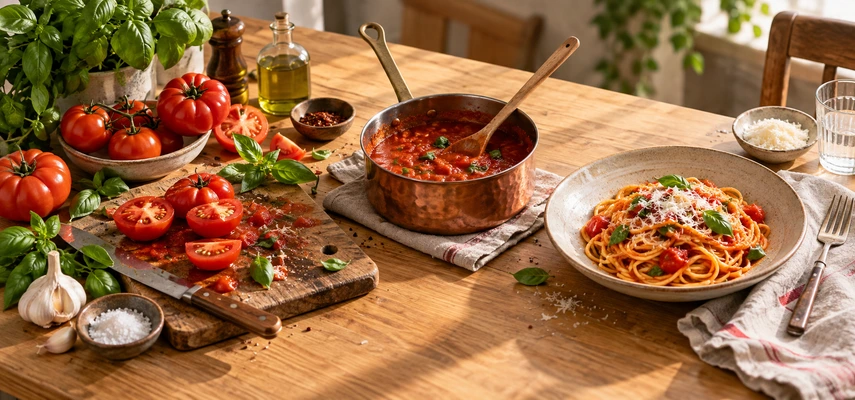

Why can a bowl of tomato pasta feel like an ordinary Tuesday dinner in one kitchen and a small revelation in another? The ingredients might look almost identical. Yet someone has chosen different tomatoes, handled the heat differently, or understood exactly what the meal needed. Someone else has brought a memory to the table.
Ask what changed, and you’ve started doing gastronomy. The word sounds as though it requires a reservation and an intimidating wine list. Its subject is much closer: the food we grow, prepare, share, and enjoy, and the reasons it becomes the food we recognize.
Gastronomy is the study and thoughtful appreciation of food and eating. It connects the pleasure of a bite with the science, people, places, and decisions behind it. You can explore it through a restaurant tasting menu. You can also begin with toast.
Gastronomy starts where the recipe opens out
A recipe tells you how to make something. A gastronomic question asks why that preparation works, where it came from, what it means to the people eating it, and what makes it satisfying. Cooking is one essential part of that inquiry. So are farming, trade, memory, and hospitality.
Imagine making a pot of beans. The cooking questions concern soaking, simmering, seasoning, and texture. The wider questions concern which beans grow locally, why a household serves them with a particular staple, who taught the cook, and whether the result tastes like home. None requires an expensive ingredient.
There isn’t a hard fence between the practical cook and the curious observer. A cook testing two methods is already investigating food. A diner asking a thoughtful question is doing something similar. Gastronomy gives that attention a wider frame.
That breadth appears in formal study, too. The University of Gastronomic Sciences brings food chemistry, ecology, anthropology, history, economics, and sensory analysis into one degree program. Food crosses those boundaries every day, even when university departments usually keep them separate.
An old idea with a surprisingly wide view
The French writer Jean Anthelme Brillat-Savarin is an important figure in the written tradition of gastronomy. His The Physiology of Taste treats the subject as something involving cultivation, chemistry, cooking, commerce, and political economy. That is a large intellectual shopping basket.
Reading him today requires perspective. His book is a historical text, with the assumptions and prejudices of its setting, rather than a modern scientific authority. But the breadth of his approach remains useful: an explanation of dinner needn’t stop at the kitchen door.
Nor does the history of food knowledge begin with European food writing. Farmers, fishers, home cooks, traders, and Indigenous communities have developed and passed on detailed knowledge of ingredients and preparation through many different traditions. A printed account records one kind of authority. Skilled practice and oral transmission preserve others.
The useful question is what a particular source can actually tell us. A community cook may explain the purpose of a preparation better than a distant commentator. A chemistry experiment may establish a mechanism that experience alone couldn’t isolate. Good food inquiry makes room for both, while checking each claim carefully.
Flavor is more than what your tongue detects
Taste and flavor are closely connected, but they aren’t identical. Taste receptors respond to basic qualities including sweet, sour, salty, bitter, and umami, the savory quality associated with glutamate. Flavor combines taste with aroma, temperature, texture, and other sensations.
The National Institute on Deafness and Other Communication Disorders explains that aromas released during chewing can reach smell receptors through a passage connecting the throat and nose. This helps explain why a blocked nose makes familiar food seem disappointingly bland. The tongue hasn’t become the entire problem; part of the sensory information is missing.
Chili’s burn and mint’s cooling sensation involve chemical sensitivity as well. Neither is simply another basic taste. A bite arrives as several kinds of information, and your brain assembles the experience.
This distinction changes the questions you ask. When a dish seems flat, does it lack salt, aroma, contrast, or a texture you expected? The answer isn’t always another spoonful of seasoning. First notice which part of the experience feels absent.
The kitchen is a place to investigate
Take a slice of bread and consider how many questions fit inside it. What gives it structure? Why are there holes? Why does the crust feel different from the crumb? How did this particular loaf become someone’s everyday bread?
The Exploratorium’s bread science introduction uses the interaction of flour, water, and leavening to open up those questions. Gluten, a network of proteins developed in wheat dough, helps give many breads their structure. Understanding that relationship makes a loaf more legible: its texture has causes you can investigate.
You don’t need to explain the entire loaf before enjoying a sandwich. A useful explanation starts with something observable, then follows one question far enough to change your understanding. Perhaps you compare a soft sandwich slice with a chewy piece of flatbread and ask what ingredients and methods differ.
The discipline lies in resisting the first neat answer. If two breads differ in flour, thickness, fermentation, and baking conditions, you can’t confidently credit one variable for every difference. By contrast, changing just the flour gives a clearer comparison. Curiosity gets you started; a fair comparison helps you learn something dependable.
Geography supplies possibilities; people make cuisines
Food begins with material constraints. Plants need suitable growing conditions. Fishing communities have access to particular waters. Transport, storage, money, and markets affect what reaches a kitchen. Geography helps explain the possibilities available to a cook.
However, a map doesn’t write a menu by itself. People choose among available ingredients, attach meanings to them, teach methods, and change their habits. Neighboring households can have quite different ideas about what belongs in the same dish. A national cuisine contains those disagreements as well as its celebrated specialties.
UNESCO’s account of traditional Mexican cuisine through the Michoacán paradigm makes the connection especially clear. It describes a living system involving farming, community practices, utensils, and preparation, with corn, beans, and chili central to that account. A tortilla belongs to a much larger story than its moment on a hot cooking surface.
The same account identifies nixtamalization, the processing of maize with an alkaline treatment such as lime, as part of this knowledge. The technique is a reminder that culinary traditions can contain sophisticated material understanding, even when their practitioners don’t describe it in laboratory language.
That doesn’t make every traditional explanation scientifically correct. It does mean that a serious investigation asks what people actually do, why they do it, and what evidence supports the proposed explanation. Respect and critical thinking can sit at the same table.
A meal includes the people around it
Suppose a meal contains beautifully prepared food, but the host rushes everyone, conversation falters, and nobody feels welcome. The cooking may succeed while the occasion disappoints. Gastronomy pays attention to that difference.
UNESCO inscribed the gastronomic meal of the French on its intangible cultural heritage list in 2010. Its description concerns a festive social practice: choosing dishes, preparing the table, tasting, and bringing people together for important occasions. Its recognition concerns a tradition of eating together, rather than a declaration that one country’s cooking outranks another’s.
Likewise, UNESCO describes the Mediterranean diet through skills and traditions extending from crops and fishing to food preparation and shared meals. Here, the word diet carries a cultural frame wider than a list of recommended ingredients.
Think about the difference between eating a familiar dish alone at your desk and sharing it with someone who taught you to make it. The recipe can remain unchanged while the significance changes considerably. That observation doesn’t require a universal rule about which setting is better. It asks you to notice what the occasion contributes.
Pleasure has a supply chain
Following food beyond the plate also brings less comfortable questions into view. Who grew the ingredients? Who handled and transported them? Who cooked, served, and cleaned up? Who could afford to take part in the meal?
These questions belong alongside aroma and presentation because those pleasures depend on other people’s work. A low menu price tells you what the customer pays. It doesn’t, by itself, tell you whether the people producing the food were treated well, how resources were used, or how much was discarded.
Nor can attractive words settle those questions. Local, traditional, artisanal, and natural each need context. Ask what a producer means, what information is available, and which tradeoffs matter in this particular case. An appealing story is a starting point for investigation, rather than its conclusion.
For an ordinary shopper, that might mean asking which farm grew a vegetable or reading how a food was made. It needn’t mean turning every lunch into a research project. Even one well-chosen question can reveal a part of the meal that usually stays invisible.
Begin with one meal you already know
Choose something familiar: a sandwich, a bowl of noodles, a bean stew, or that tomato pasta. Before changing anything, describe it plainly. Is the sauce sharp or mellow? Is the bread springy or brittle? Which aroma do you notice first?
Then choose one question you can explore. Compare the same sandwich on two breads, keeping the filling similar. Ask a relative what they consider essential to a household dish, then ask why. Read about an ingredient’s cultivation and see whether it changes what you notice when shopping.
Keep the questions small enough to answer honestly. A side-by-side comparison can show which version you prefer on that occasion. It can’t prove that everyone should prefer it, or explain an entire cuisine. Personal pleasure is real evidence about your experience; its limits matter too.
Finally, tell someone what you noticed in ordinary language. Perhaps one bread overwhelmed the filling, or a familiar dish made more sense after hearing its family story. You don’t need a critic’s vocabulary to make an accurate observation.
That is the invitation gastronomy offers: pay enough attention to discover what a meal can teach you. Dinner still gets to be dinner. It just becomes harder to call it ordinary.










